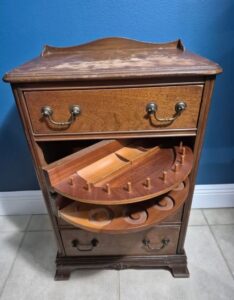
A Surprising Antique Shop Discovery
Alright, let me set the scene.
I was wandering through a charming little antique store—the kind of place that feels like stepping into another era. You know the type: soft creaking floors, the faint scent of aged wood, and a quiet atmosphere that makes you feel like every object has a story waiting to be told.
I wasn’t looking for anything specific that day. In fact, I had no intention of buying anything at all. It was more of a casual visit, the kind where you browse, admire, and leave empty-handed.
But then, tucked away in a dim, slightly dusty corner of the shop, I spotted it.
A small, vintage sewing cabinet.
It wasn’t flashy. It didn’t demand attention. But somehow, it stood out anyway—like it had been patiently waiting to be noticed.
Now, here’s the ironic part: I don’t even sew. Not really. If reattaching a button in a rush before heading out the door counts as sewing, then maybe I qualify—but that’s about it.
And yet, something about this cabinet pulled me in.
Curiosity got the better of me.
So I walked over and opened it.
And that’s when everything changed.
The Moment That Hooked Me
The second I lifted the lid and opened the front panel, I was completely taken by surprise.
Inside, it wasn’t just a simple storage unit—it was an intricate, thoughtfully designed system. There were tiny compartments, delicate wooden pegs lined up perfectly for thread spools, hidden drawers that slid out smoothly, and rotating shelves that felt almost magical.
It was like discovering a miniature workshop, carefully crafted for someone who truly valued their tools and materials.
Every detail had a purpose.
Every section had intention behind it.
It wasn’t just functional—it was beautifully designed in a way that felt personal and meaningful.
In that moment, I realized something unexpected.
I didn’t just like this cabinet.
I wanted it.
Actually, I needed it.
A Glimpse Into Another Era
Vintage sewing cabinets weren’t just decorative furniture pieces. They were once essential tools in everyday life.
There was a time when people made things instead of buying them. Clothing, curtains, costumes—everything was created by hand, often right at home. Sewing wasn’t a hobby; it was a necessary skill.
These cabinets served as the central hub for all of that creativity and productivity.
They were where materials were stored, tools were organized, and projects came to life.
In many households, especially decades ago, a sewing cabinet was just as important as a dining table or a wardrobe. It was a place where practical work and creativity came together.
Families relied on them.
Generations used them.
And they were built to last.
The Heart of the Home
For many people, these cabinets weren’t hidden away in storage rooms. They were part of everyday living spaces.
You’d often find them in living rooms, bedrooms, or tucked neatly into a corner where they were easily accessible.
Mothers, grandmothers—and yes, sometimes even fathers—used them regularly.
Inside, everything had its place.
Threads were neatly arranged.
Needles were carefully stored.
Buttons, fabrics, and tools were organized with precision.
There was a sense of order that made everything feel calm and intentional.
No clutter.
No chaos.
Just thoughtful design and practical use.
What Makes Vintage Sewing Cabinets So Special?
At first glance, a sewing cabinet might look like a simple piece of furniture.
But once you open it, you realize it’s anything but ordinary.
The design is incredibly clever, especially considering it was created long before modern storage solutions became popular.
Let’s take a closer look at what makes these cabinets so unique.
Thoughtful Storage Features
One of the most fascinating aspects of a vintage sewing cabinet is how efficiently it uses space.
Inside mine—and many others like it—you’ll typically find rotating shelves. These shelves often include small wooden pegs designed to hold spools of thread upright and organized.
It’s such a simple idea, but it works perfectly.
Instead of digging through a messy box of tangled threads, everything is visible and easy to access.
There are also small trays designed for tools like scissors, needles, and pins—items that tend to get lost easily in everyday life.
And then there are the hidden compartments.
Some are tucked away so discreetly that you might not even notice them at first. Others slide out smoothly, revealing additional storage space that feels like a secret waiting to be discovered.
A Place for Everything
What makes these cabinets truly special is how intentional the design feels.
Nothing is random.
Every compartment has a purpose.
Every feature solves a problem.
Even the lower sections often include circular holders, originally meant for storing jars of buttons or bobbins.
In my case, those spaces now hold a random collection of keys—keys to things I can no longer remember. But somehow, that feels fitting.
It adds to the charm.
Built to Last Generations
Another thing that immediately stands out about vintage sewing cabinets is their durability.
Unlike much of today’s furniture, which often relies on lightweight materials and quick assembly, these cabinets were built with care and craftsmanship.
Solid wood construction gives them weight and stability.
They don’t wobble.
They don’t feel fragile.
They feel dependable.
The hardware—like the handles and hinges—is often made of metal, sometimes brass, and designed to endure years of use.
Even after decades, these pieces remain functional.
The Beauty of Imperfection
Of course, most vintage cabinets show signs of wear.
You might notice scratches on the surface.
Small dents.
Slight discoloration.
But instead of detracting from their appeal, these imperfections actually enhance it.
They tell a story.
They suggest that the cabinet has been used, loved, and relied upon over time.
Each mark is a reminder that this isn’t just furniture—it’s history.
More Than Just a Sewing Tool
Here’s the truth: I don’t use my cabinet for sewing.
Not really.
And I’m not alone.
Today, many people are repurposing these cabinets in creative ways that go far beyond their original purpose.
A Modern Twist on a Classic Piece
In my home, the cabinet has become a charming side table.
The top surface is perfect for setting down a cup of coffee or a book.
The rotating shelves are surprisingly useful for storing small items like coasters, chargers, or even stationery.
And that bottom compartment?
Let’s just say it’s great for snacks.
Endless Possibilities
Across the internet and in homes everywhere, people are finding new uses for vintage sewing cabinets.
Some turn them into mini bars or drink stations.
Others use them to organize art supplies or craft materials.
Some even transform them into compact tool storage units.
The versatility is part of what makes them so appealing.
They adapt to modern life while still retaining their original charm.
Why Are They Trending Again?
So why is everyone suddenly interested in these cabinets?
Part of it is nostalgia.
In a world filled with fast production and disposable items, people are starting to appreciate things that feel authentic and lasting.
Vintage furniture offers something different.
It feels personal.
It feels unique.
A Break From Mass Production
Let’s be honest—many modern furniture pieces are designed for convenience rather than longevity.
They’re easy to assemble.
Easy to replace.
But they often lack character.
Vintage sewing cabinets, on the other hand, stand out.
No two are exactly alike.
Each one has its own history, its own personality.
Owning one feels like having something truly special.
A Connection to the Past
There’s also something deeply comforting about owning an object that has existed for decades.
When I open my cabinet, I can’t help but wonder about the person who owned it before me.
What did they create?
What stories were woven into the fabrics they stored inside?
It creates a quiet connection across time.
A Small Act of Rebellion
In a way, choosing vintage furniture feels like pushing back against the fast-paced nature of modern life.
It’s a decision to value quality over convenience.
To appreciate craftsmanship over mass production.
To slow down and enjoy something meaningful.
Should You Get One?
If you come across a vintage sewing cabinet, it’s worth considering.
Even if you don’t sew.
Even if you’re not sure what you’d use it for.
These cabinets offer a combination of beauty, functionality, and history that’s hard to find elsewhere.
Where to Find Them
Once you start noticing them, you’ll see them everywhere.
Antique shops.
Flea markets.
Estate sales.
Secondhand stores.
It’s almost like joining a quiet community of people who appreciate well-made, lasting items.
Final Thoughts
What started as a casual visit to an antique shop turned into something unexpected.
I didn’t plan to bring home a vintage sewing cabinet.
But now that I have one, I understand the appeal completely.
It’s not just about the object itself.
It’s about what it represents.
Care.
Craftsmanship.
History.
And the simple joy of owning something that feels truly unique.