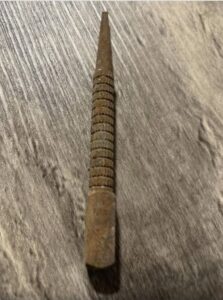
In a world filled with power tools, electric drills, and high-tech construction equipment, it’s easy to assume that older hand tools have disappeared from everyday use. Yet, surprisingly, some of the simplest tools from centuries ago are still widely used today—especially in woodworking and carpentry.
One of the most enduring examples is a small, unassuming tool known as the nail punch, also commonly called a nail set. Though it may not look impressive at first glance, this humble tool plays an essential role in achieving clean, polished, and professional-looking wood finishes.
Despite its simplicity, the nail punch has a long history that stretches back centuries, and its design has remained remarkably effective over time. To this day, it remains a trusted tool for carpenters, furniture makers, restorers, and DIY enthusiasts around the world.
What exactly is a nail punch?
A nail punch is a small handheld tool designed to push the head of a nail slightly below the surface of wood or similar materials. This process is known as “sinking” a nail.
The tool typically has a cylindrical body made of durable metal and a pointed tip at one end. The tip is placed directly on top of the nail head, and the other end is struck with a hammer. This force drives the nail deeper into the surface without damaging the surrounding material.
Once the nail is recessed, the small indentation left behind is usually filled with wood filler or putty. After sanding and finishing, the surface appears completely smooth and seamless, with no visible nail heads.
This simple process is what allows wooden furniture, trim work, and decorative carpentry to achieve a clean, professional appearance.

A tool with ancient origins
Although modern versions of the nail punch are made from steel and precision-engineered metals, the concept behind it dates back thousands of years.
Early craftsmen and builders in ancient civilizations needed ways to fasten materials together while keeping surfaces smooth and visually appealing. Before modern manufacturing, they used primitive versions of striking tools—sometimes made from stone or hardened metal—to drive fasteners beneath surfaces.
Historians suggest that early tools used for carving and shaping materials may have influenced the development of tools like the nail punch. These early innovations laid the foundation for many of the hand tools we still rely on today.
As woodworking evolved, so did the need for cleaner finishes. Visible nail heads were not always desirable, especially in furniture and architectural work. Craftsmen needed a way to hide fasteners while maintaining structural strength, and the nail punch became an essential solution.
How the Industrial Revolution improved the design
The Industrial Revolution marked a major turning point in tool manufacturing. With the mass production of nails and standardized building materials, the demand for precise and reliable tools increased significantly.
During this period, the nail punch became more refined. Manufacturers began producing consistent sizes, improving durability and shaping the tool for better accuracy. Carpenters could now rely on uniform tools that worked across different types of nails and materials.
This innovation made woodworking faster, more efficient, and more visually refined. Instead of leaving nails exposed, builders could now create smooth surfaces that were both functional and aesthetically pleasing.
The ability to recess nails also had practical benefits. By pushing nail heads below the surface, builders reduced the risk of corrosion, rust, and physical damage, helping structures last longer.
How a nail punch works in practice
Although the tool itself is simple, using it correctly requires a bit of technique.
First, a nail is driven into the wood using a hammer until it is nearly flush with the surface. Then, the tip of the nail punch is placed directly on the nail head.
A controlled strike with a hammer is applied to the back of the punch. This force pushes the nail further into the wood without splitting or damaging the surrounding surface.
Once the nail is slightly recessed, the small hole is filled with wood filler or putty. After drying, the area is sanded smooth, leaving no visible trace of the nail.
The result is a clean, polished finish that is especially important in visible woodworking projects such as furniture, cabinetry, molding, and decorative trim.
Key features of modern nail punches
While the basic concept has remained unchanged for centuries, modern nail punches have been improved with stronger materials and better ergonomics.
1. Durable materials
Most nail punches today are made from high-carbon steel or titanium. These materials are designed to withstand repeated hammer strikes without bending or wearing down.
2. Precision design
The tip of the tool is carefully shaped to match common nail head sizes. This ensures accuracy and prevents slipping during use.
3. Comfortable handling
Many modern versions include textured grips or cushioned handles to reduce hand fatigue during extended use.
4. Size variety
Nail punch sets often include multiple sizes to accommodate different nail types and woodworking needs. Some even feature laser markings for easy identification.
5. Spring-loaded versions
Some advanced designs include spring-loaded or automatic mechanisms. These reduce the need for repeated hammer strikes and make it easier to work with harder materials.
Why carpenters still use it today
Despite the rise of power tools and advanced construction technology, the nail punch remains widely used. Its continued popularity comes down to three main advantages: precision, simplicity, and reliability.
Power tools are excellent for speed and heavy-duty construction, but they are not always ideal for fine finishing work. In contrast, the nail punch allows craftsmen to control exactly how deep each nail is driven.
This level of precision is especially important in:
- Trim and molding installation
- Cabinet construction
- Furniture making
- Restoration of antique woodwork
In these applications, appearance matters just as much as strength. A visible nail head can disrupt the visual flow of a design, while a recessed and filled nail creates a smooth, professional surface.
A favorite tool in restoration work
One of the areas where nail punches are especially valued is restoration.
When working with antique furniture or historic buildings, preserving the original appearance is critical. Using modern fasteners or leaving exposed hardware can reduce authenticity.
A nail punch allows restorers to maintain traditional construction methods while ensuring a clean finish that blends seamlessly with existing materials.
Because of this, many restoration specialists consider it an essential part of their toolkit.
Simple, but incredibly effective
In an era where technology dominates nearly every industry, tools like the nail punch stand out for their simplicity. There are no batteries, no motors, and no complicated settings—just a well-designed piece of metal that performs one job extremely well.
That simplicity is exactly why it has survived for so long.
While power tools may come and go, the basic principles of woodworking have remained the same for centuries. Materials still need to be joined, surfaces still need to be smoothed, and craftsmanship still matters.
The nail punch continues to prove that sometimes the oldest solutions are also the most reliable.
Why it still belongs in every toolbox
Even today, professionals and hobbyists alike keep nail punches in their toolkits. They are affordable, easy to use, and require no maintenance. More importantly, they solve a problem that power tools cannot always address: finishing detail work with precision.
Whether you are building a new piece of furniture, repairing a wooden structure, or restoring something old, a nail punch ensures that your work looks complete and polished.
It may not be the most high-tech tool in the workshop, but it is one of the most quietly important.
Final thoughts
The nail punch is a perfect example of how simple tools can stand the test of time. From its early origins in ancient craftsmanship to its refined modern versions, it has remained a staple in woodworking for centuries.
Its purpose has never changed: to create smooth, clean, professional finishes by hiding the evidence of nails beneath the surface.
In a world increasingly driven by automation and advanced machinery, the nail punch is a reminder that sometimes the best tools are also the simplest ones.
So the next time you see a flawless wooden surface with no visible nails, there’s a good chance this small, centuries-old tool had a hand in creating it.