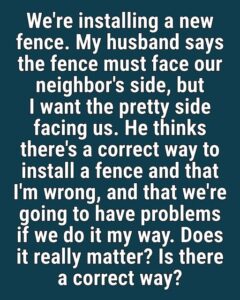
When I first decided to install a fence in my backyard, I thought the process would be straightforward. Pick a design, hire a contractor, and enjoy the added privacy. But almost immediately, I kept hearing the same advice from friends, neighbors, and even online forums: “Make sure the finished side faces your neighbor.”
At first, it sounded like a strict rule—something you simply didn’t question. But the more I looked into it, the more I realized things weren’t quite so black and white. What started as a simple home project turned into a deeper dive into property rules, neighborly etiquette, and a few surprising facts I wish I’d known earlier.
To understand the issue, I had to start with the basics. When people talk about the “finished” side of a fence, they’re referring to the side that looks clean and polished—the one without visible rails, posts, or structural supports. On the other hand, the “unfinished” side shows the framework that holds everything together. In many traditional wooden fences, one side looks neat and uniform, while the other exposes the skeleton behind it.
This difference is exactly where confusion—and sometimes tension—begins. If your fence faces inward with the polished side toward your yard, your neighbor is left staring at the less attractive side every day. Naturally, that can lead to frustration, especially in neighborhoods where homes are close together.
I assumed there must be a law about this. After all, so many people spoke about it like it was mandatory. But when I actually started researching local building codes and regulations, I was surprised by what I found.
In most places, there is no universal law that requires you to face the finished side of a fence toward your neighbor. Instead, it’s largely a long-standing social norm. Historically, homeowners would install fences with the better-looking side facing outward as a sign of courtesy and goodwill. It was a simple gesture that said, “I respect the space we share.”
That tradition stuck, which is why so many people still treat it like a rule today.
However, there are exceptions. Some local governments, neighborhoods, or homeowners’ associations (HOAs) may have specific requirements about fence orientation—especially if the fence borders a public space like a sidewalk or street. In those cases, the finished side often must face outward for aesthetic reasons. That’s why it’s always a good idea to check local guidelines before building anything permanent.
Another important factor is ownership. If you’re building a fence entirely within your property line—even just a few inches inside—you usually have full control over how it’s constructed, including which direction it faces. But things get more complicated when the fence sits directly on the boundary line between two properties.
Shared, or “boundary,” fences often come with shared responsibility. That can include maintenance, repair costs, and even decisions about design. In these situations, communication becomes essential. Without a clear agreement, small choices—like which side faces where—can turn into bigger disputes later on.
As I dug deeper, I realized that there are actually plenty of situations where the finished side doesn’t face the neighbor at all—and for perfectly valid reasons.
For example, some homeowners choose what’s called a “good neighbor fence,” which looks the same on both sides. This design removes the issue entirely, as neither party ends up with the less attractive view. Others may reverse the fence for security purposes, placing the rails on the inside so it’s harder for someone to climb over from the outside.
Terrain can also play a role. If your yard is sloped or uneven, the fence may need to be installed in a specific way for stability, which could affect which side ends up facing outward. Budget considerations, existing structures like trees or sheds, and even airflow or sunlight can all influence the final design.
Looking back, I realized that the advice I kept hearing—while well-intentioned—was more about etiquette than obligation.
Before I moved forward with my own fence, I made sure to take a few practical steps. First, I checked my local zoning rules to confirm there were no restrictions I needed to follow. Then, I reviewed my property boundaries carefully to avoid any disputes. Most importantly, I had a simple conversation with my neighbor.
That conversation made a bigger difference than anything else. We talked about the design, the placement, and what would work best for both of us. In the end, we agreed on a solution that felt fair and avoided any unnecessary tension.
If there’s one thing I learned through this process, it’s that fences aren’t just about marking space—they’re also about maintaining relationships. While there may not always be a legal requirement to face the finished side outward, choosing to do so can still be a thoughtful gesture.
At the same time, it’s important to remember that every situation is different. Local rules, property lines, and personal needs all play a role in the final decision.
So, does the finished side of a fence have to face your neighbor? Not always. Sometimes it’s required, sometimes it’s recommended, and sometimes it simply comes down to what makes the most sense for your property.
But if you’re ever unsure, a little research—and an honest conversation—can go a long way. After all, a well-built fence may define a boundary, but good communication is what truly keeps things on the right side of it.