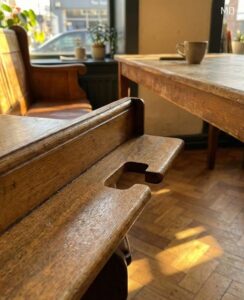
At first glance, it looks unremarkable.
A simple wooden bench inside an old church. Worn smooth by time. Slightly faded in color. The kind of object most people would walk past without a second thought.
Yet, when you slow down and actually observe it, something begins to shift.
There is a quiet complexity in its simplicity. A sense that this piece of wood has been part of something far larger than itself. Something human. Something emotional. Something enduring.
And then you notice a detail—subtle, carved, almost hidden.
A small opening built into the structure of the pew.
It does not shout for attention. It does not demand interpretation. But it is there for a reason. And like many things inside historic places of worship, it carries more meaning than its appearance first suggests.
Because in older sacred spaces, nothing was ever just decoration.
Everything had purpose.
Everything had intention.
Spaces Built for More Than Sitting
To understand something like this carved opening, you have to step back from modern assumptions.
Today, seating is simple. Chairs are designed for comfort, mobility, and efficiency. They are manufactured for convenience, not contemplation. Most of the time, we sit down, do what we need to do, and leave without ever thinking about the design of the chair itself.
But traditional church interiors were created with a different philosophy entirely.
They were not built for speed.
They were built for stillness.
Church pews, especially older wooden ones, were shaped for long hours of sitting, listening, praying, and reflecting. Every curve, every edge, every gap in the wood was considered carefully.
The carved sections were not random.
They often served practical purposes—holding books, storing hymnals, supporting posture during long services, or giving worshippers a place to rest their hands or belongings.
But beyond practicality, they also served something deeper.
They supported human presence.
The Hidden Logic Behind the Design
That small carved opening in the pew is a quiet example of functional design shaped by spiritual life.
In earlier centuries, church services could last a long time. People would remain seated, stand, and kneel repeatedly throughout a service. Movements were structured, rhythmic, and deeply physical.
So furniture had to respond to that reality.
Some pew designs included built-in compartments for prayer books or hymnals. Others had hooks or spaces for hats, coats, or personal items. In certain traditions, small architectural adjustments made it easier for worshippers to shift between sitting and kneeling without strain.
What looks unusual today was once completely logical.
These features were not added for decoration.
They were added so that people could remain focused on something greater than discomfort.
In other words, the design was meant to disappear into the experience of worship.
Comfort was not considered luxury.
It was considered necessary support for devotion.
Wood That Has Witnessed Generations
When you sit in an old church pew, you are not just sitting on wood.
You are sitting on memory.
These benches have witnessed centuries of human emotion—moments that cannot be replicated or recreated. They have held the weight of countless lives passing through different seasons of existence.
Within the same rows, over time:
Children were brought forward for baptism, held tightly in anxious parents’ arms.
Young couples sat nervously on the day of their wedding, hands intertwined beneath folded programs.
Families gathered in silence during funerals, shoulders trembling with grief they could not yet fully express.
Individuals knelt quietly in moments of personal reflection, asking questions only they could hear.
Each moment left something behind.
Not physically visible.
But emotionally embedded.
The wood wears differently because of it. Edges soften. Surfaces become polished not just by touch, but by repetition of presence.
And over time, the pew becomes less of an object and more of a witness.
A silent participant in human life.
The Emotional Weight of Still Objects
There is something powerful about objects that do not move, yet still hold stories.
A church pew does not speak. It does not change. It does not react.
But it remembers.
Or at least, it feels that way to those who pay attention.
Standing in an old sanctuary, you begin to sense that time behaves differently here. The stillness is not empty—it is layered. Every quiet moment seems to echo with everything that came before it.
That carved opening in the pew becomes part of that story. Not because it is dramatic, but because it is intentional.
It suggests a time when people built things to last.
Not just physically, but meaningfully.
They understood that spaces shape behavior. That environments influence emotion. That design can either distract or support reflection.
And so they created spaces that encouraged humility, patience, and attention.
What Modern Spaces Have Forgotten
In today’s world, design often focuses on speed.
Buildings are optimized for flow. Furniture is made for mass production. Even places meant for reflection are often simplified for convenience.
We sit, we scroll, we move on.
Rarely do we pause long enough to notice the structure around us.
That is what makes old church interiors so striking when you step into them today.
They resist that pace.
They ask you to slow down.
They remind you that not everything is meant to be rushed.
And in that contrast, even the smallest detail—a carved slot in a wooden bench—feels significant again.
Because it represents a mindset that is becoming less common.
A belief that even ordinary actions deserve thoughtful design.
Sacredness in Ordinary Objects
It is easy to assume that sacredness belongs only to rituals, ceremonies, or beliefs.
But in truth, sacredness often shows up in quieter ways.
It lives in repetition.
In care.
In objects that are built with intention and used with respect over long periods of time.
A church pew is not sacred because of what it is made of.
It is sacred because of what has happened around it.
Because of what people brought into that space when they sat down—hope, fear, gratitude, grief, uncertainty, faith.
The wood simply held space for all of it.
Without judgment.
Without interruption.
Just presence.
A Reminder Built Into Structure
When you look closely at the design of older pews, you begin to see something subtle but important.
These spaces were designed to support human experience, not overwhelm it.
They recognized that people need:
- A place to sit when life feels heavy
- A place to kneel when words are not enough
- A place to pause when everything feels uncertain
- A place to return when the world outside becomes too loud
Even the smallest carved detail reflects that philosophy.
It is a reminder that architecture can be compassionate.
That design can serve emotional life, not just physical function.
And that even wood, when shaped with care, can become part of something meaningful.
Why Details Like This Still Matter Today
You might wonder why any of this matters now.
After all, it is just a piece of old furniture in a quiet building.
But that is exactly the point.
In a world that moves quickly, small details like this remind us that meaning is often found in what we overlook.
The carved opening in the pew is not important because it is visually impressive.
It is important because it represents thoughtfulness.
It represents a time when people built slowly, intentionally, and with a sense of responsibility toward the experience of others.
It invites us to ask a simple question:
What would our spaces look like if we designed them not just for use—but for presence?
Conclusion: What Remains When Everything Else Fades
A church pew does not try to impress anyone.
It does not change with trends. It does not demand attention. It does not announce its purpose loudly.
It simply exists.
And in that existence, it carries something deeper than function.
It carries memory.
It carries emotion.
It carries time.
The carved detail in the wood is just one small reminder of that larger truth—that even the simplest designs can hold meaning when they are shaped with intention.
And long after the builders are gone, long after the services have ended, and long after the voices have quieted, the pew remains.
Still present.
Still serving.
Still quietly reminding anyone who pauses long enough to notice:
That meaning is often not found in what stands out—but in what quietly endures.