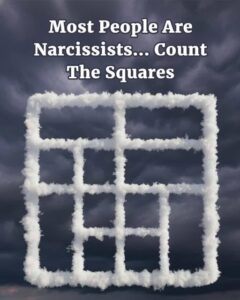
A visual puzzle featuring a cloud-shaped square grid has been circulating widely online, paired with the bold claim, “Most people are narcissists… Count the squares.” While the statement is dramatic, it’s simply a hook meant to draw attention. The real purpose of the puzzle is to challenge how people perceive patterns and shapes.
At first glance, most viewers immediately focus on the small, individual squares. This instinctive reaction reflects how our brains often latch onto the most obvious details before noticing the bigger picture. The puzzle isn’t commenting on personality traits—it’s highlighting how perception works.
Puzzles like this reveal how differently people interpret the same image. Some individuals count only the nine small squares, while others begin to spot medium and larger shapes created by the grid. The variation in responses shows that people naturally approach visual information in unique ways.
Counting the squares becomes a helpful exercise in awareness. It encourages viewers to step back and take a broader look instead of relying on their first impression. The final number is usually higher than expected, reminding us that our initial assumptions are not always complete.
In a fast-paced world full of distractions, this puzzle serves as a simple example of how easy it is to overlook what’s right in front of us. When we focus too narrowly on individual pieces, we can miss the larger structure entirely.
The cloud-shaped design also adds a playful element. Its soft outline contrasts with the sharp angles of the squares, making it harder for the eye to immediately detect the full pattern. This design choice reinforces the idea that perspective matters.
Even when the solution is revealed, people often react with surprise. Realizing how many squares were missed at first glance highlights just how limited our perception can be.
Ultimately, the puzzle is less about counting shapes and more about encouraging curiosity. Slowing down, looking deeper, and questioning assumptions are valuable skills—both in puzzles and in everyday life.