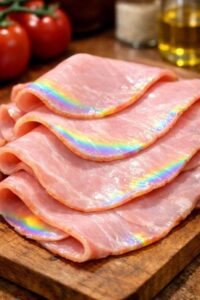
It’s a familiar moment in countless kitchens: you open a fresh pack of sliced deli ham, expecting the usual pale pink, only to notice something unexpected. Under the kitchen light, the surface flashes with subtle streaks of green, blue, and even faint purple. It looks unnatural at first glance—almost like a chemical reaction or early spoilage. For many people, that visual surprise is enough to make them hesitate, or even throw the meat away entirely.
But despite its unsettling appearance, that rainbow sheen is usually not a warning sign. In fact, it’s a well-understood physical phenomenon rooted in how light interacts with meat fibers. And once you understand what’s actually happening, the fear surrounding it starts to fade.
What you’re seeing has nothing to do with contamination or decay. It’s a natural optical effect called iridescence, and it appears more often in processed and thinly sliced meats than most people realize.
A Strange but Natural Optical Effect
Deli ham is made from muscle tissue that has been cured, pressed, and sliced extremely thin. Under a microscope, muscle fibers are arranged in tightly packed, repeating structures. When meat is sliced cleanly and uniformly, those structures are exposed in a way that allows light to bounce, bend, and scatter across the surface.
This scattering creates interference patterns—similar to what happens when light hits soap bubbles, oil slicks, or even the surface of a compact disc. Instead of reflecting a single color, the light splits into multiple wavelengths. Depending on the angle of the light and your viewing position, the meat may appear to shift between green, blue, violet, or gold tones.
In short, the rainbow effect is not inside the meat—it’s happening at the surface, where light is interacting with microscopic structures.
Moisture plays a supporting role as well. Thin films of water on the surface of deli meat can enhance reflectivity, making the color shifts more visible. That’s why freshly sliced or vacuum-sealed ham often shows this effect more clearly than drier, older cuts.
Why It Shows Up More in Deli Meats
Not all meats display iridescence equally. Deli ham, turkey, roast beef, and similar processed meats are especially prone to it because of how they are prepared.
Curing changes the protein structure slightly, and mechanical slicing creates an extremely smooth surface. The more uniform the surface, the more predictable the way light behaves when it hits it. That predictability is what allows interference patterns—and therefore rainbow coloring—to emerge.
In contrast, rougher cuts of meat or those cooked whole rarely show the same effect, because their uneven surfaces scatter light more randomly.
Salt used in curing also plays a subtle role. It helps proteins retain moisture, and moisture enhances the reflective layer that produces the visual effect. So in a strange way, the very process that preserves the meat also contributes to its shimmering appearance.
When People First Mistook It for Spoilage
Before modern food science explained the phenomenon, the rainbow sheen often triggered suspicion. It’s easy to understand why. We’re conditioned to associate unusual color changes in food with decay. Green, purple, and blue are not colors people expect to see in meat.
Historically, this led many consumers to assume the worst. Some even believed the effect was caused by chemical preservatives or early signs of bacterial growth.
But research has consistently shown that iridescence alone is not a safety issue. It is purely optical. The USDA and food safety experts have clarified that rainbow coloration in properly stored deli meats does not indicate spoilage.
That said, appearance alone should never be the only factor in judging food safety.
The Real Signs of Spoiled Deli Meat
While iridescence is harmless, spoiled meat does exhibit clear and reliable warning signs. These are not subtle visual tricks of light—they are physical and sensory changes caused by microbial activity.
The most important indicator is texture. Fresh deli ham should feel slightly moist but firm. If it becomes sticky, slimy, or leaves residue on your fingers, that’s a strong indication that bacteria have begun breaking down the proteins.
Smell is another reliable guide. Fresh ham has a mild, slightly salty, meaty aroma. Spoiled meat develops sour, sharp, or ammonia-like odors that are difficult to miss. These smells are produced by bacteria and are not related to lighting effects or surface reflections.
Color changes that do not shift with light are also important. Iridescence moves and changes as the angle of viewing changes. Spoilage does not behave that way. Static gray patches, dull green discoloration that doesn’t shift, or fuzzy mold growth are clear signs the meat should not be consumed.
The Role of Time and Storage
Even when deli ham looks and smells fine, time still matters. Processed meats are perishable once opened. Most food safety guidelines recommend consuming sliced deli meats within three to five days when refrigerated properly.
Refrigeration slows bacterial growth but does not stop it completely. Some bacteria can still multiply at low temperatures, especially if the packaging has been opened repeatedly or exposed to air.
Proper storage helps extend freshness. Keeping meat tightly sealed, minimizing air exposure, and storing it in the coldest part of the refrigerator can make a significant difference. However, no storage method eliminates the need to pay attention to expiration timelines.
Why the Rainbow Effect Persists in Modern Food
Despite advances in food processing and packaging, iridescence remains common. That’s because it isn’t a flaw—it’s a byproduct of how light behaves when it encounters structured surfaces.
In fact, in some cases, the effect is more noticeable today because modern slicing techniques are more precise than ever. Industrial meat slicers produce extremely smooth surfaces, which enhance the optical conditions needed for iridescence.
Vacuum sealing also preserves moisture levels, which can make the effect more visible when the package is first opened.
So rather than being a problem to eliminate, the rainbow sheen is essentially an unavoidable consequence of precision food production.
Understanding Instead of Reacting
The instinct to question unfamiliar food appearances is natural—and often helpful. Food safety depends on awareness and caution. But not every unusual visual cue is a warning sign.
The rainbow sheen on deli ham is a perfect example of how appearance can mislead us. What looks strange or artificial is often just physics at work—light bending across microscopic structures we can’t see with the naked eye.
Recognizing that difference helps reduce unnecessary food waste and prevents confusion in everyday situations.
The Bottom Line
Rainbow-colored deli ham may look unusual, but in most cases, it is completely safe to eat. The effect is caused by iridescence, an optical phenomenon created when light interacts with the structure of sliced meat, moisture, and curing salts.
The true indicators of spoilage remain unchanged: off smells, slimy texture, and persistent discoloration that does not shift with light.
In the end, the lesson is simple. Sometimes food looks more dramatic than it really is. And sometimes, what seems like a warning is just the quiet physics of light revealing itself on the surface of an everyday meal.