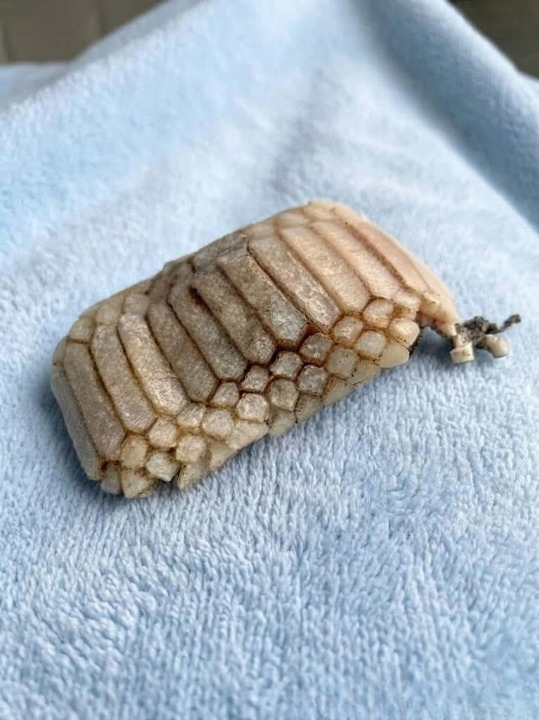
It all began with a single, highly detailed photograph uploaded to social media, but within hours, it had destabilized the internet. The image captured a grotesque, fleshy mass washed ashore on a popular beach. At first glance, it defied any classification within terrestrial biology. Its rough, leathery texture and asymmetrical shape seemed almost artificially manufactured, unnervingly unnatural.
The structural layout of the object was even more alarming. The top resembled jagged, petrified teeth; other sections bore sharp, skeletal protrusions like predatory claws. Some viewers swore it looked like decaying flesh fused with mechanical components. No two users agreed on what it could be, yet a consensus emerged: this was not normal.
As the photo went viral, speculation erupted across forums and news feeds. One theory suggested a deep-sea mutation, an apex predator from the ocean’s trenches. Another proposed extraterrestrial origins. The most extreme conjectures whispered about a top-secret government experiment gone awry—a biological weapon accidentally drifting to shore. The microscopic details of the mass seemed deliberately engineered, transforming casual curiosity into global obsession.
Zoomed-in images revealed ridges resembling rows of human-like teeth arranged in unnatural precision. Observers argued that the creature’s structural integrity defied organic fluidity, appearing mechanically reinforced. The image dominated mainstream media, sparking concern about hidden oceanic monsters.
Then, experts intervened. Marine biologists and wildlife specialists analyzed the photo scientifically, and the global panic began to unravel. The terrifying “monster” was nothing more than the underside of a common chiton—a harmless marine mollusk.
Chitons live quietly along rocky shorelines worldwide. Viewed from above, they appear as unremarkable, oval shells, easily overlooked by beachgoers. Their top is protected by eight interlocking plates, a natural suit of armor allowing them to cling to rocks and withstand crashing waves.
The panic arose from one simple fact: the chiton had been flipped upside down. Its underside, exposed to the camera, revealed a massive, muscular foot surrounded by rigid gripping structures used to anchor the mollusk to slippery surfaces. Dried in the open sun, these structures formed intricate patterns resembling rows of razor-sharp teeth or mechanical gears, evoking a nightmarish sci-fi image to untrained eyes.
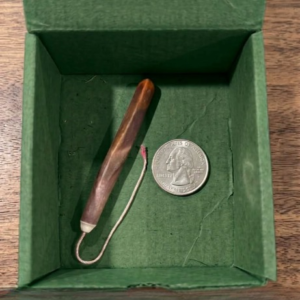
Beneath the terrifying illusion lay a remarkable biological feature. The ridges mistaken for teeth were part of the radula, a specialized feeding organ that scrapes algae from rocks. To reinforce this tool, nature embeds magnetite—a naturally occurring, highly magnetic iron oxide—into the radula’s microscopic teeth. This makes the chiton’s feeding structures among the hardest and strongest biological materials ever discovered, a genuine evolutionary marvel.
What terrified the public was simply a misinterpretation. Social media amplified the unknown angle, turning natural anatomy into a viral spectacle of fear. The chiton, a small and benign mollusk, had been elevated into a symbol of mystery and terror purely by unfamiliarity.
This episode illustrates a profound lesson about human psychology. Fear often stems not from real danger, but from a lack of understanding. When confronted with the unfamiliar, the mind instinctively projects the worst-case scenario. The beachside “monster” was never a threat; it was an extraordinary example of nature’s hidden complexity.
The viral frenzy also highlighted the gap between perception and reality in the digital age. Millions of people speculated wildly about extraterrestrials, deep-sea monsters, and secret experiments—all triggered by a humble, slow-moving mollusk. Education and scientific literacy, experts noted, are crucial to preventing misinformation from spiraling into global panic.
In the end, the chiton’s underside is not monstrous, but a testament to nature’s ingenuity. Its radula, reinforced with magnetite, can grind rock and scrape algae with unmatched durability. The elaborate, alien-like appearance is simply an adaptation for survival in harsh environments.
The bizarre flesh monster on the sand was never alien, never engineered, never a threat. It was a reminder that nature is full of hidden wonders, and that our fear often reveals more about our assumptions than about the world around us.
Uncategorized