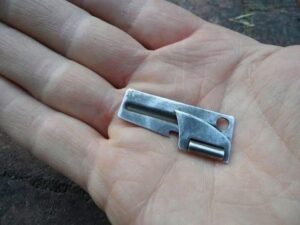
At first glance, it doesn’t look like much.
Small. Foldable. Barely noticeable if placed among modern tools.
But this simple piece of metal carries a story that stretches back decades—one rooted in history, practicality, and thoughtful design.
The tool in question is the P-38 can opener, a compact device that has quietly endured through generations. While many tools have evolved or disappeared over time, this one has remained almost unchanged.
And that raises an interesting question:
Is it a relic of the past… or a design so effective that it never needed to change?
A Tool Born From Necessity
The origins of the P-38 can opener trace back to one of the most demanding periods in modern history—World War II.
During this time, soldiers in the field relied heavily on canned rations. These meals were essential for sustaining troops, but they presented a practical challenge: how do you open them quickly and efficiently in unpredictable conditions?
Large kitchen tools weren’t practical.
Electric devices weren’t an option.
What was needed was something small, durable, and reliable.
The solution came in the form of a compact, foldable can opener that could be carried easily and used anywhere.
Simple Design, Lasting Impact
The brilliance of the P-38 lies in its simplicity.
Made from a single piece of metal, it features a small folding blade that pivots outward. There are no moving parts beyond that hinge. No electronics. No complex mechanisms.
And yet, it works.
Consistently.
Reliably.
In environments where many modern tools might fail.
This design reflects a time when functionality was prioritized above all else. Every detail served a purpose. Every element was designed to perform under pressure.
There was no room for unnecessary features—only what was essential.
Built for Portability
One of the defining characteristics of the P-38 is its size.
It’s incredibly small—small enough to fit in a pocket, attach to a keychain, or store in a basic supply kit without taking up noticeable space.
For soldiers, this portability was critical.
Carrying heavy gear was already a challenge. Every ounce mattered. A tool that could perform its function without adding weight was not just convenient—it was necessary.
This made the P-38 more than just a utensil.
It became part of a soldier’s everyday equipment.
More Than Just a Tool
While its primary purpose was practical, the P-38 can opener became something more over time.
In the midst of uncertainty and constant movement, small routines can provide comfort. Something as simple as opening a meal could create a sense of normalcy in an otherwise unpredictable environment.
For many soldiers, using this small tool became part of that routine.
It wasn’t just about accessing food.
It was about creating a moment of familiarity.
A pause.
A shared experience.
These small, repeated actions often carry meaning far beyond their original purpose.
Designed for Harsh Conditions
One of the reasons the P-38 has lasted so long is its durability.
It was designed to function in environments that were far from ideal—mud, rain, heat, cold, and everything in between.
Because it has so few moving parts, there’s very little that can go wrong.
No batteries to fail.
No delicate components to break.
Just a solid piece of metal designed to do one job—and do it well.
This level of reliability is part of what has allowed the tool to remain relevant long after its original context.
A Continued Presence in Modern Times
Even decades after its introduction, the P-38 hasn’t faded into obscurity.
In fact, it continues to be used today by a wide range of people, including campers, hikers, and those who prefer minimalist gear.
Outdoor enthusiasts often appreciate tools that are lightweight, dependable, and easy to carry.
The P-38 fits that description perfectly.
It doesn’t rely on modern technology.
It doesn’t require maintenance.
And it performs its function without complication.
In an age where many tools are designed with multiple features, this level of simplicity can feel refreshing.
A Favorite Among Minimalists
Minimalism has become a growing trend in recent years, especially in the context of travel, outdoor activity, and everyday carry items.
People are increasingly drawn to tools that offer maximum utility with minimal bulk.
The P-38 is often highlighted as an example of this philosophy.
It provides a clear function without unnecessary additions.
It’s compact without sacrificing usefulness.
And it represents a design approach that values efficiency over excess.
Why It Still Works Today
It’s easy to assume that older tools become outdated as technology advances.
But the P-38 challenges that assumption.
Its continued use suggests that some designs reach a level of effectiveness that doesn’t need improvement.
In fact, adding complexity could reduce its reliability.
This is one of the key reasons it has remained relevant.
It solves a specific problem in a straightforward way.
And it continues to do so without requiring updates or redesign.
A Reflection of Thoughtful Engineering
Looking at the P-38 more closely, it becomes clear that its design is not accidental.
It reflects careful thought and practical engineering.
Every aspect of it—from its size to its structure—serves a purpose.
This kind of design is often the result of necessity.
When resources are limited and conditions are demanding, efficiency becomes essential.
The result is a tool that is not only functional but enduring.
A Contrast to Modern Gadgets
Today’s tools often come with multiple features, digital components, and complex mechanisms.
While these advancements offer convenience, they can also introduce points of failure.
The P-38 stands in contrast to that trend.
It doesn’t aim to do everything.
It focuses on doing one thing well.
This clarity of purpose is part of what makes it so effective.
It also highlights an important idea: more features don’t always mean better design.
A Symbol of Practical Innovation
Over time, the P-38 has come to represent more than just a tool.
It symbolizes a type of innovation that prioritizes function, durability, and simplicity.
It shows that effective design doesn’t always require advanced technology.
Sometimes, the best solutions are the ones that are straightforward and reliable.
This perspective can be applied beyond tools.
It reflects a broader approach to problem-solving—one that values clarity and efficiency.
Why People Still Talk About It
The continued interest in the P-38 is not just about nostalgia.
It’s about appreciation.
People recognize the thought that went into its creation and the way it continues to perform.
It’s a reminder that good design can outlast trends.
And that usefulness doesn’t always depend on complexity.
A Lesson in Longevity
The fact that the P-38 is still in use today speaks to its longevity.
Many products are designed with a limited lifespan, often replaced by newer versions within a few years.
The P-38 is different.
It has remained largely unchanged.
And that consistency is part of its strength.
It shows that when something is designed well from the start, it doesn’t need constant reinvention.
Final Thoughts
The P-38 can opener may be small, but its story is significant.
From its origins during World War II to its continued use today, it represents a form of design that prioritizes function, durability, and simplicity.
In a world filled with increasingly complex tools, it stands as a reminder that sometimes the most effective solutions are also the simplest.
So is it modern or ancient?
In many ways, it’s both.
It carries the history of the past while continuing to serve a purpose in the present.
And that balance is what makes it truly timeless.