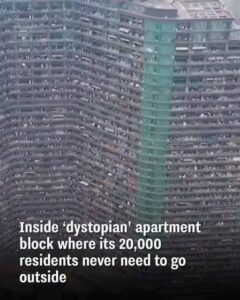
In Hangzhou, China, the Regent International apartment complex has gained global attention for its massive scale and city-within-a-building design. Rising 675 feet in an S-shaped curve, the structure dominates the skyline and represents one of the most ambitious attempts at high-density living. Designed by Alicia Loo, known for Singapore’s Marina Bay Sands, it can house up to 30,000 residents, making it one of the densest residential buildings ever created.
Today, nearly 20,000 people live inside Regent International. Within its walls are gyms, convenience stores, salons, food courts, offices, and a wide range of shops. The goal is to shorten commutes and place essential services only an elevator ride away. This approach mirrors broader trends across China, where hyper-dense, mixed-use developments are increasingly common.
Supporters argue that Regent International showcases innovation and sustainability. By building upward instead of outward, the complex reduces pressure on surrounding neighborhoods and provides a model for megacities facing fast population growth and limited land.
Critics, however, question the human experience in such a colossal structure. They warn that extreme density, smaller living spaces, and reliance on indoor environments can lead to isolation. Limited access to fresh air, natural light, and outdoor areas raises concerns about mental and physical well-being.
While some apartments include balconies or shared gardens, many do not. Residents often depend on interior communal spaces rather than outdoor courtyards. This has sparked debate about whether efficiency can truly replace the need for personal space and open environments.
Urban planners see Regent International as both groundbreaking and cautionary. It demonstrates architectural ambition but also exposes the social challenges of packing thousands of people into a single vertical community.
Defenders maintain that cities must adapt creatively to remain sustainable, and buildings like this show the possibilities of compact urban solutions. Yet they acknowledge that human experience must remain central.
As Hangzhou continues to expand, Regent International stands as a symbol of modern ambition—part innovation, part warning—highlighting ongoing questions about what makes dense city living truly livable.