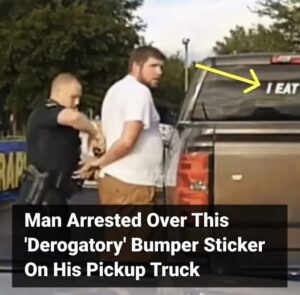
When Dillon Shane Webb pulled his vehicle onto the road, he likely expected nothing more than a routine commute. He certainly did not anticipate that a simple, albeit crude, bumper sticker would result in a confrontation with law enforcement that would eventually land in a courtroom. The incident serves as a stark reminder of how thin the line can be between what is considered offensive in the public square and what is actually illegal in the eyes of the law…
…and the law, as it turns out, is far more protective of expression than many realize. The deputy who pulled Webb over acted on the assumption that the sticker’s vulgarity constituted a disorderly conduct offense, an “obscene” display that warranted immediate intervention. However, the legal reality is that the First Amendment provides a robust shield for speech, even when that speech is intentionally provocative, rude, or deeply offensive to the average bystander.
The High Bar of Obscenity
In the United States, the threshold for “obscenity” is remarkably high. Courts have consistently ruled that being offended is not a valid legal basis for silencing someone. For a bumper sticker to be deemed illegal, it must typically cross into the territory of true threats, direct incitement to violence, or specific, legally defined obscenity—a standard that is rarely met by mere words on a piece of vinyl. Webb’s case became a classic example of police discretion clashing with constitutional rights.
The charges against Webb were dropped almost as quickly as they were filed. The legal system recognized that while the sticker was undoubtedly in poor taste, it did not meet the criteria for a public disturbance or a criminal act. The arrest was a clear overreach, illustrating the danger of allowing law enforcement to act as the ultimate arbiter of “taste” or “decency” in public spaces.
Why the Lawsuit Matters
Webb did not let the matter rest. The subsequent lawsuit was not merely about seeking compensation for the inconvenience of an arrest; it was a necessary challenge to the boundaries of government authority. When officials use their power to suppress speech simply because they find it personally distasteful, they erode the very freedoms that the Constitution is designed to protect. By taking the case to court, Webb forced a conversation about the limits of police power and the necessity of protecting unpopular speech.
This case serves as a vital lesson for everyone: the right to speak freely is not reserved for those who are polite or agreeable. It is a fundamental liberty that includes the right to be crude, the right to be provocative, and the right to express views that others might find repulsive. The legal system’s ultimate decision to side with the protection of speech reinforces a bedrock principle of democracy: the government cannot punish you simply because they do not like what you have to say.
Ultimately, the question isn’t whether the sticker was tasteful—it clearly wasn’t. The real question is who holds the power to decide when speech becomes punishable. In this instance, the legal system provided a resounding answer: not the government, and certainly not a deputy on the side of the road. It is a victory for the principle that, in a free society, we must tolerate the offensive to ensure that the essential remains protected.