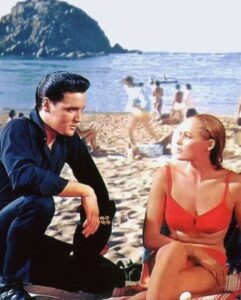
When Elvis Presley arrived on the set of Fun in Acapulco, he was already a global phenomenon—The King of Rock ’n’ Roll, a box-office magnet, and a cultural force whose every move made headlines. But in 1963, even Elvis wasn’t the only star commanding attention. Enter Ursula Andress—fresh off her breakout role in Dr. No—and suddenly, Hollywood had a pairing that sparked curiosity both on and off screen.
The film would go on to become the top-grossing movie musical of its year, anchored by Elvis’s charisma and hits like “Bossa Nova Baby.” Yet behind the vibrant colors, catchy songs, and beachside escapism, there was a quieter, more intriguing story unfolding—one involving attraction, restraint, and a love triangle that never quite became what people expected.
A Perfect On-Screen Match
On screen, the chemistry between Elvis and Andress felt effortless. She played Marguerita Dauphin, a poised and alluring social director, while Elvis portrayed Mike Windgren, a charming performer navigating life in Mexico. Their dynamic was playful, flirtatious, and filled with the kind of romantic tension audiences loved.
Off screen, however, things were far more complicated.
At the time, Ursula Andress was widely considered one of the most beautiful women in the world. Her iconic emergence from the sea in Dr. No had already cemented her status as a global sex symbol. Naturally, rumors began almost immediately that sparks were flying between her and Elvis.
But reality, as it often does, told a different story.

When the Tables Turned
According to members of Elvis’s inner circle—often referred to as the “Memphis Mafia”—this was one of the rare occasions when Elvis wasn’t the one doing the chasing.
Instead, it was Andress who appeared captivated.
Those close to the production noted how quickly she warmed to Elvis after initially keeping her distance due to tabloid portrayals. Once they met, she reportedly found him disarmingly kind, humble, and far more grounded than his public image suggested.
The attraction seemed real. The opportunity, however, was complicated.
The Invisible Third Person
Hovering over the set was another key figure: John Derek, Andress’s partner at the time. His presence introduced an unspoken tension that influenced how Elvis approached the situation.
Elvis had a personal rule—one he rarely broke. He avoided pursuing women who were already in committed relationships. It wasn’t just about image; it was about boundaries he chose not to cross.
According to close friends, Elvis was acutely aware of Derek’s attachment to Andress. That awareness, combined with his own relationship priorities, created a clear line he wouldn’t step over.
What might have developed into a headline-making romance instead remained restrained, simmering beneath the surface but never fully realized.

Elvis’s Private Reservations
Adding another layer to the story were Elvis’s own private comments—later recounted by those close to him, including Priscilla Presley.
Despite Andress’s global reputation as a beauty icon, Elvis reportedly didn’t view her through the same lens as the public. He was known to have a very specific personal preference when it came to women, and Andress didn’t entirely fit that image.
Whether those remarks reflected genuine disinterest or were a way of deflecting temptation is still debated. What’s clear is that Elvis maintained emotional distance, even as speculation grew around them.
A Film Surrounded by Unusual Circumstances
Beyond the rumored romance, Fun in Acapulco itself carried an unusual production story.
Despite its Mexican setting, Elvis never actually filmed in Mexico. Due to political controversy and lingering backlash from false rumors that he had insulted the country, he had effectively been declared unwelcome. As a result, all of his scenes were shot in Hollywood, while a body double handled location shots in Acapulco.
Even with these limitations, the film succeeded—largely because of Elvis’s star power and the undeniable visual appeal of pairing him with Andress.

A Carefully Controlled Image
Another factor shaping the dynamic was Elvis’s audience. By the early 1960s, he had cultivated a massive fanbase that included younger viewers, and his films were carefully tailored to maintain that broad appeal.
This meant toning down elements that might have leaned too heavily into sensuality—even with a co-star like Andress. Costume choices, scene direction, and character interactions were all adjusted to fit a more “family-friendly” tone.
Andress herself later expressed frustration with these limitations, noting that her wardrobe in the film was deliberately less revealing than her previous roles.
Chemistry Without Consequence
In the end, what makes the Elvis-Andress story compelling isn’t a scandal—it’s the absence of one.
The chemistry was there. The speculation was there. The opportunity was there.
But the relationship never crossed into reality.
Instead, it became one of those rare Hollywood “what ifs”—a moment where timing, personal boundaries, and external factors aligned to keep something from happening rather than pushing it forward.

A Moment in Cultural Transition
Fun in Acapulco also represents a fascinating point in entertainment history. It was one of Elvis’s last major musical films before the cultural landscape began to shift dramatically.
Just as the movie enjoyed its success, a new force was emerging: The Beatles. Their rise signaled a changing era in music and pop culture—one that would redefine celebrity, fandom, and the entertainment industry itself.
In that sense, the film stands as both a celebration of Elvis’s dominance and a quiet marker of transition.
The Legacy of an Unwritten Story
Looking back, the story of Elvis Presley and Ursula Andress isn’t about a dramatic romance or a hidden affair.
It’s about restraint.
It’s about how even in an environment built on spectacle, some stories remain subtle—defined not by what happened, but by what didn’t.
Their connection lives on through the film itself: in lingering glances, playful exchanges, and a chemistry that audiences could feel, even if it never extended beyond the camera.
And perhaps that’s what makes it enduring.
Not every Hollywood pairing needs a scandal to be memorable. Sometimes, the most intriguing stories are the ones that stop just short of becoming reality.