In a story that reads like a testament to human courage and medical innovation.
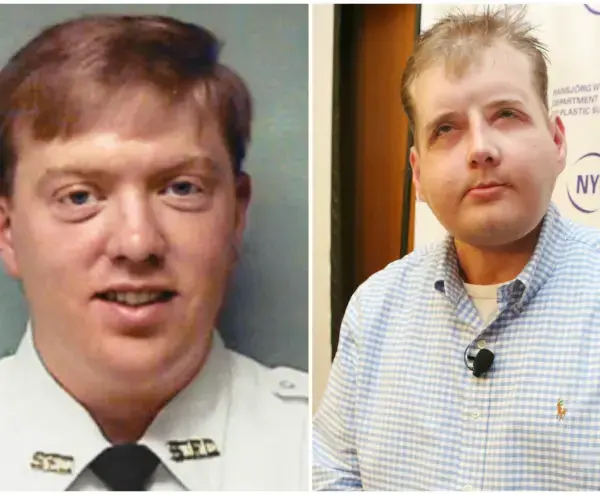
Former volunteer firefighter Patrick Hardison underwent the most extensive face transplant ever performed — a surgical feat that ultimately transformed his life after he suffered devastating injuries while responding to a blaze.
The journey that led to this groundbreaking procedure began more than a decade earlier, on a day that would irrevocably reshape Hardison’s identity, his family’s life, and the broader possibilities of reconstructive surgery.
A Hero in the Flames: The Injury That Changed Everything
On September 5, 2001, Hardison, then a 27-year-old father of three and a dedicated volunteer firefighter from Senatobia, Mississippi, ran into a burning home to rescue a woman he believed was trapped inside.
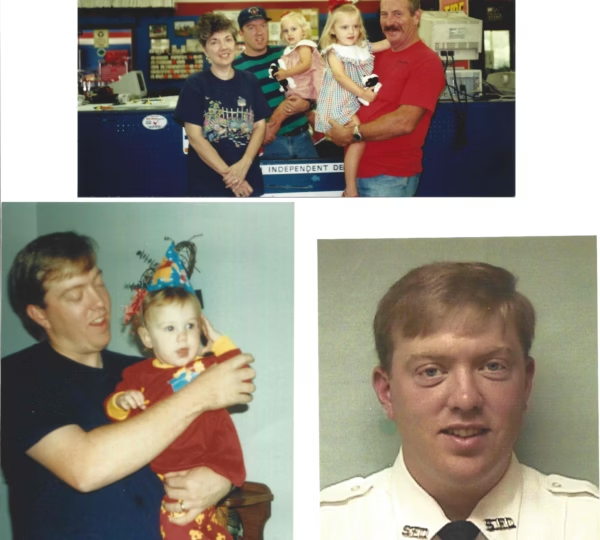
What followed was a catastrophic collapse of the building’s roof. Hardison was buried under the burning debris, and his protective gear — including his helmet and mask — melted into his skin.
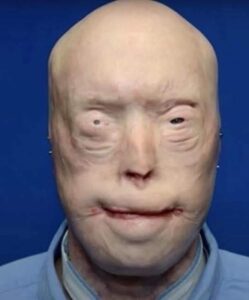
The inferno inflicted third-degree burns across his entire face, head, neck, and upper torso.
When rescuers finally pulled him from the wreckage, the damage was unimaginably severe:
He had lost his ears, lips, most of his nose, and virtually all of his eyelid tissue,
His face and scalp were scarred extensively,
He could barely close his eyes and was nearly blind without eyelids to protect them.
Doctors rushed Hardison to a specialized burn center in Memphis, Tennessee, where he spent about two months undergoing emergency care.
Despite their efforts, including skin grafts to cover the worst of the burned areas, the early surgeries could not restore his face to any semblance of normalcy.
A Decade of Survival: Pain, Stares, and Isolation
In the years that followed the accident, Hardison became intimately familiar with the crushing reality faced by many patients with severe facial disfigurement.
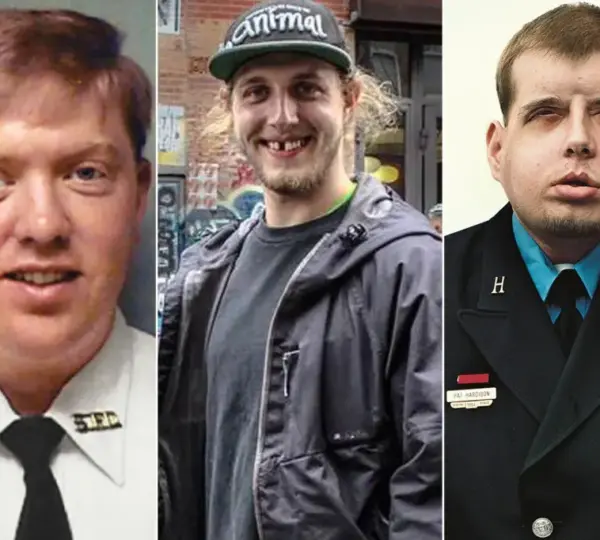
More than 70 reconstructive surgeries attempted to repair functions and aesthetics — but the results were limited.
Every time he stepped outside, strangers would stare. Children would recoil; adults whispered.
Hardison told reporters that at times he felt like a spectacle — and that living with permanent disfigurement was often more damaging than the injury itself.
“Kids would run screaming and crying when they saw me,” Hardison recounted years later. For a man whose instinct was to serve and protect, the emotional toll of isolation and public scrutiny was profound.
He described a period during which he avoided mirrors altogether. Some days, he wrapped bandanas or caps around his head; at other times he wore sunglasses and shifted his gaze downward to avoid direct eye contact with strangers.
His confidence and sense of self eroded in parallel with his physical injuries.
A Historic Opportunity: The Birth of a New Face
After hard-fought years of incremental surgeries and uncertain progress, Hardison’s life took another dramatic turn.
A friend and fellow firefighter at his church, aware of experimental developments in face transplant surgery, wrote to Dr. Eduardo D. Rodriguez, a leading plastic surgeon who had pioneered previous face-reconstructive procedures.
Rodriguez, who had previously performed a face transplant in 2012, agreed to take on Hardison’s case.
Hardison became a patient of the surgeon — first at the University of Maryland Medical Center, and later at NYU Langone Medical Center, where Rodriguez had moved to lead the Hansjörg Wyss Department of Plastic Surgery.
For more than a year, the surgical team prepared meticulously.
They looked not only for a medically compatible donor, but someone whose facial characteristics would minimize the risk of rejection and other postoperative complications.
Their patience and precision paid off.
In July 2015, a 26-year-old New York artist and competitive cyclist named David P. Rodebaugh died in a biking accident. Rodebaugh had signed up to be an organ donor during his life, and when his family was approached about donating his tissues — including facial tissue — they agreed without hesitation.
The Operation: 26 Hours That Redefined Reconstruction
On August 14, 2015, a team of more than 100 surgeons, nurses, and support staff began what would become the most extensive face transplant ever performed.
The operation lasted over 26 hours and was described by medical experts as historic for its scale and complexity.
Rather than simply replacing skin, this transplant involved the transfer of: the entire face and scalp from the donor,both ears and ear canals, the nose, eyelids, and blink mechanisms, portions of bone to provide structure and symmetry.
Precision three-dimensional modeling and cutting guides ensured that the transplanted tissues aligned accurately with Hardison’s skull.
Surgeons even anchored bone segments with plates and screws to prevent drooping and to maintain proper facial contours.
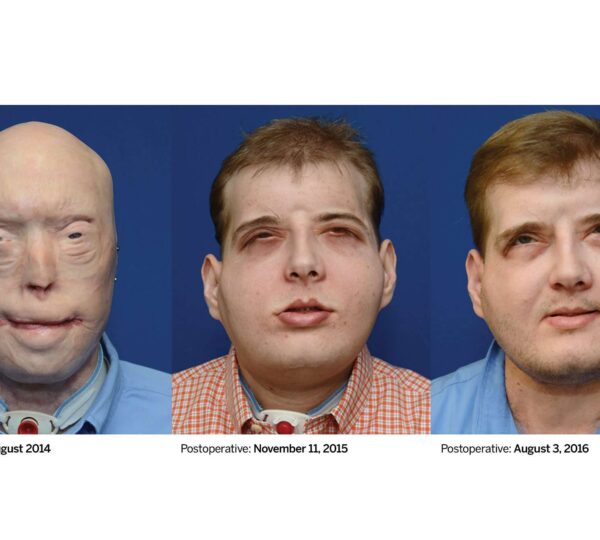
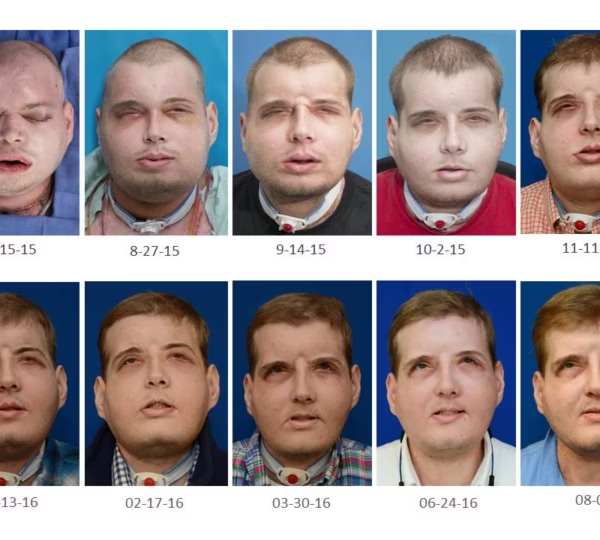
By the end of the procedure — one of the most ambitious soft-tissue transplants in medical history — Hardison’s face was no longer a mask of scar tissue but a reconstructed human face capable of blinking, expressing emotion, and functioning more normally than it had in years.
Recovery and Rehabilitation: A New Lease on Life
Hardison’s recovery was carefully monitored. Within days, his new eyelids allowed him to blink independently — a fundamental function that had been lost after his original injuries.
Three months after the surgery, swelling had significantly decreased, allowing Hardison to perform everyday tasks more comfortably.
He began physical therapy, speech rehabilitation, and activities to strengthen his facial muscles and improve coordination.
Despite the risks of rejection — one of the most serious concerns in transplant medicine — Hardison’s body accepted the new tissue remarkably well.
Doctors at NYU Langone reported that he had not experienced signs of acute rejection, a major milestone in the months following the surgery.
The reconstructive success also opened the door to functions he had not been able to perform for more than a decade: He could see more clearly without nearly blind eyelids, speak with improved articulation, and eat and drink with his own lips and mouth.
A Father Reclaimed: Life Beyond Scars
Today, Hardison’s post-transplant life is a testament to resilience. Although he will always carry the physical and emotional marks of his past, the success of the face transplant has allowed him to engage in life again without the constant reminder of stares and fear.
He has expressed profound gratitude for the donor family’s generosity, acknowledging that the immense gift of facial tissue not only restored physical function but also a sense of dignity and self-worth.
Above all, Hardison’s recovery has enabled him to participate fully in family life — from driving his children to school to sharing ordinary moments that many people take for granted.
Medical Legacy and Future Impact
While face transplants remain rare and complex, Patrick Hardison’s case has had a ripple effect across medicine.
His operation set new standards for what surgeons can achieve in reconstructive surgery, demonstrating the potential to restore not just form but function in patients who were once considered beyond hope.
Surgeons like Dr. Rodriguez now use Hardison’s case as a learning model, inspiring other teams around the world to refine techniques, improve immune suppression protocols, and broaden access to transplant procedures for people with devastating facial injuries.
Conclusion: From Tragedy to Triumph
Patrick Hardison’s story is a powerful reminder of the resilience of the human spirit and the sometimes miraculous progress of modern medicine.
From the moment he stepped into a burning home as a first responder, through the years of surgeries, social isolation, and emotional turmoil, to the historic 26-hour transplant that gave him a new face and a new future, his journey demonstrates courage in the face of overwhelming odds.
His life today stands not only as a personal victory, but as an inspiration to others living with severe disfigurements — showing that even after unimaginable loss, hope and healing are still possible.
In a story that reads like a testament to human courage and medical innovation.
Former volunteer firefighter Patrick Hardison underwent the most extensive face transplant ever performed — a surgical feat that ultimately transformed his life after he suffered devastating injuries while responding to a blaze.
The journey that led to this groundbreaking procedure began more than a decade earlier, on a day that would irrevocably reshape Hardison’s identity, his family’s life, and the broader possibilities of reconstructive surgery.
A Hero in the Flames: The Injury That Changed Everything
On September 5, 2001, Hardison, then a 27-year-old father of three and a dedicated volunteer firefighter from Senatobia, Mississippi, ran into a burning home to rescue a woman he believed was trapped inside.
What followed was a catastrophic collapse of the building’s roof. Hardison was buried under the burning debris, and his protective gear — including his helmet and mask — melted into his skin.
The inferno inflicted third-degree burns across his entire face, head, neck, and upper torso.
When rescuers finally pulled him from the wreckage, the damage was unimaginably severe:
He had lost his ears, lips, most of his nose, and virtually all of his eyelid tissue,
His face and scalp were scarred extensively,
He could barely close his eyes and was nearly blind without eyelids to protect them.
Doctors rushed Hardison to a specialized burn center in Memphis, Tennessee, where he spent about two months undergoing emergency care.
Despite their efforts, including skin grafts to cover the worst of the burned areas, the early surgeries could not restore his face to any semblance of normalcy.
A Decade of Survival: Pain, Stares, and Isolation
In the years that followed the accident, Hardison became intimately familiar with the crushing reality faced by many patients with severe facial disfigurement.
More than 70 reconstructive surgeries attempted to repair functions and aesthetics — but the results were limited.
Every time he stepped outside, strangers would stare. Children would recoil; adults whispered.
Hardison told reporters that at times he felt like a spectacle — and that living with permanent disfigurement was often more damaging than the injury itself.
“Kids would run screaming and crying when they saw me,” Hardison recounted years later. For a man whose instinct was to serve and protect, the emotional toll of isolation and public scrutiny was profound.
He described a period during which he avoided mirrors altogether. Some days, he wrapped bandanas or caps around his head; at other times he wore sunglasses and shifted his gaze downward to avoid direct eye contact with strangers.
His confidence and sense of self eroded in parallel with his physical injuries.
A Historic Opportunity: The Birth of a New Face
After hard-fought years of incremental surgeries and uncertain progress, Hardison’s life took another dramatic turn.
A friend and fellow firefighter at his church, aware of experimental developments in face transplant surgery, wrote to Dr. Eduardo D. Rodriguez, a leading plastic surgeon who had pioneered previous face-reconstructive procedures.
Rodriguez, who had previously performed a face transplant in 2012, agreed to take on Hardison’s case.
Hardison became a patient of the surgeon — first at the University of Maryland Medical Center, and later at NYU Langone Medical Center, where Rodriguez had moved to lead the Hansjörg Wyss Department of Plastic Surgery.
For more than a year, the surgical team prepared meticulously.
They looked not only for a medically compatible donor, but someone whose facial characteristics would minimize the risk of rejection and other postoperative complications.
Their patience and precision paid off.
In July 2015, a 26-year-old New York artist and competitive cyclist named David P. Rodebaugh died in a biking accident. Rodebaugh had signed up to be an organ donor during his life, and when his family was approached about donating his tissues — including facial tissue — they agreed without hesitation.
The Operation: 26 Hours That Redefined Reconstruction
On August 14, 2015, a team of more than 100 surgeons, nurses, and support staff began what would become the most extensive face transplant ever performed.
The operation lasted over 26 hours and was described by medical experts as historic for its scale and complexity.
Rather than simply replacing skin, this transplant involved the transfer of: the entire face and scalp from the donor,both ears and ear canals, the nose, eyelids, and blink mechanisms, portions of bone to provide structure and symmetry.
Precision three-dimensional modeling and cutting guides ensured that the transplanted tissues aligned accurately with Hardison’s skull.
Surgeons even anchored bone segments with plates and screws to prevent drooping and to maintain proper facial contours.
By the end of the procedure — one of the most ambitious soft-tissue transplants in medical history — Hardison’s face was no longer a mask of scar tissue but a reconstructed human face capable of blinking, expressing emotion, and functioning more normally than it had in years.
Recovery and Rehabilitation: A New Lease on Life
Hardison’s recovery was carefully monitored. Within days, his new eyelids allowed him to blink independently — a fundamental function that had been lost after his original injuries.
Three months after the surgery, swelling had significantly decreased, allowing Hardison to perform everyday tasks more comfortably.
He began physical therapy, speech rehabilitation, and activities to strengthen his facial muscles and improve coordination.
Despite the risks of rejection — one of the most serious concerns in transplant medicine — Hardison’s body accepted the new tissue remarkably well.
Doctors at NYU Langone reported that he had not experienced signs of acute rejection, a major milestone in the months following the surgery.
The reconstructive success also opened the door to functions he had not been able to perform for more than a decade: He could see more clearly without nearly blind eyelids, speak with improved articulation, and eat and drink with his own lips and mouth.
A Father Reclaimed: Life Beyond Scars
Today, Hardison’s post-transplant life is a testament to resilience. Although he will always carry the physical and emotional marks of his past, the success of the face transplant has allowed him to engage in life again without the constant reminder of stares and fear.
He has expressed profound gratitude for the donor family’s generosity, acknowledging that the immense gift of facial tissue not only restored physical function but also a sense of dignity and self-worth.
Above all, Hardison’s recovery has enabled him to participate fully in family life — from driving his children to school to sharing ordinary moments that many people take for granted.
Medical Legacy and Future Impact
While face transplants remain rare and complex, Patrick Hardison’s case has had a ripple effect across medicine.
His operation set new standards for what surgeons can achieve in reconstructive surgery, demonstrating the potential to restore not just form but function in patients who were once considered beyond hope.
Surgeons like Dr. Rodriguez now use Hardison’s case as a learning model, inspiring other teams around the world to refine techniques, improve immune suppression protocols, and broaden access to transplant procedures for people with devastating facial injuries.
Conclusion: From Tragedy to Triumph
Patrick Hardison’s story is a powerful reminder of the resilience of the human spirit and the sometimes miraculous progress of modern medicine.
From the moment he stepped into a burning home as a first responder, through the years of surgeries, social isolation, and emotional turmoil, to the historic 26-hour transplant that gave him a new face and a new future, his journey demonstrates courage in the face of overwhelming odds.
His life today stands not only as a personal victory, but as an inspiration to others living with severe disfigurements — showing that even after unimaginable loss, hope and healing are still possible.