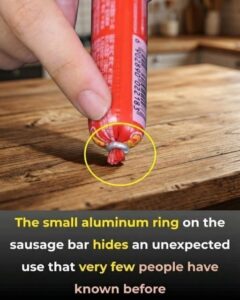
At first glance, the tiny metal ring clipped to the end of many sausage sticks looks insignificant. It’s easy to assume it’s leftover packaging or a random manufacturing detail that doesn’t really matter. In reality, that small aluminum clip is a carefully engineered component used throughout the meat processing industry.
For decades, sausage manufacturers have relied on these metal rings—often called sausage clips—to help seal, preserve, and handle sausage products during production and distribution. While most consumers barely notice them, these clips play a surprisingly important role in maintaining food quality and safety.
Across the United States, sausage sticks and cured meats are a popular snack and meal ingredient. According to the National Hot Dog and Sausage Council, Americans consume billions of pounds of sausages each year, ranging from traditional smoked sausages to modern snack sticks sold in grocery stores and convenience shops.
Behind every one of these products lies a complex manufacturing process that ensures consistency, hygiene, and shelf stability. The small aluminum ring at the end of a sausage stick is one of the simplest—but most effective—tools used to achieve those goals.
You might not realize it, but that tiny metal clip supports several essential functions in food production, including sealing the casing, maintaining shape, aiding curing processes, and improving manufacturing efficiency.
Understanding why sausage sticks have this ring offers a fascinating glimpse into the design decisions that quietly support modern food production.
The Hidden Meaning / Significance
While the aluminum ring may appear trivial, it represents a practical solution developed over many decades within the meat processing industry. Its presence reflects the need for efficiency, food safety, and product consistency on a large scale.
A Simple Solution to a Complex Problem
Sausage production involves filling casings with ground meat mixtures that often include spices, curing agents, and preservatives. Once the mixture is inserted into the casing, the open end must be sealed securely.
Without a reliable closure method, several problems could occur:
-
Air could enter the casing and cause oxidation
-
Moisture could escape, drying out the sausage
-
Bacteria or contaminants could enter
-
The sausage filling could leak or shift
To solve these challenges, manufacturers developed metal clips that can be quickly crimped onto the casing to create a tight seal.
This process ensures that the sausage remains protected from external contaminants while preserving its intended texture and flavor.
Why Even Small Design Choices Matter
Food manufacturing involves countless small design decisions that most consumers never notice. The aluminum ring is one such detail.
In large-scale production environments, even minor inefficiencies can have major consequences. For example:
-
Slower sealing methods could delay production
-
Inconsistent closures could lead to product defects
-
Weak seals could increase food spoilage rates
The aluminum clip solves these issues with a simple but reliable mechanism. Once crimped onto the casing, it forms a durable seal that holds the product together through multiple stages of handling.
The Importance of Product Consistency
Consistency is essential in the food industry. Consumers expect the same quality, taste, and appearance every time they purchase a product.
A poorly sealed sausage can become misshapen, lose moisture, or develop uneven texture.
By keeping the casing tightly closed, the metal ring helps ensure that each sausage stick maintains a uniform shape and structure.
This consistency is especially important for snack sticks sold in retail packaging, where visual appearance plays a major role in consumer perception.
Practical Implications for People / Consumers / Businesses
The aluminum ring primarily serves manufacturers, but its benefits extend to retailers and consumers as well. From food safety to shelf life, this small component supports several practical advantages throughout the supply chain.
Protecting Food Safety
One of the most important roles of the aluminum ring is preventing contamination.
Once the sausage mixture is sealed inside the casing, the clip creates a barrier that keeps the interior protected during:
-
Packaging
-
Transportation
-
Storage
-
Retail display
According to the United States Department of Agriculture, maintaining proper containment of meat products is critical for reducing exposure to bacteria and environmental contaminants.
Even small gaps in the casing could allow microorganisms to enter the product.
By securing the casing tightly, the metal clip reduces this risk and helps manufacturers comply with strict food safety regulations.
Extending Shelf Life
Shelf life is a key concern for meat products.
Sausage sticks are often cured or smoked to help preserve them, but they still require protection from air and moisture.
The aluminum ring contributes to shelf stability by minimizing exposure to oxygen. Oxygen can trigger oxidation reactions that cause:
-
Flavor changes
-
Texture degradation
-
Rancidity in fats
By sealing the casing tightly, the clip helps slow these processes and extend the product’s usable lifespan.
This is particularly important for snack sticks and cured sausages that may remain on store shelves for extended periods.
Supporting Efficient Manufacturing
Modern sausage factories produce thousands of products every hour.
To maintain this speed, manufacturers rely on automated equipment designed to fill, seal, and portion sausages rapidly.
Metal clips are ideal for this environment because they can be applied by specialized machines that:
-
Clamp the casing shut
-
Crimp the aluminum ring
-
Cut individual sausages apart
This automated clipping process ensures that each sausage receives the same tight seal with minimal variation.
Alternative methods—such as tying string knots—would slow production significantly and introduce inconsistencies.
Benefits for Retailers
Retailers also benefit from the reliability provided by aluminum rings.
Well-sealed sausages are less likely to:
-
Leak fluids
-
Lose shape
-
Develop packaging damage
This improves product presentation in grocery stores and reduces waste caused by defective packaging.
For retailers managing thousands of food items, even small improvements in product stability can make a significant difference in inventory management.
Small Practical Uses for Consumers
While the ring is primarily designed for manufacturing, consumers sometimes find small practical uses for it as well.
For example, some people use the metal clip as a grip when separating linked sausages or when hanging sausages during home curing experiments.
However, it is important to remember that the ring itself is not edible and should always be removed before eating or cooking the sausage.
Historical / Cultural Context
The use of clips in sausage production reflects centuries of evolution in meat preservation techniques. Long before modern factories existed, people developed various methods to store and protect meat.
The Ancient Origins of Sausage Making
Sausage making is one of the oldest known forms of food preservation.
Historical records show that sausage-like foods existed in ancient civilizations such as:
-
Ancient Greece
-
Ancient Rome
-
Early Chinese cultures
-
Medieval European communities
By grinding meat, mixing it with salt and spices, and storing it in casings, people could preserve protein for longer periods.
Natural casings—typically made from animal intestines—were commonly used because they were flexible, edible, and readily available.
Early Methods of Sealing Sausages
Before metal clips existed, sausage makers sealed casings using several traditional methods:
-
Tying knots in the casing
-
Wrapping the end with twine
-
Twisting the casing repeatedly
-
Using wooden skewers or pegs
While effective for small batches, these techniques were time-consuming and inconsistent.
As sausage production expanded during the Industrial Revolution, manufacturers began seeking faster and more reliable closure methods.
The Introduction of Metal Sausage Clips
Metal clips became common in commercial meat processing during the 20th century.
Advances in food machinery allowed manufacturers to integrate clipping devices into automated production lines.
These machines could simultaneously:
-
Fill sausage casings
-
Clip both ends
-
Cut individual links
The use of aluminum clips quickly spread because aluminum offered several advantages:
-
Lightweight construction
-
Corrosion resistance
-
Easy crimping
-
Hygienic properties
Today, aluminum clips remain one of the most widely used closure systems in sausage manufacturing.
The Role of Food Safety Regulations
Modern food production operates under strict regulatory oversight.
In the United States, meat processing facilities must follow safety standards established by agencies such as the Food Safety and Inspection Service.
These regulations require producers to maintain sanitary handling practices, prevent contamination, and ensure that packaging methods protect product quality.
Metal clips help meet these requirements by providing a consistent and secure closure for sausage casings.
Tips, Insights, or Takeaways
Although the aluminum ring is a small component, it highlights several broader insights about how food products are designed and manufactured.
Small Components Can Have Big Effects
In large-scale food production, minor details often have major impacts.
A simple clip can influence:
-
Product safety
-
Manufacturing speed
-
Shelf life
-
Consumer satisfaction
Designers and engineers constantly refine these small components to improve efficiency and reliability.
Packaging Is Part of Food Safety
Consumers often focus on ingredients when thinking about food quality, but packaging also plays an essential role.
The casing and its closure help protect the sausage from environmental exposure during storage and transportation.
Without reliable packaging systems, even well-prepared foods could spoil more quickly.
Aluminum Remains a Preferred Material
Aluminum continues to be widely used in food processing because it offers an ideal combination of properties:
-
Non-rusting
-
Lightweight
-
Durable
-
Easily shaped
These characteristics make it suitable for applications where strength and hygiene are both important.
Always Remove the Ring Before Eating
While the clip is safe to handle, it is not meant to be consumed.
Consumers should always remove the metal ring before cooking or eating the sausage.
Although this step is simple, it prevents accidental ingestion or damage to cooking equipment.
The Ring Reflects Decades of Innovation
The presence of the aluminum clip is the result of continuous improvement in food technology.
Manufacturers have refined its size, shape, and application methods to optimize production efficiency while maintaining product quality.
Even as new technologies emerge, some traditional solutions remain in use because they continue to perform exceptionally well.
Conclusion
The tiny aluminum ring at the end of a sausage stick may seem insignificant, but it plays an important role in modern food production.
From sealing the casing and protecting the contents to supporting curing processes and improving manufacturing efficiency, this small component contributes to the safety and consistency of sausage products enjoyed by millions of Americans.
Its design reflects decades of refinement within the meat processing industry—an example of how simple solutions can solve complex challenges.
Next time you pick up a sausage stick and notice that small metal clip, it may still appear ordinary. But behind that tiny piece of aluminum lies a carefully engineered system designed to keep food fresh, safe, and reliable.
Sometimes the smallest details in everyday products are the ones quietly doing the most important work.