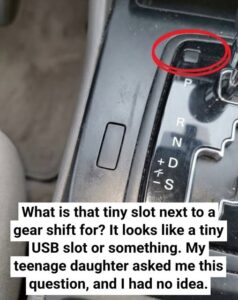
If you’ve ever sat in your car, looked around the center console, and noticed a tiny mysterious slot next to the gear shift, you’re not alone. Most drivers don’t even register it at first. It looks insignificant—almost like a design leftover or something meant for a tool you were never given.
But that small detail has a very important purpose. And once you understand it, you’ll never look at your car the same way again.
For many drivers, especially those who didn’t grow up around cars or only recently started driving, these little hidden features can feel intimidating. Cars are full of buttons, symbols, and compartments that rarely come with clear explanations. Yet, some of them exist for very practical reasons—especially in emergencies.
That tiny slot next to the gear shift is one of them.
A small detail most drivers never notice
At first glance, the slot doesn’t seem important. It’s usually a narrow rectangular opening near the gear selector, sometimes covered with a small plastic cap. In most everyday driving situations, you’ll never touch it. Your car starts normally, shifts normally, and life goes on.
Because of that, many people assume it has no real function.
But it actually does something crucial when things go wrong.
To understand it, it helps to look at how modern automatic transmissions work. Most cars today use an electronic safety system called a shift interlock. This system is designed to prevent the car from being shifted out of “Park” unless certain conditions are met—usually, the brake pedal must be pressed and the ignition must be on.
It’s a safety feature meant to prevent accidents, like a car rolling unexpectedly.
But what happens when the system itself fails?
That’s where the hidden slot comes in.

The shift lock release: your emergency backup system
The tiny slot is called the shift lock release.
Its purpose is simple: it allows you to manually override the gear selector if the electronic system stops working.
This usually becomes necessary in situations like:
- A dead car battery
- Electrical system failure
- A faulty brake switch
- A stuck shift interlock system
When any of these issues occur, your car may refuse to move out of “Park,” even if everything else seems fine.
Without the shift lock release, you could be completely stuck—unable to move the vehicle at all.
With it, you have a manual backup option that can get your car into Neutral so it can be pushed, towed, or restarted safely.
It’s one of those features you hope you never need—but are very grateful for if you do.
How people usually discover it (hint: it’s almost always by accident)
Most drivers don’t learn about the shift lock release in driving school. And unless you’ve read your owner’s manual cover to cover, chances are you won’t hear about it from a salesperson either.
Instead, people usually discover it the hard way.
A common scenario goes like this: you’re running errands, you come back to your car, and suddenly it won’t start. Worse, the gear shift is locked in “Park.” You try everything—pressing the brake, turning the key, restarting—but nothing works.
In that moment, frustration builds quickly.
It’s only later—after calling roadside assistance or searching online—that you realize there was a small manual override built into your car all along.
A simple slot. Right there in plain sight.
Many drivers describe that realization as a mix of relief and disbelief. Relief that there’s a solution, and disbelief that they never knew it existed.
Why this feature exists in the first place
Modern vehicles are designed with layers of safety systems. The shift lock system is part of a broader effort to prevent accidental movement of the car.
Imagine a situation where a child or pet accidentally bumps the gear shift. Without safeguards, that could potentially cause the vehicle to roll. The interlock system ensures that shifting requires deliberate action—usually pressing the brake and engaging the ignition.
However, engineers also know that no system is perfect.
Electronics fail. Batteries die. Sensors malfunction.
So the shift lock release acts as a mechanical “Plan B.”
It’s a reminder that even in highly digital cars, there are still physical backups built into the design—just in case.
How the shift lock release is used in an emergency
While the exact design varies from vehicle to vehicle, the general process is fairly similar.
Typically, the steps involve:
First, making sure the parking brake is engaged so the vehicle doesn’t roll unexpectedly. Then, locating the small cover near the gear shift and carefully removing it. Inside is the manual release slot.
A key, pen, or small tool is usually inserted into the slot while you gently move the gear selector out of “Park” and into “Neutral.”
Once that happens, the car can be moved safely or prepared for towing.
It’s a simple process, but it can feel surprisingly empowering the first time you learn it. Many drivers describe it as discovering a hidden “emergency mode” in their vehicle.
Not every car hides it in the same place
One of the most confusing things about the shift lock release is that it isn’t standardized in appearance.
In some cars, it’s clearly visible next to the gear shift. In others, it’s hidden under a small removable panel. And in newer models with electronic or dial-based shifters, the mechanism may not be visible at all, even though a similar backup system exists internally.
This inconsistency is why so many drivers remain unaware of it.
It’s also why checking your vehicle’s owner manual can be surprisingly useful. That small booklet often contains explanations for features you might otherwise never discover.
A feature you hope to never need—but should know anyway
The shift lock release is not something you’ll use in everyday driving. In fact, if you’re using it regularly, something is wrong and should be inspected by a mechanic.
Think of it like a spare tire. You don’t think about it until you’re stuck on the side of the road. But when the moment comes, it becomes incredibly important.
Car experts recommend treating it strictly as an emergency tool. If your car ever gets stuck in Park, using the release can help you move it temporarily—but the underlying issue still needs attention.
Ignoring it could lead to bigger, more expensive problems later.
Why small details like this matter
It’s easy to overlook features like the shift lock release because modern cars do such a good job of hiding complexity. Most of the time, driving feels effortless. You press a button, shift into Drive, and go.
But behind that simplicity is a carefully designed system full of backups and safeguards.
And sometimes, those backups are hidden in the smallest places.
That tiny slot next to your gear shift is a perfect example. It’s a reminder that even in something as familiar as driving, there are still things to learn—tools designed quietly to protect you when things don’t go as planned.
Final thoughts
Most drivers will never need to use the shift lock release. And that’s a good thing.
But knowing it exists can make a big difference if you ever find yourself stuck in a frustrating situation with a car that refuses to move.
What looks like a random design detail is actually a small but powerful safety feature—one that can save you time, stress, and a costly tow truck call.
So the next time you sit in your car and notice that little slot next to the gear shift, you’ll know exactly what it is.
Not decoration.
Not a mystery.
But a quiet backup system, waiting just in case you ever need it.