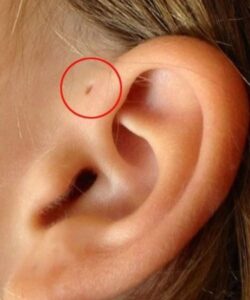
If you’ve ever noticed a small dimple, tiny pit, or subtle hole just in front of someone’s ear, you might have assumed it was the result of a piercing, an old injury, or perhaps even a minor skin condition.
But in reality, this small feature is neither accidental nor harmful. It is a naturally occurring genetic trait that some people are born with—and it has a surprisingly interesting scientific background.
Known medically as a preauricular sinus, this tiny opening near the outer ear has fascinated researchers, anthropologists, and medical professionals for decades. While it is completely harmless, its origin may trace back to very early stages of human development—and possibly even further, into our evolutionary past.
A feature present from birth
A preauricular sinus is a small tract or pit located near where the ear meets the side of the head. It is usually found on one side, although some individuals may have it on both.
This feature is not something that develops over time. Instead, it forms during embryonic development, when the structures of the face and ears are still being shaped in the womb. In most cases, it remains unnoticed throughout a person’s life unless specifically pointed out.
For the vast majority of people who have it, the sinus never causes any problems. It does not affect hearing, balance, or overall health. Many individuals may live their entire lives without realizing they have it.
From a medical standpoint, it is considered a benign congenital variation—meaning it is simply a harmless difference in physical development.

Where it comes from in development
To understand the preauricular sinus, it helps to look at how the human ear forms before birth.
During early fetal development, several small tissue structures called “branchial arches” shape parts of the face, neck, and ears. These structures gradually merge and form the complex anatomy of the outer ear.
Sometimes, during this process, a small portion of tissue does not fully fuse as intended. When this happens, it can leave behind a tiny tract or opening beneath the skin. This is what becomes the preauricular sinus.
In most cases, this leftover structure remains inactive and causes no symptoms. However, in rare instances, it may become slightly inflamed or infected, typically requiring only simple medical treatment.
Despite its unusual appearance, it is not a defect or disorder—it is simply a variation in how human development unfolds.
Is it linked to evolution?
One of the most widely discussed aspects of the preauricular sinus is its possible connection to human evolution.
In his book Your Inner Fish, American paleontologist Neil Shubin explores the idea that many features of the human body can be traced back to ancient ancestors. He explains how certain developmental patterns in humans resemble those found in distant species, including fish.
The preauricular sinus is sometimes referenced in this context because of its location and embryological origin. Some researchers have speculated that it may be a “vestigial remnant”—a leftover trace from ancient anatomical structures that were more functional in earlier stages of evolution.
One theory suggests that these structures could be linked to primitive gill-like formations seen in early vertebrate ancestors. While modern humans do not have gills, the early embryonic structures that form parts of the ear and throat share similarities with these ancient biological patterns.
However, it is important to emphasize that this remains a theoretical interpretation. There is no scientific consensus that the preauricular sinus is directly related to gills or aquatic ancestors. Instead, it is more accurately understood as part of the shared developmental blueprint that all vertebrates carry.
In other words, while the idea is fascinating, it is not confirmed fact—rather, it is an example of how evolution leaves subtle traces in biology that continue to intrigue scientists.

How common is it?
The preauricular sinus does not appear in everyone. In fact, its prevalence varies significantly across different populations around the world.
Research has shown approximate occurrence rates such as:
- Africa: Around 10% of people may have it, the highest recorded rate
- Asia: Approximately 4%
- United Kingdom: About 0.9%
- United States: Roughly 0.1%, one of the lowest reported rates
These differences suggest that genetics play a strong role in whether the trait appears. Certain inherited factors make it more likely to occur in specific populations, while it remains extremely rare in others.
Despite these variations, it is found across all ethnic groups and regions, reinforcing the fact that it is a natural part of human diversity.
Is it something to worry about?
In nearly all cases, the answer is no.
A preauricular sinus is considered completely harmless. It does not indicate illness, infection, or abnormal development. Most people never experience any symptoms at all.
In rare situations, the small opening can become blocked or infected. When that happens, it may cause mild swelling, redness, or discomfort near the ear. These cases are typically easy to treat with standard medical care, and only a small number require surgical removal.
For the overwhelming majority of people, however, no treatment is ever needed.
It is simply a small anatomical variation—no different from having a slightly different fingerprint pattern or a unique earlobe shape.
A reminder of human history in our bodies
What makes the preauricular sinus particularly interesting is not its medical significance, but what it represents in a broader biological sense.
Human beings carry countless subtle traits like this—features that exist not because they serve a clear modern function, but because they are part of the long and complex process of development and evolution.
From the structure of our bones to the way our organs form in the womb, the human body contains layers of history. Each layer reflects changes that occurred over millions of years.
The preauricular sinus is one of those quiet reminders. It is small, often unnoticed, and medically insignificant—but it reflects the intricate process that shapes every human life before birth.
Final thoughts
While it may look unusual at first glance, the small hole or mark near the ear is nothing to be concerned about. It is a naturally occurring trait known as a preauricular sinus, formed during early development and found in a small percentage of the global population.
Scientific theories have linked it to fascinating ideas about evolution and ancient biology, but its exact significance remains a topic of ongoing study rather than confirmed fact.
What is certain, however, is that it is harmless, common in some regions, rare in others, and entirely part of human variation.
In the end, it serves as a subtle reminder that the human body is not only complex—but also deeply connected to its ancient past.