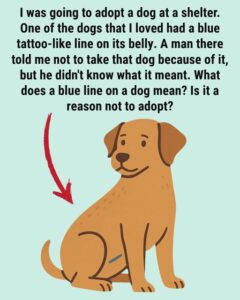
If you’ve ever noticed a faint blue line on a dog’s belly — usually near the lower abdomen — you may have paused for a second. It’s subtle. Sometimes partially hidden by fur. Sometimes barely visible unless you’re looking for it.
And the first thought that crosses many people’s minds is simple:
“Wait… is that a tattoo?”
The idea of a dog having a tattoo can sound strange if you’re not familiar with veterinary practices. It may even raise concern at first glance. Why would someone tattoo a dog? Is it decorative? Is it some kind of ownership mark?
The answer is much simpler — and much more practical — than most people expect.
That small blue line typically indicates that the dog has been spayed or neutered.
That’s it.
It’s not cosmetic. It’s not symbolic. It’s not a fashion choice. It’s a medical identifier — a quiet, functional mark used to communicate important information for the dog’s lifetime.
But the reason behind that tiny line is more thoughtful than many people realize. Let’s explore why veterinarians use it, how it’s applied, why it matters years down the road, and what it says about responsible pet care.
What Exactly Is the Blue Line?
The “blue line” is a small tattoo placed on a dog’s abdomen at the time of a spay or neuter procedure.
It’s usually:
-
A short, thin line
-
Blue or green in color
-
Positioned near the surgical incision
-
Applied while the dog is already under anesthesia
It is not decorative. It’s not meant to be artistic. It doesn’t include names, symbols, or elaborate designs.
It’s simply a permanent visual indicator that sterilization surgery has been completed.
In veterinary settings, this practice is widely recognized as a helpful safeguard — particularly for shelters, rescues, and clinics that may encounter dogs with unknown histories.
Why Is the Tattoo Necessary?
At first glance, you might wonder: isn’t the surgery itself enough?
After a spay (for females) or neuter (for males), there is a surgical incision. Wouldn’t that scar be enough proof?
Not necessarily.
Over time, scars can fade significantly — especially once fur grows back. In some dogs, especially those with thick or dark coats, surgical evidence becomes nearly impossible to see.
Years later, there may be no obvious external sign that a dog has been sterilized.
Now imagine this scenario:
A dog is found as a stray and brought into a shelter. There’s no paperwork. No medical records. No known history.
Without clear documentation, how can staff determine whether the dog has already been spayed or neutered?
Performing exploratory surgery just to check would be:
-
Unnecessary
-
Risky
-
Stressful for the animal
-
Financially costly
The small tattoo eliminates that uncertainty immediately.
It provides clear, visible confirmation — without guesswork.
Why Blue?
The color is typically blue or green because it contrasts well against most skin tones and fur colors.
It needs to be:
-
Visible
-
Recognizable
-
Long-lasting
Blue ink stands out clearly on light and dark skin alike. It does not blend in naturally with a dog’s pigmentation, which makes it easy to identify during a physical exam.
The goal is clarity, not aesthetics.
Is It Painful?
This is a common concern — and an understandable one.
However, the tattoo is applied while the dog is already under anesthesia during the spay or neuter surgery.
The animal does not feel it being placed.
It’s not a separate procedure. It’s not done while the dog is awake. It doesn’t involve prolonged discomfort.
The process is quick and minor compared to the surgery itself.
In fact, because it is applied at the same time as the operation, it does not add additional recovery stress.
Why Not Just Rely on Microchips?
Microchips are extremely valuable tools for identification and reunification with owners. However, they serve a different purpose.
Microchips:
-
Identify ownership
-
Store contact information
-
Require a scanner to read
A tattoo, by contrast, is:
-
Immediately visible
-
Permanent
-
Not dependent on technology
Not every facility has immediate access to scanning equipment. Not every dog is scanned right away. And microchip databases may not always include complete medical histories.
Additionally, records can be lost over time. Owners move. Clinics close. Files are misplaced. Paperwork does not always follow a dog throughout its life.
The tattoo acts as a simple visual backup.
It doesn’t replace documentation — it supplements it.
A Marker for Future Care
The blue line isn’t primarily for the owner. It’s for future caretakers.
Years later, that dog may:
-
Change households
-
Be surrendered to a shelter
-
Be rescued from a stray situation
-
Visit a new veterinary clinic
In any of those scenarios, clear medical indicators are helpful.
When a veterinarian sees that small line, they instantly know:
“This dog has already been sterilized.”
That clarity prevents unnecessary procedures and protects the dog’s well-being.
Is It Required Everywhere?
Not all veterinary clinics use tattoos as standard practice.
Some do it routinely. Others offer it upon request. In certain regions, it is more common in shelters and high-volume spay/neuter programs than in private practices.
Policies vary depending on:
-
Geographic location
-
Clinic philosophy
-
Regional guidelines
-
Shelter protocols
However, many professionals consider it a best practice — especially in rescue and adoption environments.
The Role of Spaying and Neutering
Understanding the tattoo also means understanding why sterilization itself is important.
Spaying and neutering:
-
Help prevent unintended litters
-
Reduce certain health risks
-
Support population management efforts
-
May influence some behavioral tendencies
Animal welfare organizations widely support responsible sterilization to help reduce overcrowding in shelters.
The tattoo quietly signals that this step has already been taken.
Why Scars Aren’t Enough
Many people assume surgical scars are permanent and obvious.
But in reality:
-
Fur regrows.
-
Skin heals smoothly.
-
Incision lines fade.
Especially in younger animals, healing can be so clean that visual evidence becomes nearly invisible.
Additionally, some dogs may have had laparoscopic procedures, which leave even smaller incisions.
Without a tattoo, it can become difficult to confirm surgery status with certainty.
The Importance for Shelters and Rescues
Animal shelters often receive dogs with incomplete or unknown histories.
When intake staff assess a new arrival, they need quick answers to key questions:
-
Is this dog already sterilized?
-
Does this dog need surgery?
-
Is it safe to place this dog for adoption without further procedures?
A visible tattoo simplifies that process.
It:
-
Saves time
-
Reduces stress
-
Avoids duplicate surgeries
-
Protects limited shelter resources
For high-volume facilities, clarity matters.
Addressing Common Misconceptions
Because the tattoo is subtle and not widely discussed outside veterinary circles, it can spark confusion.
Here are some common misunderstandings:
“Is it decorative?”
No. It serves a medical identification purpose only.
“Is it branding?”
No. It is not an ownership mark or branding practice.
“Is it done separately?”
No. It’s done during the sterilization procedure while the dog is under anesthesia.
“Does it hurt later?”
Healing is minimal and typically uneventful.
Education helps eliminate unnecessary concern.
Why It’s Usually Near the Belly
The tattoo is typically placed on the lower abdomen because that’s where the spay incision occurs.
This placement:
-
Keeps it discreet
-
Keeps it relevant to the procedure site
-
Ensures easy identification during exams
It’s not visible in everyday situations. It’s usually only seen during grooming, veterinary visits, or when the dog is lying on its back.
It’s practical, not public-facing.
Is It Always a Line?
In many cases, yes — just a simple line.
However, variations exist:
-
A small green line
-
A short blue dash
-
Occasionally a tiny symbol (depending on clinic policy)
But the vast majority are minimal marks.
The simplicity is intentional.
Why It Matters Years Later
The true value of the tattoo may not be obvious immediately after surgery.
It matters most:
-
Years down the line
-
When records are incomplete
-
When ownership changes
-
When emergency care is required
In those moments, that small mark provides clarity.
It prevents unnecessary anesthesia, surgical exploration, and stress.
It’s a tiny detail with long-term impact.
A Quiet Sign of Responsible Care
Seeing a blue line can also quietly reflect responsible pet ownership.
It indicates that:
-
The dog has received veterinary care
-
Preventive measures were taken
-
Health and population concerns were considered
While it’s not a badge or a status symbol, it does represent a thoughtful decision made at some point in the dog’s life.
Why Some People Ask About It
Interestingly, the tattoo sometimes raises more questions than other visible pet accessories.
People may overlook:
-
Collars
-
Vests
-
Identification tags
But a small tattoo line sparks curiosity.
Perhaps because tattoos are commonly associated with personal expression in humans, seeing one on a dog prompts questions.
But once explained, the mystery disappears.
Should You Choose It?
If your veterinarian offers the option when scheduling a spay or neuter procedure, many professionals recommend saying yes.
Reasons include:
-
It adds minimal time to the procedure
-
It causes no additional discomfort
-
It provides lifetime clarity
-
It may prevent unnecessary future surgery
It’s a simple preventative measure.
The Bigger Picture: Communication in Veterinary Medicine
Veterinary care often relies on both documentation and physical indicators.
While digital records are improving, permanent visual markers still serve a purpose.
The tattoo represents:
-
Efficient communication
-
Long-term thinking
-
Practical medical planning
It’s a quiet example of preventive care design.
Why It’s Not Widely Known
Many owners never notice the tattoo — especially if they’re not looking closely.
It’s subtle. Discreet. Not discussed often.
Unlike microchips or collars, it doesn’t require maintenance or attention.
It simply exists as background information.
That’s part of its effectiveness.
Final Thoughts
That small blue line on a dog’s belly isn’t decorative. It isn’t cosmetic. It isn’t unusual.
It’s a practical, thoughtful marker placed during sterilization surgery to communicate a simple but important message:
“This dog has already been spayed or neutered.”
It prevents confusion. It protects the animal. It supports responsible care.
Sometimes, the smallest details carry the most meaning — even if they’re only visible for a moment.
So if you ever notice that faint blue line, you don’t have to wonder anymore.
It’s not mysterious. It’s not alarming.
It’s simply a quiet, permanent note — written in blue — that says, “Already done.”