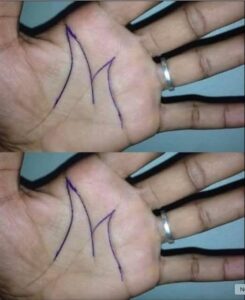
Human hands are extraordinary instruments, enabling everything from delicate artistry to precise engineering. Alongside their physical capabilities, palms carry a complex network of lines, creases, and ridges. These patterns have fascinated people for centuries and have been interpreted in many different ways across cultures. Among these markings, one of the most intriguing is the shape resembling the letter “M” formed by the intersections of major lines on the palm.
While some consider these patterns purely anatomical, others—especially enthusiasts of palmistry—believe they hold symbolic meaning related to personality, intuition, and life paths. Exploring the origins, interpretations, and science behind the “M” pattern offers insights into both human biology and cultural traditions.
The Anatomy of Palm Lines
The lines on human palms develop as a result of genetics, hand movement, and fetal growth in the womb. Every individual has a unique set of creases, just like fingerprints. These lines do not serve a functional purpose for gripping or dexterity; rather, they reflect the complex folding and stretching of skin over the hand’s muscles and joints.
The major lines of the palm are typically categorized as:
- The Heart Line – This line runs horizontally across the upper palm and is traditionally associated with emotional tendencies, relationships, and the way a person expresses love or compassion. Its curvature, depth, and length are interpreted in palmistry as reflections of openness, warmth, or emotional reserve.
- The Head Line – Positioned below the heart line, it symbolizes thinking style, intellect, and decision-making. In palmistry, a straight line may indicate analytical tendencies, while a curved line suggests creativity or intuition.
- The Life Line – Curving around the base of the thumb, it does not predict lifespan as commonly believed. Instead, it reflects vitality, energy levels, and the potential for major life changes.
- The Fate Line – Running vertically toward the middle finger, this line is associated with career direction, external influences, and life purpose. Some people have a strong fate line, while others may lack one entirely, which palmists interpret as a sign of flexibility rather than aimlessness.
- The Sun Line (Apollo Line) – Linked to creativity, fulfillment, and recognition, a distinct sun line is seen as a sign of artistic expression or achievement satisfaction.
The combination of these lines, along with their intersections, can produce distinctive patterns. One of the most celebrated is the “M” shape.

What the “M” Shape Represents in Palmistry
The “M” pattern emerges when major lines—usually the heart, head, life, and occasionally the fate or sun lines—intersect in a specific way. In palmistry, this formation is often viewed as a symbol of:
- Heightened intuition and perceptiveness
- Leadership abilities
- Confidence and determination
- The potential for professional or personal success
Some sources claim that only a small percentage of people display this pattern, though such statistics are anecdotal rather than scientifically verified. Despite the lack of empirical evidence, the “M” shape has become popular in cultural discussions about hand markings, often highlighted in social media and lifestyle articles.

Palmistry: Tradition and Cultural Context
Palmistry, also known as chiromancy, is an ancient practice with roots in India, China, Egypt, Greece, and the Middle East. Historically, it was used alongside astrology, numerology, and other symbolic systems to provide insights into human nature, tendencies, and possible life paths.
It is crucial to recognize that palmistry is a cultural and interpretive tradition, not a scientific discipline. Modern research has not found evidence linking palm lines with intelligence, success, or specific personality traits. Instead, palm lines reflect biological development, including genetic and environmental factors.
Palmists themselves often emphasize that readings are interpretive rather than predictive. Lines may indicate tendencies, emotional patterns, or potential challenges, but they are not deterministic. Just as every fingerprint is unique, every set of palm lines is distinct, yet interpretations remain subjective.
Clarifying Misconceptions: The Simian Line
A common point of confusion is the Simian line, medically known as the single transverse palmar crease. Unlike the “M” pattern, the Simian line is a single crease formed when the heart and head lines merge. While it occurs naturally in a small percentage of people, it has no scientific connection to personality or life outcomes.
Medical studies note that the Simian line can appear in certain genetic conditions, though it also occurs in healthy individuals. Its presence has inspired symbolic interpretations in palmistry, often associated with focus, willpower, or intensity, but these meanings are cultural rather than empirical.
Dominant vs. Non-Dominant Hands
Palmistry also differentiates between dominant and non-dominant hands. Traditionally:
- The non-dominant hand represents inherited traits, potential, and inner character.
- The dominant hand reflects how these traits manifest through choices and actions.
Right-handed individuals are generally considered to have the left hand as the “inner” hand and the right as the “outer” hand. For left-handed people, these interpretations are reversed. Again, this framework is symbolic and interpretive rather than scientifically validated.
The Popularity of the “M” Pattern
Cultural fascination with the “M” shape has grown, in part, because of celebrity examples. Public figures like Meghan Markle have been highlighted by palmistry enthusiasts for possessing this marking. Palm readers often describe the pattern as signifying sensitivity, focus, and determination.
For instance, lifestyle publications have cited palm reader Gary Markwick, who interprets individuals with an “M” formation on both hands as highly goal-oriented and able to read situations and people effectively. While these interpretations add interest and intrigue, it is important to note that they are symbolic rather than predictive.
Beyond palmistry, public achievements—such as Markle’s career in acting, advocacy, and co-founding the Archewell Foundation—are clearly influenced by education, opportunity, determination, and social engagement rather than palm markings.
Why Palmistry Continues to Fascinate
Despite lacking scientific evidence, palmistry remains popular worldwide because it is personal and reflective. Observing one’s hands creates an immediate, tangible connection to the self, and interpretations often resonate emotionally.
Psychologists suggest that palmistry appeals in a manner similar to personality quizzes. It encourages introspection, self-awareness, and storytelling. For many, it functions as a symbolic tool for reflection, helping people consider their tendencies, strengths, and potential choices.
Palm lines also capture imagination because each hand is unique. Even individuals who do not believe in palmistry may find value in noticing subtle patterns, fostering curiosity about anatomy, genetics, and development.
Biological Origins of Palm Lines
From a scientific perspective, palm lines are the result of:
- Genetics: Inherited traits influence the number, depth, and orientation of creases.
- Hand movement: Repeated motion during fetal development contributes to line formation.
- Skin structure: Differences in collagen and skin elasticity shape the appearance of creases.
This combination ensures that no two palms are alike, making each hand an individualized map of biological growth rather than a predictor of future events.
Interpretation vs. Reality
While palmistry assigns meaning to the “M” shape and other patterns, it is essential to approach interpretations with balance.
- Interpretive value: Can inspire reflection, storytelling, and self-awareness.
- Scientific limitations: There is no evidence linking palm creases to intelligence, destiny, or personality traits.
- Cultural relevance: Patterns like the “M” shape hold symbolic significance in palmistry traditions but are not universal truths.
Responsible engagement with palmistry involves understanding it as a cultural, symbolic, and psychological practice rather than a predictive science.
Observing Your Own Palms
Looking closely at your palms can be an enlightening experience. Even without assigning symbolic meaning, the lines, creases, and ridges tell a story of growth, movement, and individuality. They reflect the unique way your hands have developed and the actions you have performed throughout life.
The next time you examine your hands:
- Notice the intersections of the major lines.
- Observe whether any patterns resemble shapes, such as an “M.”
- Reflect on the story your hands may tell about growth, flexibility, and resilience.
For those who enjoy palmistry, interpretations can provide a framework for self-reflection. For others, palms are a fascinating example of human anatomy and individuality.
The Broader Perspective
The fascination with palm lines, and the “M” pattern in particular, highlights how humans seek meaning in natural phenomena. Across cultures, people have explored symbolic interpretations of hands, stars, faces, and other observable traits.
Whether viewed scientifically or symbolically, palms offer insights into uniqueness, personal history, and human development. The “M” pattern, while culturally significant in palmistry, is one example of how physical features can spark curiosity, reflection, and discussion.
By studying palms, we can appreciate:
- Biological complexity: How genetics and development shape anatomy.
- Cultural symbolism: How societies create meaning and narrative from observable traits.
- Personal insight: How self-reflection can be inspired by simple observation.
Conclusion: Appreciating the Patterns in Your Hands
The “M” shape on palms may not determine destiny or predict success, yet it captures attention because it represents something unique and visually intriguing. It serves as a reminder of the complexity of human anatomy, the diversity of genetic expression, and the enduring fascination with symbolism.
Palmistry traditions provide a rich framework for interpreting patterns, encouraging curiosity, self-reflection, and dialogue. Even in a modern, scientific world, these interpretations continue to captivate because they connect people to their own hands in a tangible, immediate way.
Ultimately, whether you view palm lines as meaningful symbols or fascinating biological features, they remind us of individuality and the subtle intricacies of human development. Your palms carry a personal story, shaped by genetics, movement, and experience—an ever-present canvas illustrating growth, uniqueness, and potential.
So the next time you glance at your hands, take a moment to observe. Notice the lines, creases, and patterns. Whether you see shapes, inspiration, or simply biology at work, your palms reflect a lifetime of movement, development, and individuality.