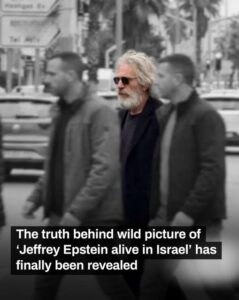
The image spread fast—faster than most people had time to question it.
A grey-haired man in sunglasses, walking casually through what looked like a sunny street in Tel Aviv. The caption was simple, almost provocative: “Jeffrey Epstein alive in Israel.” Within hours, it was everywhere. Shared, reshared, debated, believed.
For many, it didn’t come out of nowhere. The name Jeffrey Epstein has long carried a shadow of unanswered questions. Ever since his death in 2019, suspicion has lingered in public conversations, fueled by his powerful connections and the scale of his crimes. So when a photo appeared that seemed to challenge the official narrative, it found an audience ready to believe.
The claims were bold. Some posts insisted the man had been “spotted walking freely in Tel Aviv.” Others framed it as proof of a larger cover-up. A few even claimed there was digital evidence—suggesting his online gaming activity had resurfaced overseas.
At a glance, the image looked convincing. Natural lighting. Realistic posture. Familiar facial structure. Just enough resemblance to raise doubt.
But the truth, as it turned out, was far less mysterious—and far more modern.
Digital analysts quickly stepped in, using tools designed to detect manipulated media. Among them, systems developed by Google identified clear signs that the image had not been captured by a camera at all.
It had been created.
Artificial intelligence, to be precise.
Experts pointed to subtle inconsistencies—details most viewers wouldn’t consciously notice, but that algorithms and trained eyes can detect almost instantly. The shadows didn’t align correctly. The facial textures appeared slightly unnatural under close inspection. Background elements showed faint distortions, the kind often left behind by automated image generation.
Earlier versions of the image had reportedly contained a watermark linked to AI software, later cropped out before the picture began circulating widely.
In other words, the photo wasn’t evidence of a hidden truth. It was a product of increasingly sophisticated technology.
At the same time, another claim began spreading alongside it—this one tied to gaming. According to online posts, an account allegedly linked to Epstein had recently been active, supposedly traced to Israel through the popular video game Fortnite.
That rumor, too, unraveled quickly.
The game’s developer, Epic Games, issued a clarification: the account in question did not belong to Epstein. Instead, it had been created by an unrelated user who changed their username to mimic the name circulating in public discussions. Tracking platforms, which only display current usernames, amplified the confusion. New accounts were even created to imitate the identity further once the rumor gained traction.
What appeared to be digital “proof” turned out to be little more than a coordinated illusion—part misunderstanding, part deliberate misdirection.
Still, the speed at which these claims spread says something deeper.
Stories like this don’t gain attention solely because of the images themselves. They resonate because they tap into existing doubt. Epstein’s death—ruled a suicide by officials—has remained a focal point of public skepticism for years. When new documents surface or discussions resurface, the uncertainty returns with them.
In that environment, even a single convincing image can ignite a wave of belief.
And today, creating that image no longer requires advanced technical skill. AI tools have made it possible to generate realistic visuals in minutes—images that look authentic enough to pass through social media unchecked, especially when paired with emotionally charged narratives.
That combination is powerful.
But in this case, the conclusion is clear.
There is no credible evidence that Jeffrey Epstein is alive, in Israel or anywhere else. The viral images were artificially generated. The gaming claims were fabricated. What spread online wasn’t a hidden truth—it was a reflection of how easily misinformation can take shape in the digital age.
And perhaps more importantly, how quickly it can feel real.