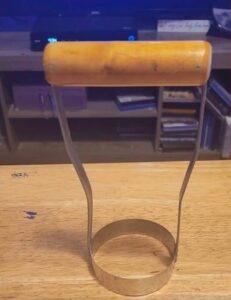
In many kitchens today, food preparation is fast, electric, and increasingly automated. Blenders hum, food processors whir, and chopping vegetables can be done in seconds with the press of a button. Yet long before modern appliances took over, home cooking depended on tools that were simple, durable, and built for everyday use.
Among those tools, one stood out for its ingenuity and practicality: the Kwik-Kut Deluxe Food Chopper.
Though it may not be widely recognized today, this small hand-crank device once played a meaningful role in kitchens across the United States. For decades, it represented efficiency, affordability, and the kind of hands-on cooking that defined early 20th-century home life.
A Simple Idea That Changed Daily Cooking
The Kwik-Kut Deluxe Food Chopper first appeared in American households in the early 1900s, a time when most food preparation was done entirely by hand. Chopping vegetables, fruits, herbs, and nuts required time, patience, and considerable effort. For many families, especially those preparing meals daily for large households, this process was one of the most time-consuming parts of cooking.
The Kwik-Kut offered a straightforward solution.
At its core, the device was designed around a simple idea: reduce repetitive knife work through mechanical motion. It featured a metal cylinder that housed a rotating blade system. Food items were placed inside the chamber, and a hand crank on the exterior was turned to activate the internal blades. With each rotation, the blades chopped the ingredients into smaller, more uniform pieces.
What made this design remarkable was not its complexity, but its simplicity. There were no electrical components, no complicated settings, and no fragile parts that required specialized care. It was a tool that relied entirely on human effort—yet made that effort significantly more efficient.

A Kitchen Companion for Everyday Life
For many households in the early 20th century, the Kwik-Kut Deluxe Food Chopper quickly became an essential kitchen companion. It was especially valued in homes where cooking was done from scratch, often multiple times a day.
Vegetables for soups could be chopped in seconds. Nuts for baking could be processed evenly. Fruits could be prepared for preserves or desserts with minimal effort. Even onions—one of the most tedious ingredients to chop by hand—became easier to manage.
What users appreciated most was consistency. Unlike hand chopping, which could vary in size and texture depending on speed and skill, the Kwik-Kut produced uniform pieces. This not only improved cooking efficiency but also enhanced the appearance and texture of finished dishes.
In many ways, the device reflected a growing shift in domestic life during that era: a desire to simplify household tasks without sacrificing quality.
Design Built on Practical Engineering
The Kwik-Kut Deluxe Food Chopper was not just functional—it was thoughtfully engineered.
Its cylindrical metal body provided durability and stability, allowing it to withstand repeated daily use. Inside, a set of sharp blades rotated in a controlled motion when the handle was turned. The mechanism ensured that food was drawn evenly toward the blades, reducing waste and improving cutting precision.
One of the key strengths of the design was its ease of maintenance. Unlike more complex machinery, the Kwik-Kut could be disassembled for cleaning without specialized tools. This made it particularly appealing in an era when hygiene in food preparation was becoming increasingly important.
Its simplicity also meant fewer points of failure. There were no motors to burn out or electrical systems to malfunction. As a result, many units lasted for years—even decades—often passed down through families.
Evolution Through the Decades
Although the core concept of the Kwik-Kut remained unchanged, the device did evolve over time to meet changing household needs.
By the 1930s, manufacturers began refining its design. The base was widened for improved stability, and the handle was extended to provide better leverage. These adjustments made the chopping process smoother and reduced physical effort, especially when processing tougher ingredients.
In the 1950s, further updates reflected broader trends in kitchen design. Materials became lighter, and some models incorporated plastic components, particularly in the handle. This modernization helped reduce production costs while maintaining the durability of the core metal structure.
Despite these updates, the fundamental operation remained the same. Users still relied on the hand crank, the rotating blades, and the simple mechanical advantage that made the device so effective in the first place.
These gradual improvements allowed the Kwik-Kut Deluxe to remain relevant for decades, even as new technologies began entering the kitchen.

The Rise of Electric Appliances and a Changing Era
As the 20th century progressed, kitchens began to change dramatically. Post-war innovation brought a wave of electric appliances designed to reduce manual labor. Food processors, electric blenders, and automated choppers began to replace traditional hand-operated tools.
These new devices offered speed and convenience that manual tools could not match. With the push of a button, users could achieve results in seconds that once required physical effort.
Gradually, the Kwik-Kut Deluxe Food Chopper began to disappear from mainstream kitchens.
It was not that the tool stopped working or lost its usefulness. Rather, it was overtaken by a cultural shift toward automation and convenience. Kitchens became more technologically advanced, and older manual tools were often set aside in favor of newer innovations.
By the late 20th century, the Kwik-Kut had largely faded from store shelves and advertising.
A Tool That Never Truly Disappeared
Despite its decline in popularity, the Kwik-Kut Deluxe Food Chopper never fully disappeared.
In some households, it remained in regular use—often because it still worked perfectly after decades of service. Many families kept their original choppers as dependable backup tools, especially for small or quick kitchen tasks where using a large electric appliance felt unnecessary.
In other homes, the device became a nostalgic keepsake. It represented a time when cooking was slower, more intentional, and deeply connected to daily life. For some, it carried sentimental value, reminding them of parents or grandparents who once used it regularly.
Collectors and vintage kitchenware enthusiasts also helped preserve its legacy. The Kwik-Kut is now often seen in antique shops, estate sales, and online marketplaces, where it is appreciated not just as a tool, but as a piece of domestic history.
Why It Still Matters Today
Even in modern kitchens filled with advanced appliances, the Kwik-Kut Deluxe Food Chopper offers lessons that remain relevant.
It represents an era when tools were designed to be practical, long-lasting, and easy to maintain. It shows how thoughtful engineering can solve everyday problems without unnecessary complexity. And it highlights the value of durability in a world where many products are designed for short-term use.
There is also a growing appreciation today for manual kitchen tools. Many home cooks have begun returning to simpler equipment for certain tasks, valuing control, quiet operation, and reliability. In that sense, the Kwik-Kut is not just a relic of the past—it is part of a broader conversation about how we cook and what we value in the kitchen.
Conclusion: A Quiet Legacy of Simplicity
The Kwik-Kut Deluxe Food Chopper may no longer hold a prominent place in modern kitchens, but its legacy remains significant. For decades, it helped families prepare meals more efficiently, bringing simplicity and structure to daily cooking routines.
Its design was straightforward, its purpose clear, and its impact lasting. While technology has moved forward, the principles behind the Kwik-Kut—efficiency, durability, and practicality—continue to influence kitchen tools today.
In the end, it stands as a reminder that innovation does not always mean complexity. Sometimes, the most enduring solutions are the simplest ones—built not to impress, but to quietly and reliably serve generations of everyday life.