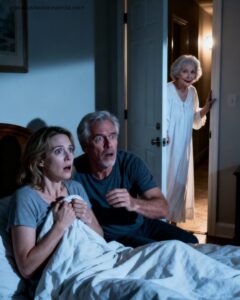
When Liam and I married, our life together started quietly and sweetly in a small Boston home. We spent evenings cooking simple meals, talking about the future, and feeling grateful for the calm after a whirlwind courtship. But not long after we moved in, something began happening that disturbed that peace — something small at first, but impossible to ignore.
Every night, exactly at 3 a.m., there came three soft, steady knocks on our bedroom door.
Knock. Knock. Knock.
They weren’t loud or frantic — just quiet, deliberate, and unnervingly precise.
Each time, I would wake with my heart pounding, listening in the darkness. When I opened the door, the hallway was empty — dim, still, and silent.
At first, I thought I’d imagined it. But then it happened again. And again. Always three knocks. Always at the same time.
The Unsettling Pattern
My mother-in-law, Margaret, had moved in with us a few months earlier after a fall made it hard for her to live alone. She was kind in her own way, though distant and unpredictable — a woman who smiled politely but whose eyes always seemed elsewhere.
When I told Liam about the knocks, he brushed it off.
“Mom’s been restless lately,” he said. “She doesn’t sleep much. Probably just walking around.”
I wanted to believe that. But as the nights went on, my unease deepened. I began to dread 3 a.m., knowing that the gentle tapping would come again, followed by silence that seemed to swallow the air.
After nearly a month, curiosity won over fear. I decided to find out what was really happening.
The Hidden Camera
Without telling Liam, I bought a small camera and tucked it near the top of our bedroom door. I felt a little guilty, but I needed answers.
That night, I stayed perfectly still when the sound came — three taps, soft but clear. I didn’t move, didn’t breathe, waiting until the morning light slipped through the curtains.
When I finally watched the footage, my breath caught.
There was Margaret — pale in her long white nightgown, walking slowly down the hallway. She stopped outside our door, glanced around, and knocked three times. Then she just stood there.
Ten long minutes passed. She didn’t move, didn’t speak, just stared at the door like she was waiting for something — or someone — to answer. Then she turned and drifted away into the dark.
I felt a chill run through me.
When I showed Liam, his face turned white.
“You knew something about this,” I said quietly.
He hesitated. “Mom doesn’t mean any harm,” he murmured. “She just… has her reasons.”
But he wouldn’t tell me what they were.
Searching for Answers
That afternoon, I went to Margaret directly. She was in the living room, sipping tea as if nothing in the world was wrong.
“I know about the knocks,” I said gently. “We saw the video. I just want to understand why.”
Her eyes lifted to mine — calm, sharp, and unreadable.
“What do you think I’m doing?” she asked, her voice almost a whisper.
Before I could answer, she stood and quietly walked away.
That night, I reviewed the rest of the footage. My hands shook as I pressed play.
After knocking, she reached into her pocket and pulled out a small silver key. She held it against our door lock — not turning it, just holding it there for a few seconds — before slipping it back into her pocket and walking off.
It was as if she was checking the door, not trying to open it. But why?
The Secret in the Notebook
The next morning, desperate for clarity, I searched Liam’s nightstand. Tucked between books was a worn notebook. One entry read:
“Mom still checks the doors every night. Says she hears noises, but I never hear anything. She asked me not to worry, but I think she’s hiding something.”
When Liam found me holding the notebook, he finally told me everything.
After his father passed away years earlier, his mother began struggling with anxiety and severe insomnia. She became obsessed with checking doors and windows, convinced that someone might break in.
Recently, she’d begun saying strange things like, ‘I have to keep Liam safe from her.’
I froze. “From me?” I whispered.
He nodded, guilt clouding his face.
That night, fear kept me awake long after the house had gone quiet. What if one night, she didn’t just knock?
Facing the Truth
I told Liam I couldn’t stay unless he found her help. To his credit, he agreed.
A few days later, we took Margaret to a psychiatrist in Cambridge. She sat quietly through the appointment, hands folded, eyes downcast.
When the doctor gently asked what she thought was happening at night, her voice trembled.
“I have to make sure he’s safe,” she said. “He’ll come back. I can’t lose my son again.”
Later, the doctor spoke to us privately. Thirty years ago, he explained, Margaret and her husband had lived in upstate New York. One night, an intruder broke into their home. Her husband confronted the man — and didn’t survive.
From that night forward, she had lived in fear that the intruder would return. When I entered Liam’s life, that fear latched onto me. She didn’t truly see me — she saw a stranger who might take her son away, just as tragedy had before.
I felt a wave of sorrow and guilt. I had feared her, but she had been living in fear all along.
A Family Begins to Heal
The doctor recommended therapy, medication, and — most importantly — patience. “Trauma doesn’t disappear,” he said softly. “But love and consistency can help quiet it.”
That evening, Margaret approached me in tears. “I don’t want to scare you,” she whispered. “I just want to make sure my son is safe.”
For the first time, I reached for her hand. “You don’t have to knock anymore,” I said gently. “We’re all safe now.”
She cried, not with anger, but with relief.
Finding Peace Together
The following weeks were not easy. There were still nights when she woke and thought she heard footsteps, moments when fear flickered in her eyes. But little by little, we built new habits.
Every evening, the three of us checked the doors together — not out of fear, but as a shared ritual of reassurance. We installed smart locks, made tea, and talked before bed. Slowly, the knocking stopped.
Margaret’s laughter returned. Her eyes softened. The house felt lighter, filled again with warmth instead of worry.
The doctor called it progress. I called it peace.
And in time, I learned something that changed how I saw her — and people in general.
Healing someone doesn’t mean fixing them. It means walking beside them, through fear and memory, until they find their way back to the light.