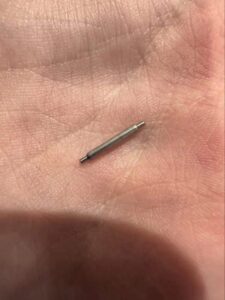
Sometimes, we encounter objects so small and seemingly ordinary that their significance isn’t immediately clear. A minuscule piece of metal—perhaps a pin, clip, bracket, or spring—might appear entirely mundane, lying quietly among other household or industrial items. Its unremarkable size and lack of moving parts can make it easy to overlook, yet these tiny components often perform vital functions that are critical to the operation of larger systems.
Despite their simplicity, these small metal artifacts embody decades of engineering knowledge, precise craftsmanship, and careful material selection. Each component, no matter how small, is designed to withstand stress, ensure safety, or facilitate mechanical function. The story of these unassuming pieces reveals a deep connection between design, functionality, and human ingenuity.
The Science of Small Components
At first glance, a tiny metal piece may seem insignificant, yet its design is anything but simple. Engineers carefully consider every aspect of a small component: its material, shape, size, and strength. Micrometer-level precision is often required to ensure it fits perfectly into a larger assembly, where even the slightest deviation can cause malfunction or failure.
The choice of material is deliberate. Metals such as stainless steel, aluminum, brass, titanium, or specialized alloys are selected based on their durability, resistance to corrosion, thermal properties, and mechanical performance. Even objects that appear identical to the naked eye may have subtle differences, such as surface coatings or hardness levels, tailored to the specific demands of their role.
Some components are fasteners or connectors, responsible for holding larger structures together. A single misplaced pin or bracket can compromise an entire machine, emphasizing how even the smallest pieces are integral to functionality. Other parts serve as guides, alignment tools, or pivots, ensuring complex systems operate smoothly and accurately.

Precision in Design and Manufacturing
The manufacturing of small metal objects requires meticulous planning and execution. Modern techniques such as CNC machining, laser cutting, and precision stamping allow engineers to produce millions of identical pieces, each adhering to strict specifications. The tolerances are often so fine that a fraction of a millimeter can distinguish a functional part from a defective one.
Even minor imperfections—such as burrs, scratches, or uneven edges—can prevent the component from fitting correctly, interfere with mechanical motion, or compromise structural integrity. That is why quality control is paramount. Each piece is carefully inspected visually, mechanically, or using automated measurement systems to ensure it meets exact standards before being incorporated into a larger system.
The design process often involves extensive testing. Engineers simulate stress, fatigue, and environmental conditions to verify that a component can endure real-world usage over long periods. Micro-springs, tiny brackets, and small locking plates might appear inconsequential, yet they are often engineered to endure repeated stress, extreme temperatures, and high loads without failure.
Applications Across Industries
Small metal components play crucial roles in almost every sector of modern life. In aerospace and aviation, pins, bolts, and brackets must endure extreme vibrations, temperature fluctuations, and high-pressure conditions. A single failure in these tiny components can have catastrophic consequences, so their design, testing, and maintenance are exceptionally rigorous.
In automotive engineering, miniature metal parts help maintain engine performance, suspension integrity, and electrical system reliability. A tiny clip securing a wire harness, a small pivot in a gear mechanism, or a microscopic spring in a locking assembly can all determine whether a vehicle operates safely and efficiently.
Medical devices rely on small metal components in equally critical ways. Surgical instruments, prosthetics, and diagnostic machines utilize pins, plates, and springs crafted to exacting specifications, ensuring patient safety and consistent performance. Even in robotics, tiny metal parts act as linkages, pivots, and connectors, translating motorized motion into precise mechanical actions that allow machines to perform intricate tasks.

The Hidden Brilliance of Everyday Objects
Many small metal objects go unnoticed in daily life. A smartphone battery clip, for example, may be so tiny that its presence is almost invisible, yet it prevents short circuits and ensures reliable electrical connections. Household appliances, computers, and even furniture contain hundreds of these subtle yet essential pieces. Their absence is often only recognized when a malfunction occurs, revealing the critical role they play.
The ingenuity behind these parts lies in their combination of simplicity and effectiveness. Engineers optimize size, shape, and material to achieve maximum functionality while minimizing cost and weight. A micro-spring or locking plate, just a few millimeters long, may enable decades of reliable operation with minimal maintenance.
Collectors, hobbyists, and enthusiasts often find fascination in these obscure components. The curiosity sparked by a tiny metal object can lead to exploration, research, and learning about engineering principles, manufacturing techniques, and the evolution of technology. Even objects whose functions remain unknown inspire appreciation for human creativity and design intelligence.
Materials and Their Importance
The selection of metal for tiny components involves a complex balance of mechanical properties. Tensile strength, corrosion resistance, thermal conductivity, wear resistance, and machinability all influence the choice. Stainless steel may be chosen for durability, aluminum for lightweight applications, and specialized alloys for high-stress environments.
Each material contributes to the longevity and reliability of the component. In high-performance industries, even microscopic variations in alloy composition or heat treatment can affect performance. Engineers meticulously consider these factors, understanding that every tiny piece can influence the overall functionality of a larger system.
Precision, Performance, and Safety
Small metal components demonstrate the principle of “strength in simplicity.” Though physically small, their role in ensuring stability, alignment, and structural integrity is disproportionate. A single failure can disrupt machinery, compromise safety, or halt production.
In aerospace, a missing pin in a control system could endanger lives. In medical devices, a broken spring in a prosthetic could impair mobility or function. In robotics, a misaligned bracket can reduce accuracy and efficiency. These examples highlight how tiny components are fundamental to operational success, despite their modest appearance.
Historical Significance and Technological Evolution
Many small metal objects also carry historical and educational value. Antique machinery and tools often contain components that reveal the ingenuity and skill of earlier engineers. Examining these parts allows insights into past manufacturing techniques, material use, and design evolution.
Collectors and museums often catalog obscure components, tracing their origins and documenting their functions. By studying these small artifacts, engineers and historians can appreciate the incremental improvements and problem-solving innovations that shaped modern technology.
Even small parts that were temporary or specialized—such as shipping supports, assembly jigs, or experimental prototypes—demonstrate meticulous design and engineering foresight. Their precision ensured successful assembly, transport, or testing, illustrating the depth of thought invested even in objects meant to be discarded.
Small Objects as Educational Tools
Tiny metal components are valuable teaching tools. Engineering students and apprentices often examine pins, brackets, and micro-springs to learn about load distribution, stress, force, and mechanical interaction. By studying these miniature parts, learners gain insights into the principles of mechanics, materials science, and product design.
Classroom demonstrations using unknown or unfamiliar components encourage problem-solving and critical thinking. Students hypothesize about function, forces, and alignment, developing skills that extend to real-world engineering applications. This hands-on exploration illustrates how even the smallest elements embody essential lessons in science and engineering.
Observation, Curiosity, and Appreciation
There is a psychological aspect to the fascination with small metal objects. Humans are naturally curious about unknown items, seeking explanations and uncovering meaning. The discovery of an obscure pin or bracket can spark intellectual engagement, imagination, and a deeper appreciation of the complexity embedded in everyday objects.
Hobbyists, collectors, and engineers often maintain detailed records of these components, documenting dimensions, materials, and potential functions. Such efforts preserve knowledge, enable learning, and celebrate the often-invisible ingenuity behind modern devices.
Even when the function of a small object is not immediately apparent, its existence signals careful thought, planning, and mastery of materials and mechanics. Observing and analyzing these components teaches lessons in design efficiency, adaptability, and precision engineering.
Lessons in Engineering and Design
Small metal objects illustrate several core principles of engineering:
- Optimization: Each part balances strength, weight, and cost for maximum efficiency.
- Durability: Components are designed to withstand repeated use, stress, and environmental changes.
- Precision: Tolerances are incredibly tight to ensure seamless integration with larger systems.
- Functionality: Every element, no matter how small, serves a purpose, sometimes multiple roles simultaneously.
- Innovation: Even minor parts reflect centuries of problem-solving and incremental improvements in technology.
The hidden value of these components reminds us that engineering ingenuity does not always manifest in grand structures; it often resides in the smallest, most overlooked details.
Everyday Impact and Global Applications
Tiny metal components are not just limited to industrial or scientific applications. They influence daily life in subtle yet critical ways. A spring in a pen, a clip in a smartphone, or a pin in a camera can make the difference between smooth operation and frustration. Their precision ensures reliability and user safety in countless consumer products.
In industries such as aerospace, medicine, robotics, and automotive engineering, these objects are indispensable. They demonstrate that successful systems depend on the flawless integration of components at all scales. In many cases, their absence or failure is the only moment their importance becomes visible.
The Broader Significance
Beyond engineering, small metal objects tell a story about human creativity, problem-solving, and the relentless pursuit of improvement. They reflect the intersection of science, design, and craftsmanship, showing that even the tiniest elements are integral to the functionality and safety of complex systems.
Collectors, engineers, hobbyists, and educators recognize that these objects—while small—have an outsized impact on our understanding of mechanics, materials, and history. By observing them, we learn to value subtlety, precision, and thoughtful design.
Conclusion: Appreciating the Invisible
Small metal components may be easy to overlook, but they are essential threads in the fabric of modern engineering. From household gadgets to life-saving medical devices, from aerospace technology to precision robotics, these tiny artifacts embody human ingenuity, precision, and meticulous craftsmanship.
The next time you encounter a miniature pin, clip, or spring, take a moment to consider the design, engineering, and care behind it. Each piece is a testament to the hidden brilliance that allows complex systems to function reliably and safely.
These unassuming objects remind us that in both technology and life, even the smallest elements can have profound significance. Their presence connects history, science, and human ingenuity in ways that are often invisible yet indispensable.
Tiny metal artifacts are not just pieces of metal—they are symbols of precision, resilience, and innovation, quietly shaping the world around us.