In today’s fast-paced digital environment, visual puzzles and optical illusions have become increasingly popular across social media platforms, attracting millions of curious viewers worldwide.
These challenges are designed to test attention, focus, and pattern recognition skills in a fun and engaging way. One of the latest viral puzzles features a simple yet surprisingly difficult task that has left many people confused and intrigued.
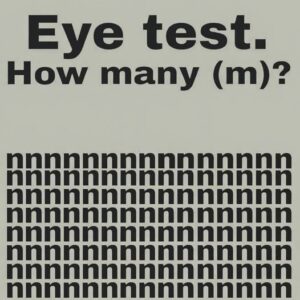
The challenge revolves around identifying a hidden letter “M” among a large collection of similar-looking letters “N”.
At first glance, the image appears extremely uniform and repetitive, making it difficult for the human eye to detect any differences.
This type of illusion plays on how our brain processes repeated visual patterns and often overlooks small irregularities.
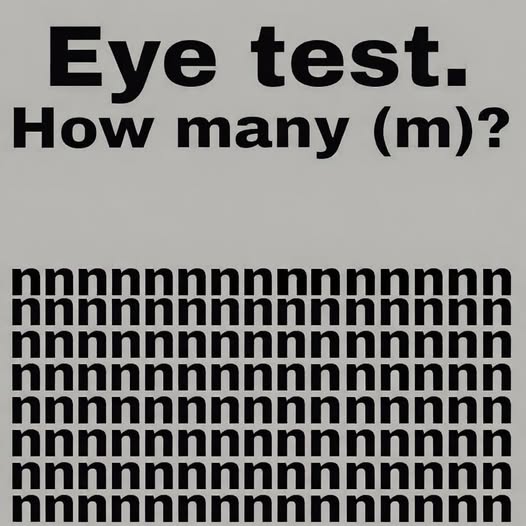
As users scroll through the puzzle, they are encouraged to carefully scan each row in search of the hidden target.
Despite its simplicity, many viewers report that the task becomes more difficult the longer they look at the image.
This is because the brain begins to group similar shapes together, reducing attention to subtle variations.
The letter “M” is designed to blend seamlessly into the surrounding pattern of “N” characters.
In many viral versions of this puzzle, the difference between the letters is minimal, increasing the difficulty level significantly.
This creates a strong optical illusion effect that challenges even the most observant individuals.
The purpose of such puzzles is not only entertainment but also cognitive stimulation and focus training.
Researchers often highlight that visual search tasks like this can improve attention to detail over time.
However, success in these puzzles often depends on patience rather than speed.
Many users initially believe they have found the hidden letter quickly, only to realize they have missed additional elements.
This is especially common when the puzzle includes trick instructions or hidden clues within the text itself.
Some versions of this challenge suggest that there may be more than one hidden “M” in the image.
In certain viral posts, it is claimed that the total number of “M” letters is ten.
According to those versions, two of the “M” letters are found within the written question itself.
The remaining eight are said to be hidden within the grid of repeating “N” letters.
However, it is important to note that the exact number can vary depending on the specific image being shared online.
Different creators may design slightly different versions of the puzzle to increase difficulty or engagement.
Therefore, the answer should be understood within the context of the specific visual used in each post.
What makes this illusion particularly interesting is how easily the human brain can be tricked by repetition.
When identical shapes are placed closely together, our perception tends to normalize the pattern.
This normalization process causes subtle differences, such as a rotated or altered letter, to become harder to detect.
As a result, viewers often need to slow down and carefully examine each section of the image.
Experts in visual cognition explain that this happens because the brain prioritizes efficiency over precision.
Instead of analyzing every single character individually, it relies on pattern recognition shortcuts.
These shortcuts are useful in everyday life but can be misleading in optical illusions.
The hidden “M” works by exploiting this natural tendency of visual processing.
Its shape closely resembles the surrounding “N” characters, making it blend into the overall structure.
Only upon closer inspection can the slight differences be identified by attentive viewers.
This type of challenge has become extremely popular in online communities and puzzle forums.
People often share their results and compare how quickly they were able to solve the illusion.
In some cases, users even challenge friends and family to find the hidden letter faster than they did.
This social aspect has contributed significantly to the puzzle’s viral spread across platforms.
While some viewers find the answer quickly, others may struggle for several minutes or longer.
The difficulty level largely depends on visual focus, patience, and familiarity with such patterns.
Even though the puzzle appears simple, it serves as a reminder of how perception can be misleading.
It demonstrates that what we see is not always a complete reflection of what is actually present.
This is one of the key reasons optical illusions continue to fascinate both scientists and casual viewers.
They reveal the complex ways in which the human brain interprets visual information.
In educational contexts, such puzzles are sometimes used to demonstrate cognitive biases and perception errors.
They help illustrate how attention can be influenced by repetition and visual similarity.
For many people, solving the hidden “M” puzzle provides a sense of satisfaction and accomplishment.
It also encourages viewers to slow down and observe details more carefully in future tasks.
Whether or not someone finds all the hidden elements, the experience itself is often enjoyable.
In the most widely shared version of this puzzle, the claim is that there are multiple hidden instances of the letter “M”.
As previously mentioned, some versions suggest a total of ten hidden or embedded occurrences.
This includes both the text portion and the visual grid, depending on how the puzzle is constructed.
Still, viewers are encouraged to treat each version independently rather than assuming a fixed answer.
Ultimately, the goal of the challenge is engagement, observation, and mental exercise rather than strict accuracy.
It invites users to question their perception and test how carefully they can examine visual details.
In conclusion, the hidden “M” puzzle remains a popular example of how simple designs can create complex visual challenges.
It continues to entertain users while also offering insight into how human perception works in everyday life.