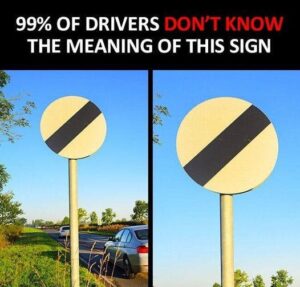
Many drivers have encountered a road sign they recognize instantly, yet still find themselves second-guessing what it actually means. A recent online discussion in the United Kingdom highlighted this familiar uncertainty, focusing on a sign that looks deceptively simple: a white circle with a single black diagonal stripe running across it.
Although it frequently appears on the driving theory test, a surprising number of motorists admitted they weren’t fully confident about its meaning once they were out on the road. The sign marks the beginning of the national speed limit, which replaces any previously posted limit. Its plain design can make it easy to misinterpret, especially when drivers expect speed signs to clearly display numbers.
Online, people joked that it meant anything from “free-for-all speed” to “go as fast as you want,” which reflects just how unclear it can feel in real-world driving situations. Others pointed out that many motorists see the sign, accelerate automatically, and assume that overtaking becomes acceptable, even when conditions don’t support it. According to the RAC, the national limit depends on both the road type and the vehicle.
Cars can travel up to 60 mph on single carriageways and up to 70 mph on dual carriageways or motorways. Larger vehicles, vans, and vehicles towing trailers must follow lower limits. In built-up areas, the standard remains 30 mph, unless signs state otherwise. Experts emphasize that speed limits are maximums, not targets. Weather, traffic, and visibility should influence the speed a driver chooses. The online debate serves as a reminder that road knowledge fades over time, and refreshing key rules can help drivers make safer decisions every day.
A Sign That Looks Too Simple
Part of the confusion surrounding this sign comes from its minimal design. Most speed-related road signs include clear numbers that immediately tell drivers the exact limit. A red circle with “30,” “40,” or “50” inside leaves little room for interpretation. Drivers see the number, adjust their speed, and move on.
The national speed limit sign, however, works differently. Instead of providing a specific number, it signals that drivers should follow the general speed limits that apply to that particular type of road. Because the sign doesn’t display a number, many motorists assume they already know what it means, even if they haven’t reviewed the rules in years.
That assumption can lead to misunderstandings. Drivers may believe the sign always means 70 mph, when in reality the correct limit depends on the road’s layout and whether it is a single carriageway, dual carriageway, or motorway. For someone who passed their driving test years—or even decades—ago, it’s easy to forget those distinctions.
Another factor is that drivers rarely think about the sign until a conversation or social media post draws attention to it. When people suddenly realize they are unsure about something they encounter regularly on the road, it can feel surprising and even a little embarrassing. Yet that reaction highlights an important truth: road knowledge isn’t static, and staying informed requires occasional refreshers.
How the National Speed Limit Works
Understanding the national speed limit requires a basic knowledge of different road types. In the UK, speed limits are not universal across every vehicle or roadway. Instead, they vary depending on the situation.
For standard passenger cars, the national speed limit allows drivers to travel up to 60 miles per hour on single carriageways. These roads have one lane in each direction and no physical barrier separating opposing traffic. Because vehicles move in both directions on the same roadway, these roads require careful attention and safe overtaking practices.
On dual carriageways, the limit increases to 70 miles per hour. Dual carriageways typically have two or more lanes in each direction and are separated by a central barrier or median. This separation reduces the risk of head-on collisions, allowing for higher speeds compared to single carriageways.
Motorways also follow the 70-mph limit for cars. However, motorways are designed specifically for high-speed traffic and usually include multiple lanes, controlled entry points, and long stretches without intersections. Because of these features, they are often safer for sustained higher speeds.
It’s important to remember that these limits apply only when no other speed restrictions are posted. If a lower limit sign appears—such as 50 mph or 40 mph—that number overrides the national speed limit until another sign indicates a change.
Different Vehicles, Different Limits
Another reason drivers sometimes misunderstand the sign is that national speed limits vary depending on the type of vehicle. Many people assume the same rules apply to everyone on the road, but that isn’t always the case.
Large goods vehicles, vans, buses, and vehicles towing trailers typically have lower speed limits than standard passenger cars. The goal is to account for differences in size, weight, braking distance, and overall handling.
For example, vans may be limited to 50 mph on single carriageways and 60 mph on dual carriageways, even when cars are allowed to travel faster. Vehicles pulling trailers also face stricter limits because towing can affect stability and stopping distance.
These differences mean that drivers must consider both the road and the vehicle they are operating. While the national speed limit sign may appear identical in every location, the correct interpretation depends on several factors.
Why Drivers Misinterpret the Sign
There are several psychological and practical reasons why drivers sometimes misinterpret the national speed limit sign.
One of the most common explanations is familiarity. When people encounter the same visual cues repeatedly, they often rely on habit rather than conscious interpretation. Over time, drivers may stop actively thinking about what a sign means and instead react automatically.
Another factor is expectation. Drivers are used to seeing speed limits displayed with numbers, so a sign without one can feel incomplete. When faced with ambiguity, the brain tends to fill in the missing information based on past experience or assumptions.
Social influence also plays a role. If other vehicles on the road accelerate after passing the sign, drivers may follow suit even if they are unsure about the exact limit. Traffic flow often shapes behavior more strongly than individual interpretation of road signs.
In addition, some motorists admit they simply forgot the details they learned during their driving tests. Without regular reminders, it’s natural for certain rules to fade from memory over time.
The Role of Driving Tests and Education
Driving theory tests are designed to ensure that new drivers understand the meaning of road signs before they begin driving independently. However, once someone passes the test, there is usually no requirement to revisit that knowledge unless they choose to do so.
Over the years, driving habits can change, road designs evolve, and new traffic rules are introduced. While many drivers stay informed through experience, others may rely solely on the information they learned when they first obtained their license.
Some safety advocates suggest that occasional refresher courses or voluntary knowledge checks could help drivers stay up to date. These programs would not necessarily involve formal testing but could provide reminders about important rules and changes in road regulations.
Technology may also play a role in the future. Navigation apps and digital dashboards already display speed limits in many vehicles, helping drivers remain aware of current restrictions. However, these systems are not perfect and should never replace a driver’s understanding of road signs.
The Importance of Context
Experts often emphasize that speed limits represent the maximum safe speed under ideal conditions. In reality, drivers must adjust their behavior based on circumstances such as weather, traffic, and visibility.
For example, a national speed limit road may technically allow a driver to travel at 60 mph. But if the road is narrow, winding, or wet from rain, a lower speed may be safer.
Similarly, heavy traffic or reduced visibility can make high speeds dangerous even when the posted limit allows them. Responsible driving requires constant judgment rather than simply aiming to reach the maximum allowed speed.
This idea is sometimes summarized by a simple phrase: “The limit is not the target.” In other words, just because a driver is legally allowed to travel at a certain speed does not mean it is always the safest choice.
How Online Discussions Sparked Interest
The recent online conversation about the national speed limit sign began when a user posted a photo and asked a straightforward question: “What does this sign actually mean?”
The responses ranged from confident explanations to humorous guesses. Some users admitted they weren’t entirely sure and relied on following the speed of surrounding vehicles. Others shared stories about learning the rule years earlier but forgetting the details.
The discussion quickly spread across social media platforms, attracting thousands of comments. For many people, it became a reminder that even experienced drivers can occasionally feel uncertain about common road signs.
Interestingly, the tone of the conversation remained largely lighthearted. Instead of criticizing those who didn’t know the answer, many participants treated the discussion as an opportunity to learn and share information.
Why Refreshing Road Knowledge Matters
Situations like this highlight the value of periodically reviewing driving rules. Even small misunderstandings can influence how people behave on the road.
When drivers misinterpret a sign, they may accelerate too quickly, assume overtaking is allowed, or follow the behavior of surrounding vehicles without considering the conditions. While these actions don’t always lead to accidents, they can increase risk in certain situations.
Refreshing road knowledge doesn’t require extensive effort. Reading updated driver guides, paying attention to educational campaigns, or simply discussing road rules with others can help reinforce important information.
Many drivers find that revisiting these topics increases their confidence behind the wheel. Instead of relying on assumptions, they know exactly how to interpret the signs they encounter.
A Reminder Hidden in Plain Sight
The national speed limit sign is one of the simplest symbols on the road, yet it carries important information about how drivers should behave. Its understated design may contribute to confusion, but it also reflects the idea that the rule applies broadly rather than specifying a single number.
For most motorists, encountering the sign is an everyday occurrence. Yet the recent discussion shows that even familiar sights can prompt new questions and conversations.
In many ways, this small debate serves as a reminder that driving is a skill that evolves over time. The more attention people pay to the details of the road environment—including the signs that guide them—the safer and more confident they can become.