Three days after undergoing surgery, I was still recovering and far from my usual strength. Simple tasks felt heavier than usual, and I moved slowly through the house as I adjusted to the discomfort and fatigue that followed the procedure. I relied on patience, rest, and the quiet support of my husband Daniel, who had been helping me during my recovery.
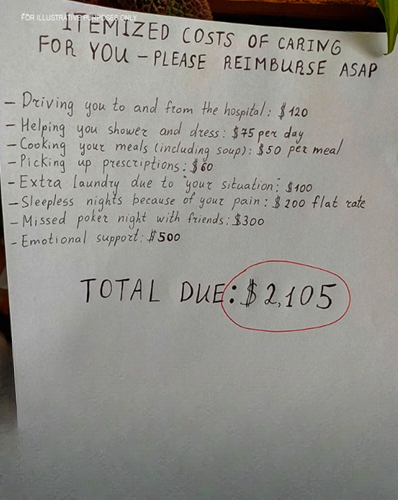
One morning, as I made my way into the kitchen, something unusual caught my attention. A piece of paper was taped neatly to the refrigerator door. At first, I assumed it was a grocery list or a reminder about errands. But as I stepped closer, I noticed the title written in Daniel’s handwriting: “Expenses of Taking Care of You.”
Something about those words immediately made me uneasy.
I carefully removed the paper and began reading.
What I saw left me stunned.
Daniel had created a detailed list of everything he had done for me since my surgery. On its surface, it looked like a record of care and effort — meals prepared, trips to medical appointments, assistance around the house, and emotional support during recovery. But what shocked me most was that each action had been assigned a monetary value, as though every act of kindness had a price tag attached.
At the bottom of the page, a total figure stood out clearly: $2,105.
I stood there in silence, trying to process what I was seeing.
The man I had trusted, loved, and built a life with had reduced my recovery — a vulnerable and deeply personal time — into an itemized bill.
It didn’t feel like gratitude. It felt like accounting. And in that moment, it hurt more than I could explain.
I felt a mix of confusion, disappointment, and emotional distance growing inside me. Our marriage had always felt balanced, or at least I believed it was. We had supported each other through life’s challenges, celebrated milestones, and shared responsibilities. I never imagined that care and effort would one day be translated into a financial statement.
For a long time that morning, I said nothing. I placed the paper back where I found it and walked away, trying to steady my thoughts. Confronting Daniel immediately didn’t feel right. I needed time to understand what I was feeling and how I wanted to respond.
As the days passed, I reflected deeply on the situation. Instead of reacting with anger or confrontation, I decided to respond in a structured way — using the same method he had used. If care could be measured in numbers, then I would take the time to calculate what our years together truly represented.
Over the next several weeks, I began documenting everything I had done throughout our relationship. I thought carefully about the small and large ways I had contributed to our life together. It wasn’t just about chores or tasks — it was about emotional presence, consistency, patience, and support during difficult times.
I listed home-cooked meals prepared over the years, late-night conversations when he needed comfort, times I adjusted my own schedule to support his responsibilities, errands I handled without hesitation, and moments where I offered emotional support during his personal struggles. I even considered the mental and emotional effort that often goes unnoticed in long-term relationships — the kind of care that doesn’t come with receipts or timestamps.
It took time and reflection, but I wanted the result to be fair based on the same logic that had been used on me.
When I finally completed my calculation, I added everything together. The total came to just over $18,000.
Seeing that number gave me a strange sense of clarity. Not because I believed love could truly be measured in dollars, but because it highlighted the imbalance and emotional misunderstanding that had occurred between us.
I printed my summary on a clean sheet of paper. At the top, I wrote “Final Notice.” Then I placed it beside Daniel’s coffee cup the next morning, choosing a quiet moment where he would see it without immediate confrontation.
When he noticed it, his reaction was immediate. His expression changed as he read through the document. The confidence he had when creating his own list seemed to disappear.
I didn’t raise my voice. I simply said, “If love is about keeping score, this is what mine looks like.”
The room fell silent.
What followed wasn’t an argument, but a long and emotional conversation — one that we had needed for a long time. Daniel admitted that he hadn’t fully understood how his actions had affected me. He explained that he had been overwhelmed, perhaps even trying to express stress in a way that came out wrong. But more importantly, he acknowledged that reducing care to numbers had been hurtful and inappropriate.
For hours, we talked openly about expectations, communication, and what genuine partnership really means. It became clear that somewhere along the way, we had stopped expressing appreciation in healthy ways and had fallen into a mindset that turned support into obligation rather than love.
That conversation became a turning point in our relationship.
In the weeks that followed, things slowly began to change. We made a conscious effort to communicate better, to express gratitude more openly, and to avoid treating acts of care as transactions. Instead of focusing on what each of us had “done” for the other, we focused on how we could support each other moving forward.
Our marriage did not become perfect overnight, but it became more honest. There was more understanding, more patience, and more emotional awareness between us.
Looking back, I realized that the experience had taught me something important. Love is not meant to be measured like a financial statement. It is not something that should be tracked, priced, or compared. Real care exists in moments of presence, empathy, and willingness to support each other without expectation of repayment.
That incident, as painful as it was at the time, ultimately led to growth. It forced both of us to confront how we viewed relationships and what we valued within them.
Today, I no longer see that paper on the fridge as just a hurtful moment. Instead, I see it as the beginning of a necessary conversation — one that helped us rebuild our understanding of love on stronger, more compassionate terms.
Because in the end, the most meaningful things in a relationship are never the ones that can be calculated.
Uncategorized