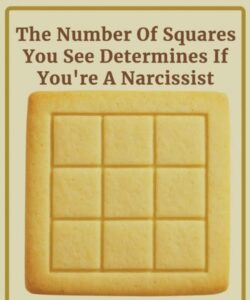
A seemingly simple grid image has captivated thousands across social media platforms, transforming a basic visual into an interactive exercise that encourages users to engage, count, and reflect on their own cognitive approach to challenges.
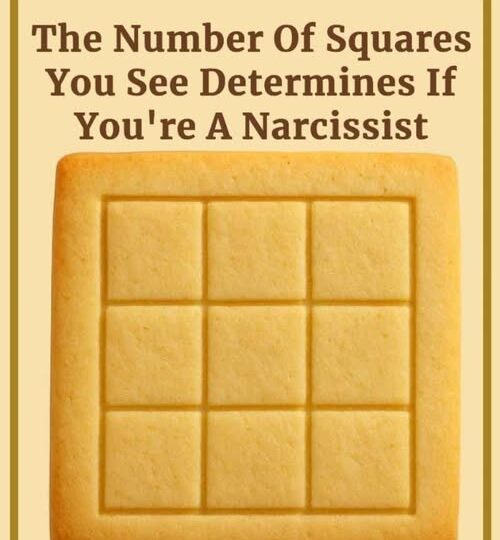
The puzzle’s caption reads: “The number of squares you see determines if you’re a narcissist.” This playful framing instantly alters perception, turning a basic geometric pattern into a personal and psychological experiment.
What begins as a casual glance quickly evolves into a detailed task. Viewers start counting, re-counting, and verifying, often comparing results with friends online, creating widespread discussion across social networks.
Its viral nature stems from its perfect blend of simplicity and curiosity. A single line of text paired with a visual challenge taps into a universal desire to explore self-awareness, even in a lighthearted context.
The Psychology Behind Immediate Engagement
Human beings naturally seek insight into themselves. Even trivial tasks become meaningful when paired with personality labels, encouraging individuals to invest attention and effort into seemingly simple challenges.
The combination of counting with a playful psychological claim adds intrigue. Participants are not only recognizing shapes—they are evaluating what their observation might imply about personality traits.
Before counting begins, viewers may subconsciously question themselves. Could their perception indicate something deeper? This subtle prompt engages the mind even before action starts, enhancing the puzzle’s appeal.
The puzzle functions as more than entertainment. It becomes a mirror of cognitive style, drawing attention to perception habits, attention to detail, and how individuals approach problem-solving in daily life.
Step One: Counting the Squares
Initial observation often reveals nine obvious squares. These smaller shapes, clearly defined and evenly arranged, are immediately visible and easily counted by most participants without extensive analysis.
Closer inspection reveals additional, larger squares formed by combining sections. Awareness of these hidden shapes requires careful focus and patience, testing an individual’s attention to layered structures.
Eventually, the entire grid itself forms a single large square, bringing the total to 14. Achieving this number requires both persistence and an ability to consider relationships between individual elements and the whole structure.
The counting process is deceptively simple but psychologically engaging. It encourages iterative observation and analytical thought while providing an entertaining challenge that anyone can attempt.
Interpreting Your Count
Playful personality interpretations accompany the puzzle. Those identifying six to eight squares are described as easy-going, generally accepting visible information without overanalyzing, reflecting a more relaxed cognitive style.
Individuals spotting nine to eleven squares are often labeled analytical. They balance logic with intuition, scrutinizing patterns carefully, demonstrating a methodical approach that combines observation with reasoning.
Finding twelve to fourteen squares is framed as attention to detail taken to an extreme. Humorously, these individuals are sometimes labeled perfectionists or self-centered, highlighting the puzzle’s playful, non-serious nature.
The “narcissist” label is intentionally provocative yet humorous. It encourages social sharing and discussion while reminding participants that the test is for entertainment rather than serious psychological assessment.
Why This Puzzle Resonates
Despite its simplicity, the puzzle often feels surprisingly accurate. Individual perception styles influence results, making the experience feel personally relevant and encouraging reflection on cognitive habits.
Some participants naturally see the big picture, quickly identifying overall structure. Others focus on small details, gradually uncovering all possible squares and developing a more complete understanding.
This contrast highlights diverse cognitive strategies. Both approaches—global and detail-oriented—are valid, offering insight into the variety of ways humans process information.
The puzzle also underscores that perception is flexible. Shifts in focus or perspective can reveal previously unnoticed elements, illustrating the dynamic nature of human observation.
Emotional Engagement
Reactions to the puzzle often matter more than the final count. Emotional responses—pride, frustration, amusement—reflect mindset and approach, offering additional insight into participant personality and engagement style.
Some feel satisfaction upon identifying all 14 squares. Others experience mild frustration if they overlook certain shapes, while a group approaches the exercise with humor, treating it as a playful, low-stakes challenge.
These responses reveal cognitive flexibility, patience, and resilience. The process of engagement demonstrates how people handle challenges, highlighting traits not captured by the number alone.
The Puzzle as a Reflection of Cognitive Styles
At its core, the square puzzle showcases differences in visual processing. Global thinkers prioritize the overall pattern, while detail-oriented individuals dissect components before forming a complete mental image.
Neither cognitive approach is superior. Both are valuable, illustrating alternative methods for solving problems and interpreting complex stimuli, while encouraging participants to appreciate diverse perceptual strategies.
The puzzle also emphasizes the intersection of observation and introspection. It subtly encourages participants to question how they interpret not only images but complex real-world scenarios as well.
Beyond Counting: Symbolic Significance
The grid can be seen metaphorically, representing how people organize life. Each square might symbolize work, relationships, health, or personal goals, reflecting whether individuals prioritize individual components or the whole system.
Some focus on individual sections, akin to detail-oriented observers, while others perceive connections between all parts, echoing global cognitive approaches. This layer of symbolism enriches the exercise.
By framing counting as an act of self-reflection, the puzzle transforms from a visual task into a commentary on awareness, decision-making, and attention allocation in everyday life.
Curiosity Drives Engagement
Curiosity is central to the puzzle’s success. People are compelled to explore, examine, and reconsider initial observations, making engagement both enjoyable and mentally stimulating.
This intrinsic motivation reflects a broader learning style: a willingness to explore, test hypotheses, and question assumptions. Curiosity enhances attentional focus and deepens cognitive engagement.
The puzzle’s open-ended design allows for unique interpretations, ensuring no two experiences are identical. Participants learn not only about the grid but about their approach to problem-solving and perception.
Humor Enhances Appeal
The narcissism label functions as a humorous hook. While exaggerated, it encourages social interaction, meme sharing, and discussion, boosting the puzzle’s visibility across multiple platforms.
Humor lowers barriers to participation. By framing the exercise playfully, viewers are less likely to feel judged, instead approaching the challenge with curiosity and enjoyment.
This balance of entertainment and subtle self-reflection makes the puzzle memorable, shareable, and widely appealing across diverse demographics.
Social Interaction and Virality
One reason for the puzzle’s viral nature is its capacity for social comparison. Friends and strangers alike share results, debate interpretations, and discuss personality implications in online communities.
The format is highly inclusive, requiring no specialized knowledge. Its simplicity allows almost anyone to participate, creating a broad, multi-generational audience engaged through shared curiosity and discussion.
As participants share results, engagement extends organically, demonstrating how interactive visuals and social commentary can amplify attention and foster communal exploration.
A Cognitive Exercise in Disguise
Although presented as a simple game, the puzzle encourages critical thinking, attention management, and self-analysis. It subtly trains the brain to observe patterns, discern structures, and consider multiple perspectives simultaneously.
By combining visual and psychological elements, the exercise strengthens mental flexibility and pattern recognition skills. It is both entertaining and educational without overtly appearing as a cognitive test.
The Ongoing Conversation
The puzzle continues to circulate because it sparks dialogue. Each person’s perception differs, ensuring ongoing discussion about results, strategies, and interpretations, keeping engagement dynamic and continuous.
The simple question—how many squares can you see?—becomes a catalyst for reflection, conversation, and humor, demonstrating the appeal of minimalistic yet cognitively rich challenges.
Conclusion: Observation, Curiosity, and Insight
Ultimately, the square-counting puzzle blends amusement with subtle psychological insight. It highlights perception differences, encourages reflection, and promotes social engagement without demanding formal analysis or expertise.
Its charm lies in its ability to be simultaneously simple and thought-provoking. The number of squares is less important than the engagement process, curiosity, and self-awareness it stimulates.
By offering both humor and insight, the puzzle creates a memorable experience. Participants gain awareness of their perceptual tendencies while enjoying a lighthearted, sharable challenge that transcends age, location, and background.
Whether approached seriously or playfully, the exercise illustrates the complex interplay of cognition, attention, and personality, proving that even the simplest images can reveal surprising truths about the human mind.
As it spreads further online, the puzzle continues to captivate, reminding us that observation, curiosity, and thoughtful reflection can coexist with humor and entertainment in the most unexpected ways.