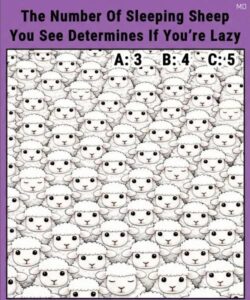
At first glance, the image appears simple and cheerful: a field filled with adorable cartoon sheep, all standing close together with nearly identical expressions. But hidden among the wide-eyed faces are a few sheep with their eyes gently closed, as if they’ve drifted off to sleep. The challenge is straightforward—count how many sleeping sheep you can find. Some people quickly spot three, others confidently identify four, and a few proudly claim to have found five. While playful captions may suggest that your answer says something about your personality, this is meant purely as a fun brain teaser, not a serious evaluation.
Even so, puzzles like this can reveal interesting insights into how our minds process visual information. The human brain is naturally wired to detect patterns. When looking at a crowded image filled with nearly identical shapes, your mind automatically groups them together. Because most of the sheep look the same, your brain settles into a rhythm and assumes uniformity. The tiny difference—closed eyes instead of open ones—can easily be overlooked unless you consciously slow down and examine the details more carefully.
People often interpret their results in lighthearted ways. If you found three sleeping sheep, you may rely on quick scanning and big-picture thinking. You move efficiently and trust your first impression, though subtle details might sometimes slip past. If you found four, you likely balance speed and accuracy, double-checking without overanalyzing. If you found five, you may have strong attention to detail and persistence, carefully reviewing patterns until you feel confident in your conclusion. In reality, the number you see reflects your approach to problem-solving more than anything else.
Hidden-object challenges like this test a skill called visual discrimination—the ability to detect small differences among similar objects. When images are repetitive, the brain conserves energy by assuming sameness, which is a natural and efficient process. Only when you intentionally shift your focus does your mind override that shortcut. Activities such as spot-the-difference puzzles, memory games, jigsaw puzzles, and limiting multitasking can help strengthen attention over time. So before checking the image again, consider how you searched. Whether you found three, four, or five, you gave your brain a healthy workout—and that’s something worth appreciating.