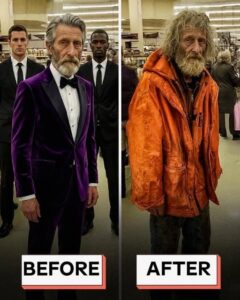
At the age of ninety, I decided to do something that many might consider risky or even reckless.
I dressed as a homeless person and walked into one of my own supermarkets—not to promote any product, nor to test a new store layout, but to see how people would treat me when they didn’t know who I was.
What I discovered during that visit was more than just surprising—it shattered long-held beliefs and altered the course of my life in ways I could never have imagined.
At my age, you stop caring about outward appearances. You stop hoping that people will respect you because of your wealth or legacy. At ninety, all you want is honesty—before it’s too late.
My name is Mr. Hutchins, and for seventy years, I built the largest grocery chain in Texas. I began with a small corner store right after World War II, in a time when a loaf of bread cost just a nickel, and people rarely locked their doors.
Those first years were challenging—long hours, supply shortages, competition from larger businesses—but my ambition, determination, and vision kept me going.
By the time I was eighty, my brand had expanded to five states. My name was on storefronts, contracts, and checks. I was even called the “Bread King of the South.”
But with all that success came a lesson that few wealthy people admit: money doesn’t keep you warm at night. Power doesn’t comfort you when illness strikes, and success can’t ease the loneliness at breakfast.
In 1992, I lost my wife, and without children, I found myself alone in my large mansion. That’s when the reality of life’s impermanence hit me.
As I reflected on my life, I wondered: when I’m gone, who truly deserves all I’ve built? Certainly not the greedy board members, or the polished lawyers eager to claim a piece of my wealth. I wanted someone who understood the real value of hard work and respect for others—someone who would treat people with dignity, even when no one was watching.
So, I devised a plan. I put on my oldest clothes, grew a few days’ worth of stubble, dirtied my face, and entered my own supermarket, looking like a man who hadn’t eaten in days.
I wanted to find out the truth—who would see me as a human being, and who would look right through me?
The Test Begins
As soon as I entered, I felt the stares. Whispers followed me through the aisles.
A young cashier wrinkled her nose and muttered loudly enough for me to hear, “He smells like garbage meat.” Her coworker laughed.
A father, pulling his child along, whispered, “Don’t stare at the bum, Tommy.”
I kept my head down, my heart sinking with every step. The empire I had built over decades seemed like a distant memory as I became nothing more than a man to be avoided.
Then, the worst moment came. Kyle Ransom, the floor manager I had promoted years ago, approached me and said, “Sir, you need to leave. Customers are complaining.”
I looked up, and to my shock, Kyle didn’t recognize me.
“We don’t want your kind here,” he said.
The man I had trusted and trained now saw me as an outsider.
I didn’t feel hurt, though. I’ve been through worse. But that moment revealed something unsettling—how easily respect and decency can fade.
As I began to leave, a hand touched my arm.
It was Lewis, a young administrator in his twenties. His tie was worn, his sleeves rolled up, but his eyes held a quiet wisdom.
“Come with me,” he said kindly. “Let’s get you something to eat.”
I played along, trying to keep my disguise intact: “I don’t have any money.”
“That’s okay,” he said with a smile. “You don’t need money to be treated like a human being.”
He led me to the staff lounge, where he made me a cup of coffee and handed me a wrapped sandwich. Then, he looked me in the eyes and said, “You remind me of my dad. A Vietnam vet. Tough. He saw the world chew people up, but he never gave up.”
That moment, sharing a simple meal with someone who treated me with such dignity, marked a turning point in my life. Lewis had passed the test I hadn’t even told anyone about.
I left the store that day with a lump in my throat. Not a single person had recognized me, but I knew who had earned my trust. Lewis had shown me compassion when it mattered most.
The Revelation and a Life-Changing Decision
That night, I sat in my study surrounded by old photographs of my stores and employees, and I rewrote my will. Every asset I had—every penny, every store—I left to Lewis.
He was a stranger, yes, but he had proven himself to me in ways no one else had. He showed me that true worth comes from empathy, integrity, and treating others with respect, no matter their circumstances.
A week later, I returned to the same store, dressed in a charcoal-gray suit, cane in hand. The automatic doors opened, and suddenly, everyone remembered their manners. But my eyes went straight to Lewis. He didn’t smile or wave—he simply nodded, understanding that the moment had arrived.
That evening, Lewis called me.
“Mr. Hutchins, it’s me. I knew it was you in the store. I recognized your voice. But I didn’t say anything. Kindness shouldn’t depend on who someone is. You were hungry, and that was enough.”
I closed my eyes. He had passed the final, unspoken test.
A Hidden Past and a Tough Lesson
But the story didn’t end there. A few days later, I received an anonymous letter warning me about Lewis’s past. It mentioned that he had served time in prison for grand theft auto at the age of nineteen.
I called Lewis into my office, expecting excuses or defenses. Instead, he simply said, “I was young and foolish. Prison changed me. That’s why I treat people with dignity now—I know what it’s like to lose everything.”
In his eyes, I saw true remorse. And at that moment, I understood that his past didn’t define him. His growth, his struggles, and his redemption were what mattered now.
Family Interference and Protecting the Legacy
As word of my rewritten will spread, distant relatives resurfaced, claiming entitlement to my fortune. My niece, Denise, tried to pressure me to reconsider my choice of Lewis over family.
I reminded her, “Blood doesn’t make family. Compassion does.”
When she tried to undermine Lewis by rifling through my safe, I realized the true danger wasn’t my wealth—it was protecting the man who had shown me real human decency.
I sat down with Lewis and told him everything: the disguise, the letter, the family’s interference. He listened quietly and then said, “I don’t want your money. I just wanted you to know that there are still people who care.”
That’s when I understood. My legacy wasn’t about wealth—it was about purpose.
A Legacy of Compassion
I decided to redirect my wealth to create the Hutchins Foundation for Human Dignity, funding scholarships for ex-convicts, shelters, and food banks. Lewis became the foundation’s director, not because of inheritance, but because of his heart, judgment, and humanity.
At ninety, I know my time is limited. But I can leave this world knowing that my legacy is in good hands. Because I’ve learned one thing for sure:
“It’s not about who they are. It’s about who you are.” Lewis passed the test. I passed the torch. And in the end, humanity—not money—endures.