The courtroom was quiet in the way only small-town courtrooms can be—where the air conditioner rattles like it has personal opinions about everyone present.
The judge sat behind the bench, flipping through a thin stack of case files. He had seen everything from land disputes over goats to neighbors arguing about mango theft. But divorce cases always had a special kind of emotional chaos attached to them.
“Next case,” he said, adjusting his glasses. “Petition for divorce. State your names.”
The husband stood first. “Your Honor, my name is Arjun Mehta.”
The wife stood beside him, arms folded, expression unreadable. “Sonia Mehta.”
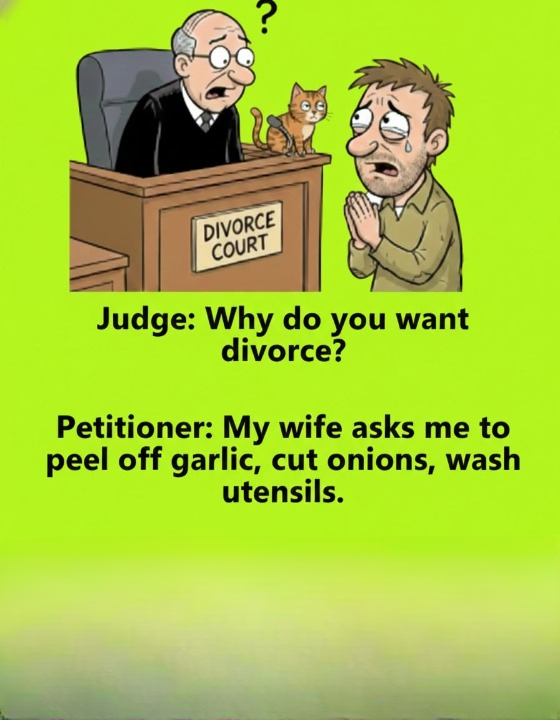
The judge leaned back. “Mr. Mehta, you are the petitioner. Why do you want a divorce?”
Arjun sighed dramatically, like a man who had been storing complaints for years and finally found a microphone.
“Your Honor, my wife makes me do everything in the house.”
A murmur went through the courtroom. The court clerk looked up. Even the bailiff seemed mildly interested.
The judge raised an eyebrow. “Everything?”
Arjun nodded quickly. “Everything. She makes me peel garlic, cut onions, wash utensils, do laundry… I am exhausted. I cannot live like this anymore.”
Sonia didn’t react. She just blinked slowly, as if she had already heard this speech many times before—and was waiting for the end.
The judge sighed, the way experienced people do when they know a lesson is about to be taught whether they asked for it or not.
“Mr. Mehta,” the judge said, “you are asking for a divorce over household chores?”
“Yes, Your Honor.”
The judge leaned forward, folding his hands.
“Let me ask you something. Do you cook?”
Arjun hesitated. “No.”
“Do you clean the house?”
“No.”
“Do you do laundry?”
Arjun shifted in his seat. “Well… no.”
The judge nodded slowly. “Then let me help you.”
He turned slightly, speaking like a man delivering ancient wisdom passed down through generations of tired husbands and equally tired judges.
“When you peel garlic, soak it in warm water for five minutes. The skin comes off easily.”
Arjun blinked. That was… new information.
The judge continued, warming up now.
“When you cut onions, chill them in the fridge for ten minutes before slicing. You won’t cry.”
A few people in the courtroom nodded as if this was life-changing scientific research.
“And utensils,” the judge said, “you don’t scrub them immediately. Soak them in water with a little soap for ten minutes. The grease loosens. Less effort.”
He leaned back, satisfied.
“And laundry—don’t just attack it like it’s your enemy. Soak it first. Half an hour. Stains dissolve. Less strain on your hands.”
The courtroom was silent.
The bailiff whispered, “I should’ve known this earlier.”
Arjun slowly turned his head toward the judge. His expression had changed from frustration to something dangerously close to reflection.
“I… I didn’t know that,” he admitted.
The judge nodded. “Most people don’t. They just complain.”
Arjun looked down at his hands, imagining a world where chores required less suffering. It was almost offensive how simple it sounded.
Sonia, still silent, finally spoke.
“So… is the case over?” she asked calmly.
The judge looked at Arjun. “Do you still want a divorce?”
Arjun opened his mouth.
Closed it.
Opened it again.
Then sighed deeply.
“I understand, Your Honor,” he said. “Please withdraw my petition.”
The clerk quickly scribbled notes. The bailiff relaxed.
The judge tapped his pen. “So what did you understand?”
Arjun straightened up, as if delivering a formal statement to the court of marriage itself.
“That I was overreacting.”
The judge nodded. “Good.”
A pause.
Arjun added, almost reluctantly:
“And that my situation is worse than I thought.”
There was a beat of silence.
Then someone in the back of the courtroom snorted.
The judge didn’t react. He had heard worse truths.
“Case dismissed,” he said.
But the courtroom wasn’t done that day.
As Arjun and Sonia turned to leave, the judge called out.
“Next case.”
A young couple stepped forward nervously.
The husband looked anxious. The wife looked angry.
“Why are you here?” the judge asked.
The husband immediately pointed at his wife.
“She doesn’t let me rest, Your Honor! She gives me lists! She says things like ‘clean properly’ and ‘do it again if it’s not clean’!”
The judge held up a hand.
“Stop.”
The courtroom froze.
The judge leaned forward slowly.
“Son,” he said, “did you also file this case because of household chores?”
The husband nodded vigorously.
The judge leaned back with a long, exhausted breath.
Then he looked at the clerk.
“Bring me tea. This is going to be a long day.”
Outside the courtroom
Arjun stood in the hallway, staring at his wife cautiously.
“So…” he said carefully. “About the onion thing…”
Sonia raised an eyebrow.
“You’re welcome,” she said.
He nodded slowly. “Right. Thank you.”
A pause.
Then he added:
“But I still think you could’ve told me earlier.”
Sonia smiled faintly.
“And miss the entertainment of you discovering it in court?”
Arjun had no response to that.
Some battles, he realized, were already lost.
Final note from the judge (later that day)
As he closed his files, the judge muttered to himself:
“In my thirty years of law, I have seen theft, fraud, betrayal…”
He paused.
“…and today I have seen a man nearly end his marriage because of onions.”
He shook his head.
Then added:
“And honestly… I should write a cookbook.”
Uncategorized