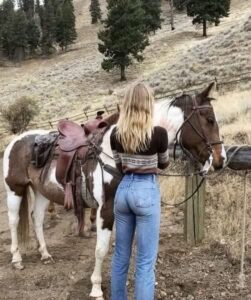
It began as a quiet afternoon, the kind that doesn’t announce itself as meaningful while it is happening. The sky was open, the light steady, and everything around me felt ordinary in the most comforting way. I was on a simple trail, walking without urgency, letting my thoughts drift in and out without focus. At some point during that walk, I took a photo. It was not planned or staged. It was just a moment that felt worth keeping—trees, light, distance, nothing unusual. I didn’t think much of it.
I simply sent it to my husband, the way people do when they share small pieces of their day without expecting anything in return. For a few minutes, everything remained normal. There was no tension, no hidden meaning, no reason to expect anything other than a casual exchange. It was just a photograph, sent across distance, like countless others before it. Then came the reply.
It wasn’t about the scenery or the light or the moment I had captured. Instead, it was a question—short, direct, and unexpectedly specific. He asked what the initials on the saddle were. That was the first point where the conversation shifted in a direction I had not anticipated.
I looked back at the image. At first, I saw nothing new. Then I zoomed in slowly, letting the details come forward. On the leather saddle, faint and slightly worn, there were letters—A.M. Small, almost unnoticeable unless someone pointed them out. They were not dramatic or bold. They were just there.
At that moment, those letters meant very little to me. They could have belonged to anyone. Saddles change hands. Equipment gets reused. Initials remain long after ownership changes. I did not assign importance to them because, to me, there was none.
But perception is not always shared equally between two people. What felt insignificant to me became something heavier for him. The initials were no longer just markings on leather. They became connected to interpretation, memory, and association that I had not considered.
He recognized them as belonging to a name from my past. Someone I had not thought about in a long time. For me, that past connection held no emotional presence anymore. It was distant, almost irrelevant. But once the connection was made, it could not easily be unseen.
I explained that calmly when he asked. I told him what I knew, what I didn’t know, and what I believed to be the simplest explanation. There was no intention behind the image, no hidden meaning, no story attached to it beyond what was visible.
However, explanations do not always settle what has already begun to form internally. Doubt does not behave like a question that waits for an answer. It often grows while answers are still being given.
The more I tried to clarify, the more I noticed the shift in how my words were being received. It felt as though the explanation itself was becoming part of the uncertainty rather than resolving it. What I saw as straightforward was being interpreted through a different emotional lens.
This is where conversations begin to change shape. Not because of new information, but because of interpretation. A small detail stops being just a detail. It becomes a symbol. And once something becomes a symbol, it can carry more weight than it was ever meant to hold.
I remember realizing that we were no longer discussing a photograph. We were no longer discussing initials or leather or coincidence. The conversation had moved somewhere else entirely, into a space shaped by doubt rather than observation.
At some point, I could sense that the search for meaning had expanded beyond the image itself. It was no longer about what was visible. It was about what might exist behind it. That shift created distance, even while the conversation was still happening.
Doubt rarely stays contained. Once it begins, it often looks for reinforcement elsewhere. It seeks patterns, connections, anything that might confirm the feeling that started it. In doing so, it can turn neutral details into something they were never meant to represent.
From my perspective, nothing had changed about the photograph. The same saddle, the same initials, the same moment frozen in time. But from his perspective, what those initials represented was no longer fixed. It had started to move.
This is often how distance forms between people—not through a single event, but through the slow transformation of meaning. A detail becomes a question. A question becomes a possibility. A possibility becomes a narrative.
And once a narrative begins to form, it can start to feel more real than the original moment itself.
What stayed with me afterward was not the image or the initials, but the realization of how differently the same information can be experienced. One person sees coincidence. Another sees implication. Neither experience feels artificial to the person holding it.
Trust, I learned, does not usually break in a single moment. It bends quietly before it breaks. It shifts in small degrees that are not always visible at first. And by the time it becomes noticeable, the change has already taken place.
The initials never changed. They remained exactly as they were—simple, faint, unremarkable marks on leather. But what they meant had changed entirely depending on how they were viewed.
That is perhaps the most important part of the experience. Meaning is not only in what is seen, but in how it is interpreted. And interpretation is shaped by memory, emotion, and expectation as much as by fact.
Looking back, the afternoon itself remains unchanged. It was peaceful, ordinary, and unremarkable in every objective sense. The photo was simple. The trail was quiet. Nothing about it suggested complexity or conflict.
Yet what followed showed how easily meaning can expand beyond intention. A single detail can carry more weight than it was ever designed to hold, not because of what it is, but because of what it becomes in someone’s mind.
In the end, I understood something that stays with me even now: not every detail requires explanation, and not every question needs to grow into certainty. Sometimes, the most important decision is knowing when a small thing is just a small thing—and allowing it to remain that way.
Because peace often depends not on what we see, but on what we choose not to turn into something larger than it is.