Our bodies truly are amazing tools. So amazing, in fact, that I don’t think the vast majority of us ever appreciate the marvel of natural evolution that we represent.
I mean, if you stop to think about it, we’ve evolved from beings not dissimilar to modern day chimpanzees, to walking, talking creatures capable of constructing complex societies and sending things to other planets, all in the blink of an eye (at least when the age of the universe is taken into account).
Yet one of the most interesting concepts related to our evolution as a species is how we’re virtually the same as we were, say, twenty-thousand years ago… though we now live in a world that could not be any more different to the one our ancestors once roamed.
More interesting still is the fact that we’re continuing to evolve, though the process happens so slowly, over the course of so many generations, that we rarely see evidence of it occurring at all.
Which is why we thought we would bring your attention to the link between a seemingly innocuous tendon in your wrist and the ongoing journey we humans are on as we lumber forward into the future.
Tendon and evolution
The tendon in question is attached to an old muscle called the palmaris longus, and these days it has been gradually phased out in 10-15% of the human population.
According to the research we were able to dig up, the palmaris longus is vital for animals that use their forearms to move around, including lemurs and monkeys. The muscle helps them to better swing from branch to branch, for example, and so is an important part of their anatomy.
And here’s where it gets interesting. Ground-dwelling apes, such as gorillas, have gradually lost the function, since they don’t rely on their forearms to move from place to place as they perhaps once did. Much in the same vein, we humans have started to lose the tendon that connects to the palmaris longus.
As stated above, evolution has a tendency to move slowly, so almost 90% of humans still have the tendon, though the evidence suggests that it is steadily being phased out.
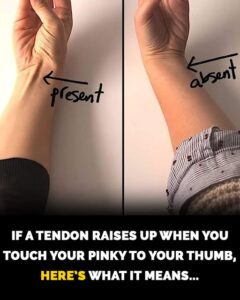
To check if you still have yours, there’s a simple test you can do at home. First, place your forearm on a flat surface with your palm facing up, then touch your pinky finger to your thumb and slightly lift your hand off the surface.
Have you done it? Well, if you can see a pronounced band in the middle of your wrist (this is your tendon), then you have it. If you don’t, then you likely belong to the small percentage of humans who have already shifted away from the need to have the tendon at all.