The news moved across Iowa like a shockwave — sudden, heavy, and impossible to prepare for.
In towns large and small, across neighborhoods where front doors are still left unlocked and names are known without introductions, people paused mid-routine as the reality settled in.
Two young soldiers from Iowa, serving far from home on a mission most Americans rarely see or hear about, had been killed in an ambush in Syria.
There was no gradual buildup, no warning. One moment, families were going about ordinary days; the next, they were confronted with the kind of loss that reshapes time itself.
The grief traveled swiftly, from military bases to farm towns, from city streets to quiet rural roads, leaving disbelief and heartbreak in its wake.
Leaders spoke carefully, knowing that words — even sincere ones — cannot fill the space left behind by lives cut short.
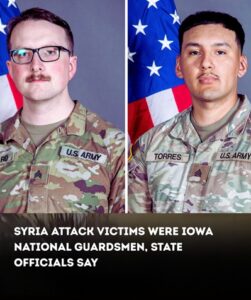
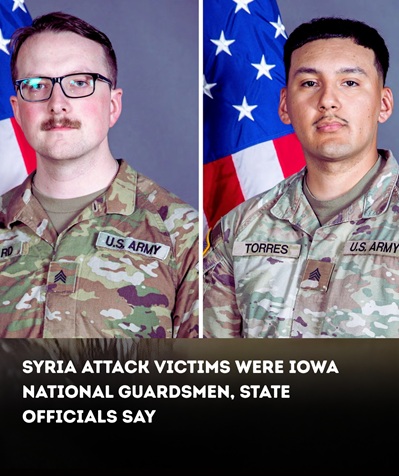
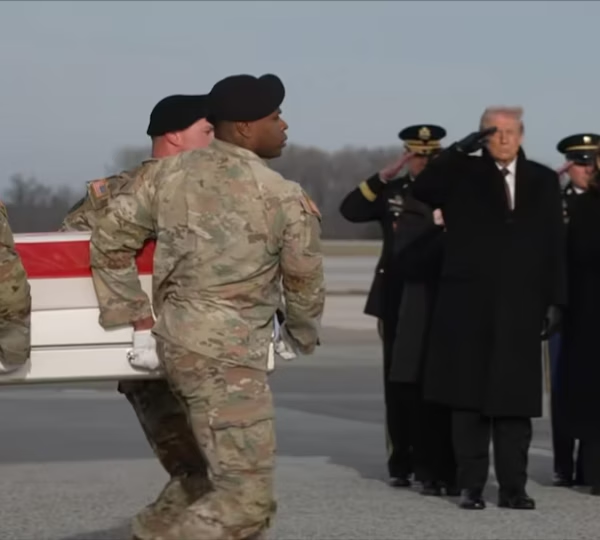
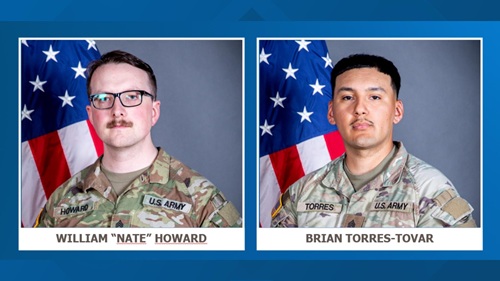
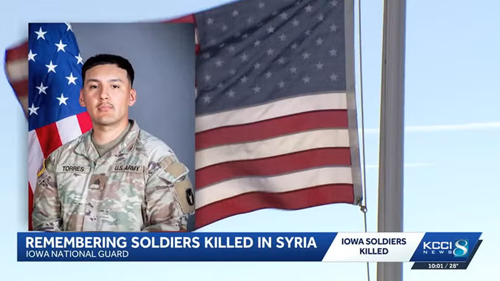
The soldiers were Sgt. Edgar Brian Torres Tovar, 25, of Des Moines, and Sgt.
William Nathaniel Howard, 29, of Marshalltown. They were sons of Iowa — raised in communities where service is not abstract and sacrifice is not theoretical.
In these places, military service is often woven into family histories, community traditions, and everyday conversations. It is not something admired from afar, but something lived and understood.
Though they wore the same uniform, the two men carried different stories. They grew up in different households, walked different streets, and imagined different futures.
Each had their own hopes, ambitions, and personal plans waiting back home.
Yet both answered the same call: to serve their country in one of the world’s most volatile regions, far removed from the rhythms of Midwestern life they knew so well.
They were killed while conducting a meeting with local leaders — part of the ongoing effort to stabilize areas still threatened by ISIS. It was not a dramatic combat operation or a headline-driven mission.
It was the quiet, persistent work that defines much of modern military service:
building trust, gathering information, supporting local stability, and preventing extremist groups from regaining ground.
This kind of work rarely draws attention. It does not dominate nightly news broadcasts or generate widespread public discussion.
It often happens beyond the awareness of most Americans — until tragedy forces it into view.
The ambush claimed the life of an American civilian as well and left three others wounded.
What should have been a routine engagement turned into chaos within moments, the kind of sudden violence that military families understand all too well. In places thousands of miles away, the impact was immediate.
In Iowa, flags were lowered to half-staff, a visual acknowledgment of loss that carried weight across the state.
Governor Kim Reynolds and Maj. Gen. Stephen Osborn addressed the tragedy with somber remarks, attempting to hold the grief of an entire state within carefully chosen words.
Their statements were measured and respectful, recognizing both the individual lives lost and the broader meaning of their sacrifice.
No official message could offer comfort equal to what had been taken away. Still, the acknowledgment mattered — especially in a state where military service runs deep.
Nearly 1,800 Iowa National Guard members are currently deployed in the region. For every one of them, there is a family waiting.
Parents check their phones more often than they admit. Spouses learn to live with uncertainty. Children ask questions that do not have easy answers.
Time is measured in missed holidays, delayed plans, and the distance between messages.
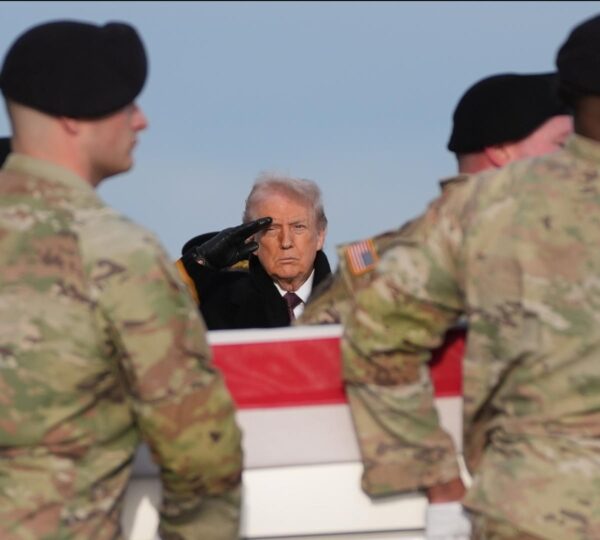
For the families of Sgt. Torres Tovar and Sgt. Howard, the waiting ended in the most devastating way possible.
The knock on the door — the moment that every military family dreads — arrived at their homes and changed everything.
That sound now echoes in the hearts of families across Iowa, a reminder that behind every uniform is a person deeply loved.
A son. A daughter. A sibling. A partner. A parent. A friend.
Military service carries with it a quiet understanding of risk, but that knowledge does not soften the blow when loss becomes real.
It does not lessen the pain of birthdays that will go uncelebrated, milestones that will be missed, or futures that will remain unwritten.
In moments like these, political arguments and global debates fade into the background.
What remains is the human cost of service — the courage of those who step forward, the resilience of those who remain behind, and the grief of communities that lose their own.
Iowa grieves not only for the soldiers themselves, but for the lives they were building. The routines they were meant to return to.
The careers they were developing. The relationships they were nurturing. These are the unseen losses that ripple outward, touching far more people than a headline can convey.
Communities in Des Moines and Marshalltown began gathering almost immediately. Vigils formed. Conversations grew quieter.
People shared memories, even if they had known the soldiers only indirectly. In towns where everyone is connected by just a few degrees of separation, loss feels collective.
Teachers think of former students. Coaches think of players. Neighbors think of familiar faces.
Employers think of empty chairs. Every connection becomes part of the mourning.
As the investigation into the ambush continues, officials will search for answers — tactical, strategic, and logistical.
These questions matter for future missions and for the safety of those still deployed. But for families and communities, answers do not heal grief.
They may provide clarity, but they cannot restore what has been lost.
For now, the focus remains on remembrance.
Honoring Sgt. Torres Tovar and Sgt. Howard means recognizing not only how they died, but how they lived.
It means acknowledging the decision they made to serve, knowing the risks and accepting them anyway.
It means understanding that their sacrifice was not abstract — it was personal, deliberate, and rooted in a sense of duty that extends beyond self.
Their names now become part of Iowa’s story.
They will be remembered in ceremonies and quiet moments alike — in folded flags, in prayers spoken softly, in the stillness that settles over families adjusting to a new reality.
Their service will be taught to younger generations, not as a distant concept, but as something that came from their own towns and neighborhoods.
For those still serving overseas, the loss carries another weight. Military units feel these deaths deeply.
Bonds formed in service are unlike any other, and the loss of one reverberates through the entire unit.
Grief is carried forward alongside duty, a burden shared silently among those who continue the mission.
Back home, families wait — some with renewed anxiety, others with reinforced resolve.
They continue living with the knowledge that service, while honorable, comes with a cost that is never evenly distributed.
In honoring these two young men, Iowa also honors every family that bears that cost.
Their sacrifice is not just a statistic or a line in a report. It is a reminder of the realities faced by those who serve in places most Americans will never see.
It is a reminder that even in missions that receive little attention, the stakes remain profoundly human.
As the days pass and news cycles move on, the grief will remain — quieter, perhaps, but no less real. Communities will continue to support the families left behind.
Memories will be shared. Stories will be told. And in that remembering, Sgt. Edgar Brian Torres Tovar and Sgt. William Nathaniel Howard will continue to live on.
They answered their country’s call. They served with courage.
And they are now part of a legacy that Iowa carries forward — in its flags, its prayers, and in the hearts of all who understand the true meaning of sacrifice.
The news moved across Iowa like a shockwave — sudden, heavy, and impossible to prepare for.
In towns large and small, across neighborhoods where front doors are still left unlocked and names are known without introductions, people paused mid-routine as the reality settled in.
Two young soldiers from Iowa, serving far from home on a mission most Americans rarely see or hear about, had been killed in an ambush in Syria.
There was no gradual buildup, no warning. One moment, families were going about ordinary days; the next, they were confronted with the kind of loss that reshapes time itself.
The grief traveled swiftly, from military bases to farm towns, from city streets to quiet rural roads, leaving disbelief and heartbreak in its wake.
Leaders spoke carefully, knowing that words — even sincere ones — cannot fill the space left behind by lives cut short.
The soldiers were Sgt. Edgar Brian Torres Tovar, 25, of Des Moines, and Sgt.
William Nathaniel Howard, 29, of Marshalltown. They were sons of Iowa — raised in communities where service is not abstract and sacrifice is not theoretical.
In these places, military service is often woven into family histories, community traditions, and everyday conversations. It is not something admired from afar, but something lived and understood.
Though they wore the same uniform, the two men carried different stories. They grew up in different households, walked different streets, and imagined different futures.
Each had their own hopes, ambitions, and personal plans waiting back home.
Yet both answered the same call: to serve their country in one of the world’s most volatile regions, far removed from the rhythms of Midwestern life they knew so well.
They were killed while conducting a meeting with local leaders — part of the ongoing effort to stabilize areas still threatened by ISIS. It was not a dramatic combat operation or a headline-driven mission.
It was the quiet, persistent work that defines much of modern military service:
building trust, gathering information, supporting local stability, and preventing extremist groups from regaining ground.
This kind of work rarely draws attention. It does not dominate nightly news broadcasts or generate widespread public discussion.
It often happens beyond the awareness of most Americans — until tragedy forces it into view.
The ambush claimed the life of an American civilian as well and left three others wounded.
What should have been a routine engagement turned into chaos within moments, the kind of sudden violence that military families understand all too well. In places thousands of miles away, the impact was immediate.
In Iowa, flags were lowered to half-staff, a visual acknowledgment of loss that carried weight across the state.
Governor Kim Reynolds and Maj. Gen. Stephen Osborn addressed the tragedy with somber remarks, attempting to hold the grief of an entire state within carefully chosen words.
Their statements were measured and respectful, recognizing both the individual lives lost and the broader meaning of their sacrifice.
No official message could offer comfort equal to what had been taken away. Still, the acknowledgment mattered — especially in a state where military service runs deep.
Nearly 1,800 Iowa National Guard members are currently deployed in the region. For every one of them, there is a family waiting.
Parents check their phones more often than they admit. Spouses learn to live with uncertainty. Children ask questions that do not have easy answers.
Time is measured in missed holidays, delayed plans, and the distance between messages.
For the families of Sgt. Torres Tovar and Sgt. Howard, the waiting ended in the most devastating way possible.
The knock on the door — the moment that every military family dreads — arrived at their homes and changed everything.
That sound now echoes in the hearts of families across Iowa, a reminder that behind every uniform is a person deeply loved.
A son. A daughter. A sibling. A partner. A parent. A friend.
Military service carries with it a quiet understanding of risk, but that knowledge does not soften the blow when loss becomes real.
It does not lessen the pain of birthdays that will go uncelebrated, milestones that will be missed, or futures that will remain unwritten.
In moments like these, political arguments and global debates fade into the background.
What remains is the human cost of service — the courage of those who step forward, the resilience of those who remain behind, and the grief of communities that lose their own.
Iowa grieves not only for the soldiers themselves, but for the lives they were building. The routines they were meant to return to.
The careers they were developing. The relationships they were nurturing. These are the unseen losses that ripple outward, touching far more people than a headline can convey.
Communities in Des Moines and Marshalltown began gathering almost immediately. Vigils formed. Conversations grew quieter.
People shared memories, even if they had known the soldiers only indirectly. In towns where everyone is connected by just a few degrees of separation, loss feels collective.
Teachers think of former students. Coaches think of players. Neighbors think of familiar faces.
Employers think of empty chairs. Every connection becomes part of the mourning.
As the investigation into the ambush continues, officials will search for answers — tactical, strategic, and logistical.
These questions matter for future missions and for the safety of those still deployed. But for families and communities, answers do not heal grief.
They may provide clarity, but they cannot restore what has been lost.
For now, the focus remains on remembrance.
Honoring Sgt. Torres Tovar and Sgt. Howard means recognizing not only how they died, but how they lived.
It means acknowledging the decision they made to serve, knowing the risks and accepting them anyway.
It means understanding that their sacrifice was not abstract — it was personal, deliberate, and rooted in a sense of duty that extends beyond self.
Their names now become part of Iowa’s story.
They will be remembered in ceremonies and quiet moments alike — in folded flags, in prayers spoken softly, in the stillness that settles over families adjusting to a new reality.
Their service will be taught to younger generations, not as a distant concept, but as something that came from their own towns and neighborhoods.
For those still serving overseas, the loss carries another weight. Military units feel these deaths deeply.
Bonds formed in service are unlike any other, and the loss of one reverberates through the entire unit.
Grief is carried forward alongside duty, a burden shared silently among those who continue the mission.
Back home, families wait — some with renewed anxiety, others with reinforced resolve.
They continue living with the knowledge that service, while honorable, comes with a cost that is never evenly distributed.
In honoring these two young men, Iowa also honors every family that bears that cost.
Their sacrifice is not just a statistic or a line in a report. It is a reminder of the realities faced by those who serve in places most Americans will never see.
It is a reminder that even in missions that receive little attention, the stakes remain profoundly human.
As the days pass and news cycles move on, the grief will remain — quieter, perhaps, but no less real. Communities will continue to support the families left behind.
Memories will be shared. Stories will be told. And in that remembering, Sgt. Edgar Brian Torres Tovar and Sgt. William Nathaniel Howard will continue to live on.
They answered their country’s call. They served with courage.
And they are now part of a legacy that Iowa carries forward — in its flags, its prayers, and in the hearts of all who understand the true meaning of sacrifice.