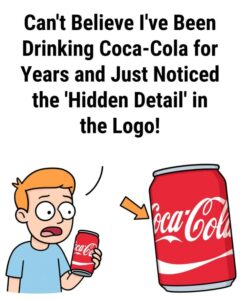
The Coca-Cola logo is one of the most familiar pieces of lettering in the world, yet many people today insist they see something tucked inside its curves: a quiet, friendly smile. Once pointed out, it seems unmistakable. But when you look back at the origins of that famous script, the mystery only grows deeper rather than disappearing.
The logo dates to the 1880s, when a bookkeeper named Frank Mason Robinson created it using Spencerian script, the elegant handwriting style that defined professional correspondence in the late nineteenth century. Robinson wasn’t a designer in the modern sense. He was simply trying to give a new beverage a recognizable identity, choosing lettering that felt refined, balanced, and pleasing to the eye.
There are no surviving notes explaining why he shaped the letters the way he did. No design drafts describe his intentions. Nothing in the historical record suggests he hid a smile in the swish beneath the name. Everything points instead to something practical: ornamentation, visual harmony, and a graceful style that matched the era.
Yet over time, many of us began to notice a curve that feels warmer than pure decoration, a flourish that looks less like a line and more like a grin.
And that is where the story shifts—away from Coca-Cola, and toward the way our minds work.
How Our Brains Turn Shapes Into Stories
Human beings are natural storytellers, even when we’re not trying to be. Our brains are wired to find faces, emotions, and patterns in the world around us. It’s an instinct as old as our species. It helped our ancestors spot danger in shadows and safety in familiar shapes.
That instinct remains strong today. We see expressions on the fronts of cars. We find animals in the shapes of clouds. We sense intention in the flicker of lights through trees. Even the simplest forms can take on a personality when we look at them long enough.
So when someone suggests there’s a smile hidden in a logo we’ve seen thousands of times, our minds lock onto it. Once the idea takes root, it becomes part of what we see—every time we see it.
A Logo Woven Into Our Daily Lives
The Coca-Cola logo surrounds us. It appears on billboards, bottles, vending machines, menus, movie screens, and holiday displays. For many people, it’s part of both childhood memories and everyday routines. Because the brand has long promoted ideas of joy, sharing, refreshment, and celebration, we naturally fold those warm feelings back into the design itself.
Our minds complete the connection.
That long, sweeping stroke at the bottom of the lettering begins to look friendly. A decorative flourish becomes cheerful. We don’t just look at the logo—we participate in interpreting it, layering our own emotions onto what we see.
When you repeat an image over years, even decades, these associations grow stronger. A suggestion becomes a belief. New generations hear that the logo contains a hidden smile, see it once, and then can’t unsee it. Whether Robinson intended it or not no longer matters.
Meaning shifts from the artist’s hand to the viewer’s eyes.
When a Symbol Reflects Its Audience
What makes this phenomenon so interesting is how naturally we accept it. Most of us never pause to ask whether the smile was intentional. The idea simply feels right. The story fits the emotions we already associate with the brand. Coca-Cola markets itself as joyful, uplifting, and nostalgic—so our minds shape the lettering to match that feeling.
We teach the logo to smile because we expect it to.
In this way, the Coca-Cola script becomes less of a message and more of a mirror, reflecting how ready we are to attach emotion to even the simplest line. What began as a straightforward piece of nineteenth-century penmanship has become a vessel for modern meaning.
The curves haven’t changed. The ink hasn’t shifted. But we have.
Our imaginations have filled the open space between what we see and what we feel. And in that space—without a memo, without intent, without a designer’s secret—the hint of a smile quietly appeared, shaped not by the artist who drew it but by the millions who look at it every day.