One small piece of fabric. That was all it took to ignite global outrage, spark moral debates, provoke religious condemnation, and even lead to arrests on beaches around the world.
Few garments in human history have been as controversial — or transformative — as the bikini.
Across decades, it became a symbol of rebellion, liberation, sexuality, fashion, and social change. It was banned by governments, condemned by religious leaders, and rejected by communities…
Yet women kept wearing it. And with each decade, with every bold design, the bikini helped reshape society’s ideas about modesty, gender, freedom, and the human body.
The Early 1900s: When Modesty Ruled the Shoreline
In the early 20th century, swimwear looked nothing like the sleek styles we know today. Instead of fashion, function, or comfort, the rules were simple:
Cover everything.
Swimsuits were heavy, knee-length wool garments designed to conceal a woman’s shape. They were often paired with stockings, caps, and shoes — even in the water.
The goal was not to swim beautifully or comfortably but to maintain “respectability.”
From Chicago’s Clarendon Beach to the shores of New England, strict dress codes were enforced.
According to historians Kathleen Morgan Drowne and Patrick Huber, some beaches even hired tailors to modify swimsuits on the spot if too much skin showed.
At Coney Island, “dimpled knees” were illegal to display.
In Washington, D.C., beach police used measuring tapes to check a woman’s skin exposure.
These rules sound absurd now, yet they reflected a real fear — the belief that seeing too much of a woman’s body could upset society’s moral foundation.
But change was coming.
Annette Kellerman: The Woman Arrested for a One-Piece Swimsuit
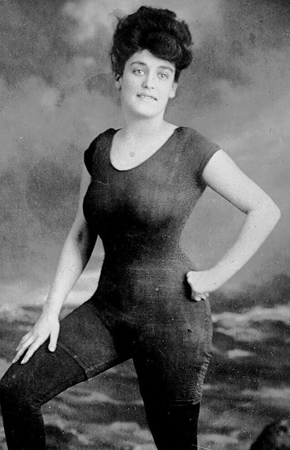
In 1907, Australian swimmer Annette Kellerman stood on a Massachusetts beach wearing something unbelievable for its time:
A one-piece swimsuit.
It exposed her arms.
It exposed her legs.
Her neck was uncovered.
The horror.
Kellerman — an athlete, performer, and feminist — insisted that women deserved practical swimwear. Her story became legendary when she claimed she was arrested for public indecency.
While official police records never confirmed the arrest, newspapers at the time described widespread outrage at her “shocking” attire.
But the public reaction surprised everyone:
Women loved her swimsuit.
Demand skyrocketed. Soon Kellerman launched her own swimwear line — the first modern women’s swimwear brand in history.
Her boldness didn’t just change fashion. It opened a doorway for the next revolution.
The 1920s: When Women Decided to Rewrite the Rules
The 1920s brought flappers, jazz, and a cultural shift toward freedom. The same rebellious spirit reached the beaches.
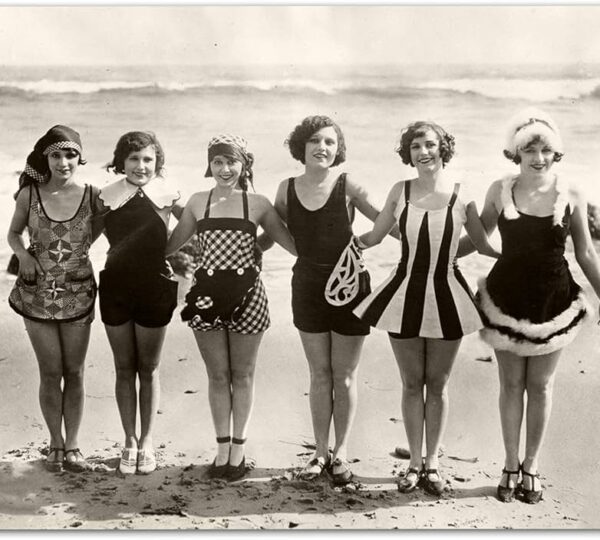
On California shores, a group of women known as the “skirts-be-hanged girls” rejected bulky swimwear. They wanted mobility, function, and comfort.
Their designs were empowering — more fitted, more flexible, and far more practical than anything before.
For the first time, women’s arms, backs, and legs became visible in mainstream swimwear.
Society gasped. Fashion moved on anyway.
But the boldest leap was still years away.
1946: The Bikini Drops Like a Bomb
In July 1946, French engineer and designer Louis Réard introduced a two-piece swimsuit so revealing that no model wanted to wear it. He hired a nude dancer from the Casino de Paris to debut it.
And he gave it a name:
The bikini.
Just days earlier, the U.S. conducted nuclear tests at Bikini Atoll in the Pacific Ocean. Réard reportedly predicted his design would cause an explosion of public reaction — as shocking as an atomic bomb.
He was right.
Governments reacted immediately:
-
France banned bikinis from public beaches in 1949
-
Germany barred them from public pools until the 1970s
-
Italy, Portugal, Spain, Belgium, and other Catholic countries banned them
-
Communist governments condemned them as “capitalist corruption”
-
Pope Pius XII declared the bikini sinful
In the U.S., many beaches prohibited them entirely. Women could be — and were — fined or removed for wearing one.
One Australian model, Ann Ferguson, was ordered off Surfers Paradise beach in 1952 for wearing a bikini too “daring.”
The world was furious.
But women kept buying the bikini.
And slowly, the bans began to crumble.
The Viral Photo Mystery — Was a Woman Really Ticketed for Wearing a Bikini?
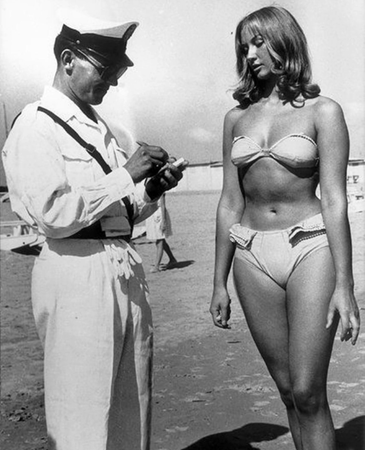
A famous black-and-white photograph has circulated online for years. It shows:
-
A woman in a bikini on a beach
-
A stern man in uniform beside her
-
What looks like a ticket being issued
Millions believed it showed a real arrest in Rimini, Italy, in 1957.
In 2023, the photo went viral again, gaining over 31,000 Reddit upvotes. But historians later revealed the truth:
The photo is real —
but the story behind it is unclear.
There is no proof the woman was fined for her bikini.
It may have been staged, or the officer may have been speaking to her for an unrelated reason.
However, Gianluca Braschi, director of the State Archives of Rimini, confirmed that Italy did have swimwear laws at the time.
A 1932 law prohibited:
“bathing in public view in a state of complete nudity and with indecent swimwear.”

This law technically remained in effect until 2000.
So even if the story remains a mystery, its context is undeniably real:
Wearing a bikini in the 1950s could truly get a woman in trouble.
Hollywood Changes Everything
By the 1960s, culture was shifting.
Music grew bolder. Cinema became more daring. Women’s rights movements were gaining strength.
And Hollywood stepped in with a wave of unforgettable bikini moments:
Brigitte Bardot — The Girl Who Made the Bikini Iconic
Her role in The Girl in the Bikini (1952) made international headlines. Bardot didn’t just wear a bikini — she embodied it.
Relaxed, sensual, confident, rebellious.
She became the first actress to make the bikini a central part of a film’s identity.
Ursula Andress — The Birth of the Bond Girl
In 1962, Andress walked out of the water in Dr. No wearing a white bikini and a knife at her hip.
The iconic scene redefined cinematic sexuality. It was strong, bold, unforgettable — and it made the bikini a global sensation.
Marilyn Monroe, Raquel Welch, and others further cemented the bikini’s mythic status.
And once Hollywood embraced it, society followed.
The 1970s–1990s: From Scandal to Standard
By the 1970s, the bikini was everywhere:
-
String bikinis
-
Thong bikinis
-
Metallic bikinis
-
High-cut 80s styles
-
Neon 90s looks
The modesty of earlier decades vanished.
Men’s swimwear shrank too — no more wool shorts or knee-length suits.
The bikini was no longer rebellion.
It was mainstream.
Today: Body Positivity, Choice, and Freedom
In the 21st century, swimwear reflects something deeper than skin:
Self-expression.
The modern swimwear industry is vast — inclusive of all shapes, sizes, styles, genders, and cultures. Women choose:
-
full-coverage suits
-
athletic swimwear
-
tankinis
-
high-waisted bikinis
-
thongs
-
burkinis
-
one-pieces
-
custom adaptive swimwear
The bikini, once a symbol of rebellion, is now simply one option among many.
Society has shifted from shaming women to empowering them — letting individuals decide what comfort, beauty, and confidence mean.
The era of “decency police” is long gone.
Today, the only rule that matters is:
Wear what makes you feel free.
One small piece of fabric. That was all it took to ignite global outrage, spark moral debates, provoke religious condemnation, and even lead to arrests on beaches around the world.
Few garments in human history have been as controversial — or transformative — as the bikini.
Across decades, it became a symbol of rebellion, liberation, sexuality, fashion, and social change. It was banned by governments, condemned by religious leaders, and rejected by communities…
Yet women kept wearing it. And with each decade, with every bold design, the bikini helped reshape society’s ideas about modesty, gender, freedom, and the human body.
The Early 1900s: When Modesty Ruled the Shoreline
In the early 20th century, swimwear looked nothing like the sleek styles we know today. Instead of fashion, function, or comfort, the rules were simple:
Cover everything.
Swimsuits were heavy, knee-length wool garments designed to conceal a woman’s shape. They were often paired with stockings, caps, and shoes — even in the water.
The goal was not to swim beautifully or comfortably but to maintain “respectability.”
From Chicago’s Clarendon Beach to the shores of New England, strict dress codes were enforced.
According to historians Kathleen Morgan Drowne and Patrick Huber, some beaches even hired tailors to modify swimsuits on the spot if too much skin showed.
At Coney Island, “dimpled knees” were illegal to display.
In Washington, D.C., beach police used measuring tapes to check a woman’s skin exposure.
These rules sound absurd now, yet they reflected a real fear — the belief that seeing too much of a woman’s body could upset society’s moral foundation.
But change was coming.
Annette Kellerman: The Woman Arrested for a One-Piece Swimsuit
In 1907, Australian swimmer Annette Kellerman stood on a Massachusetts beach wearing something unbelievable for its time:
A one-piece swimsuit.
It exposed her arms.
It exposed her legs.
Her neck was uncovered.
The horror.
Kellerman — an athlete, performer, and feminist — insisted that women deserved practical swimwear. Her story became legendary when she claimed she was arrested for public indecency.
While official police records never confirmed the arrest, newspapers at the time described widespread outrage at her “shocking” attire.
But the public reaction surprised everyone:
Women loved her swimsuit.
Demand skyrocketed. Soon Kellerman launched her own swimwear line — the first modern women’s swimwear brand in history.
Her boldness didn’t just change fashion. It opened a doorway for the next revolution.
The 1920s: When Women Decided to Rewrite the Rules
The 1920s brought flappers, jazz, and a cultural shift toward freedom. The same rebellious spirit reached the beaches.
On California shores, a group of women known as the “skirts-be-hanged girls” rejected bulky swimwear. They wanted mobility, function, and comfort.
Their designs were empowering — more fitted, more flexible, and far more practical than anything before.
For the first time, women’s arms, backs, and legs became visible in mainstream swimwear.
Society gasped. Fashion moved on anyway.
But the boldest leap was still years away.
1946: The Bikini Drops Like a Bomb
In July 1946, French engineer and designer Louis Réard introduced a two-piece swimsuit so revealing that no model wanted to wear it. He hired a nude dancer from the Casino de Paris to debut it.
And he gave it a name:
The bikini.
Just days earlier, the U.S. conducted nuclear tests at Bikini Atoll in the Pacific Ocean. Réard reportedly predicted his design would cause an explosion of public reaction — as shocking as an atomic bomb.
He was right.
Governments reacted immediately:
-
France banned bikinis from public beaches in 1949
-
Germany barred them from public pools until the 1970s
-
Italy, Portugal, Spain, Belgium, and other Catholic countries banned them
-
Communist governments condemned them as “capitalist corruption”
-
Pope Pius XII declared the bikini sinful
In the U.S., many beaches prohibited them entirely. Women could be — and were — fined or removed for wearing one.
One Australian model, Ann Ferguson, was ordered off Surfers Paradise beach in 1952 for wearing a bikini too “daring.”
The world was furious.
But women kept buying the bikini.
And slowly, the bans began to crumble.
The Viral Photo Mystery — Was a Woman Really Ticketed for Wearing a Bikini?
A famous black-and-white photograph has circulated online for years. It shows:
-
A woman in a bikini on a beach
-
A stern man in uniform beside her
-
What looks like a ticket being issued
Millions believed it showed a real arrest in Rimini, Italy, in 1957.
In 2023, the photo went viral again, gaining over 31,000 Reddit upvotes. But historians later revealed the truth:
The photo is real —
but the story behind it is unclear.
There is no proof the woman was fined for her bikini.
It may have been staged, or the officer may have been speaking to her for an unrelated reason.
However, Gianluca Braschi, director of the State Archives of Rimini, confirmed that Italy did have swimwear laws at the time.
A 1932 law prohibited:
“bathing in public view in a state of complete nudity and with indecent swimwear.”
This law technically remained in effect until 2000.
So even if the story remains a mystery, its context is undeniably real:
Wearing a bikini in the 1950s could truly get a woman in trouble.
Hollywood Changes Everything
By the 1960s, culture was shifting.
Music grew bolder. Cinema became more daring. Women’s rights movements were gaining strength.
And Hollywood stepped in with a wave of unforgettable bikini moments:
Brigitte Bardot — The Girl Who Made the Bikini Iconic
Her role in The Girl in the Bikini (1952) made international headlines. Bardot didn’t just wear a bikini — she embodied it.
Relaxed, sensual, confident, rebellious.
She became the first actress to make the bikini a central part of a film’s identity.
Ursula Andress — The Birth of the Bond Girl
In 1962, Andress walked out of the water in Dr. No wearing a white bikini and a knife at her hip.
The iconic scene redefined cinematic sexuality. It was strong, bold, unforgettable — and it made the bikini a global sensation.
Marilyn Monroe, Raquel Welch, and others further cemented the bikini’s mythic status.
And once Hollywood embraced it, society followed.
The 1970s–1990s: From Scandal to Standard
By the 1970s, the bikini was everywhere:
-
String bikinis
-
Thong bikinis
-
Metallic bikinis
-
High-cut 80s styles
-
Neon 90s looks
The modesty of earlier decades vanished.
Men’s swimwear shrank too — no more wool shorts or knee-length suits.
The bikini was no longer rebellion.
It was mainstream.
Today: Body Positivity, Choice, and Freedom
In the 21st century, swimwear reflects something deeper than skin:
Self-expression.
The modern swimwear industry is vast — inclusive of all shapes, sizes, styles, genders, and cultures. Women choose:
-
full-coverage suits
-
athletic swimwear
-
tankinis
-
high-waisted bikinis
-
thongs
-
burkinis
-
one-pieces
-
custom adaptive swimwear
The bikini, once a symbol of rebellion, is now simply one option among many.
Society has shifted from shaming women to empowering them — letting individuals decide what comfort, beauty, and confidence mean.
The era of “decency police” is long gone.
Today, the only rule that matters is:
Wear what makes you feel free.