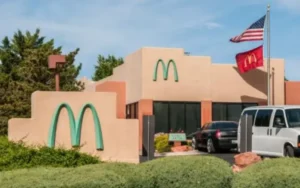
If you ever find yourself wandering through the magical desert town of Sedona, Arizona, there’s something you absolutely can’t miss — and it’s not just the towering red rocks or peaceful energy vortexes. It’s something far more unexpected. At the corner of Highway 89A, tucked among the rust-colored cliffs and bright desert skies, you’ll spot a McDonald’s unlike any other in the world.
That’s right — instead of the famous golden arches we all grew up with, this McDonald’s sports arches in a striking turquoise blue.
You might be wondering, why turquoise? Why would the most recognizable brand on Earth decide to ditch its signature color? As it turns out, the answer isn’t just a fun fact it’s a story of compromise, local pride, and a deep respect for nature that’s worth sharing.
And yes, it’s also a story that’s caught the attention of travelers, fast food lovers, and fans of quirky Americana all across the country.
The Only McDonald’s With Blue Arches A Tale Rooted in Red Rock Country
Sedona isn’t your average town. Located in the heart of northern Arizona, it’s surrounded by dramatic red rock formations that seem to glow at sunrise and sunset. The town has built its identity around these stunning natural backdrops. Residents, city officials, and business owners alike have worked hard to protect that unique aesthetic and that includes how buildings look.
So when McDonald’s came knocking in the early 1990s, hoping to open a new location in town, they were met with a serious design challenge.
Sedona had strict guidelines. Buildings had to blend in with the desert landscape. No flashy lights. No bright, bold colors. Everything — from rooftops to signage — needed to complement the natural scenery.
Needless to say, the iconic golden arches just didn’t make the cut.
City planners and community members worried that the yellow would clash too strongly with the earthy reds and browns of the surrounding rocks. The last thing Sedona wanted was a garish symbol sticking out like a sore thumb in their serene desert landscape.
A New Color for an Old Classic: Why Turquoise Was Chosen
After much discussion, the solution came in the form of turquoise a cool, calming shade of blue-green that not only softened the fast food chain’s presence, but also held cultural significance.
Turquoise has long been associated with the Southwest. Native American tribes like the Navajo and Hopi have used it for centuries in jewelry, art, and ceremonial items. It’s a color tied to the land, to history, and to the spirit of the desert.
So it made sense — if any color was going to replace gold, it would be turquoise.
In 1993, McDonald’s agreed to the compromise. The building was designed with low, earthy tones to blend in with Sedona’s adobe-style architecture, and instead of their classic yellow, the arches were given that now-famous turquoise hue.
It was the first — and to this day, only — McDonald’s in the world to make such a change.
Locals and Tourists Alike Fell in Love With the Change
You might think that changing something as iconic as the golden arches would spark backlash or confusion. But quite the opposite happened.
The turquoise arches became a local treasure.
Travelers passing through would often pull over just to snap a photo. It became a tourist destination all its own — a quirky roadside attraction that also happened to serve fries and Big Macs. For locals, it was a point of pride: proof that Sedona could stand up to a global brand and still protect its charm.
Older visitors, especially, find something nostalgic and refreshing about it. It reminds many of a time when communities had more say in how their towns looked — when a business had to work with the town, not bulldoze over it. And in a world where so many places feel cookie-cutter, this little blue twist is a breath of fresh air.
A Symbol of Harmony: When Corporate Meets Community
What happened in Sedona is more than just a marketing curiosity — it’s an example of how even the biggest corporations can adapt and listen.
The turquoise arches aren’t just about color. They’re about compromise, care, and community values. They show that it’s possible to respect local beauty while still doing business. And that message seems to be resonating far beyond Arizona.
In fact, over the years, other McDonald’s locations in scenic towns and national parks have taken notes. From muted color schemes to more natural materials in their architecture, the fast-food giant has slowly begun to blend into some of America’s most beloved landscapes.
But none have gone quite as far — or made as bold a visual statement — as the McDonald’s in Sedona.
What It Means for the Rest of Us
This small change in one desert town offers a gentle reminder for the rest of us, especially those of us who remember what towns used to feel like — more personal, more connected to the land, more mindful.
Whether you’re retired, traveling, or just feeling nostalgic for quieter times, it’s comforting to know that there are still places like Sedona, where community voices are heard and natural beauty is respected.
The turquoise arches remind us that not everything has to be big, loud, and bright to be meaningful. Sometimes, the most powerful statement comes in a quieter, more thoughtful form.
Planning a Visit? Don’t Miss This Unlikely Landmark
If you’re heading to Arizona or exploring Route 66 or the Grand Canyon region, consider adding Sedona to your travel list. The town is known for more than just red rocks. You’ll find art galleries, charming cafes, scenic hiking trails, and yes — the one and only McDonald’s with turquoise arches.
Snap a picture, grab a bite, and soak in the view. It’s not every day you get to experience a piece of corporate history shaped by a town’s love for its natural surroundings.
And who knows seeing that splash of turquoise in the middle of the desert might just make you smile in a way you didn’t expect.
A Little Blue Goes a Long Way
At the end of the day, Sedona’s turquoise arches are a testament to what can happen when people work together to preserve what makes a place special. It’s a feel-good story in a world that sometimes forgets the value of slowing down and looking around.
So the next time you pass a fast food restaurant, or drive through a small town, think about how a simple choice even the color of a sign can say so much about the values of a place and the people who live there.
We might not all live in Sedona, but we can still carry that spirit of harmony and respect wherever we go.