You’ve probably handled coins thousands of times without ever really thinking about them. A quarter tossed onto a counter, a handful of change dropped into a jar, a coin spun absentmindedly across your fingers during a quiet moment. They feel ordinary—almost invisible in daily life.
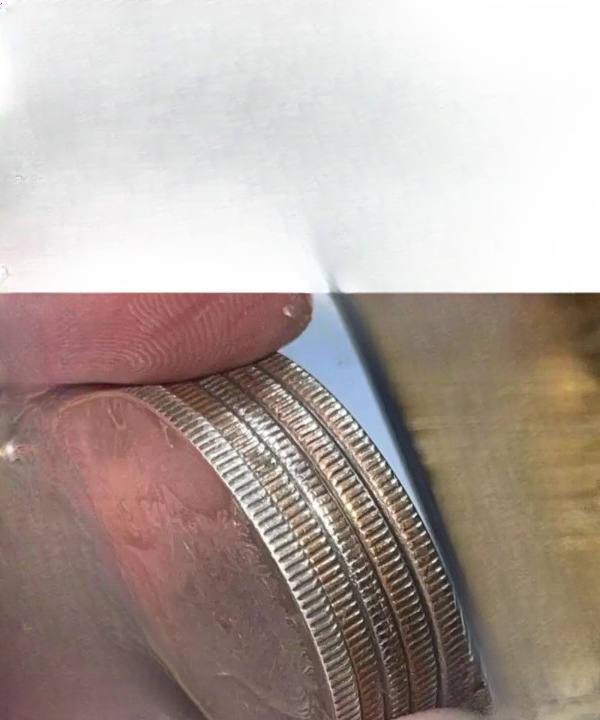
But if you pause for a second and run your thumb along the edge of a coin, something becomes noticeable. The surface isn’t smooth. It’s lined with tiny, evenly spaced grooves. They feel intentional, engineered, precise.
Those ridges are not decorative. They are not random. And they are far more important than most people realize.
They are a physical reminder of a time when money could be quietly stolen—not through robbery, but through something almost imperceptible: shaving off its value one microscopic piece at a time.
To understand why coin edges look the way they do today, you have to go back several centuries, to an era when coins were made from real silver and gold. Their worth wasn’t symbolic—it was embedded in the metal itself. A silver coin wasn’t just a representation of value. It was the value.
And that made it vulnerable.
The Era of “Coin Clipping”
In early modern Europe, one of the most persistent financial crimes was something known as coin clipping. The concept was simple but devastatingly effective.
Criminals would take coins made of precious metal and shave off tiny fragments from the edges. These shavings—barely noticeable individually—were collected over time, melted down, and sold. The altered coins were then passed back into circulation at full face value.
To an average person receiving the coin, nothing seemed wrong. It still looked like money. It still functioned like money. But it wasn’t. Each clipped coin represented a small loss. Multiply that across thousands or millions of transactions, and the damage became enormous.
What made coin clipping especially dangerous was its subtlety. It didn’t rely on force or open theft. It relied on invisibility. The system was being drained slowly, almost politely, until economies began to feel the strain.
Merchants grew suspicious. Governments lost revenue. Confidence in currency weakened—not because money stopped existing, but because people stopped trusting it.
At its peak, coin clipping wasn’t just a crime problem. It was a systemic threat to financial stability.
A Problem That Required a Design Solution
By the late 17th century, European governments realized that punishment alone wasn’t solving the issue. Even when clippers were caught and executed or imprisoned, the crime continued. The incentive remained too strong, and detection too difficult.
What was needed was not just enforcement, but prevention built directly into the currency itself.
In England, that responsibility eventually fell to an unexpected figure: Isaac Newton.
Known today for his contributions to physics and mathematics, Newton was appointed Warden of the Royal Mint in 1696. His role placed him at the center of a financial system under pressure from widespread counterfeiting and coin clipping.
Newton approached the problem with the same mindset he used in science—observe the system, identify its weaknesses, and redesign it so that failure becomes obvious.
His solution was deceptively simple.
The Introduction of Reeded Edges
Newton’s answer was the introduction of ridged coin edges, known as reeded edges.
Instead of smooth sides, coins were struck with a series of fine, uniform grooves around their circumference. This design immediately changed the game.
If someone attempted to shave or clip a coin, the ridges would be visibly disrupted. Even a small alteration would break the pattern. A clipped coin could no longer pass unnoticed.
In other words, the coin itself became its own security system.
The brilliance of the design wasn’t in complexity—it was in visibility. Fraud could no longer hide in subtlety. It became detectable at a glance or even by touch.
Newton didn’t stop there. During his time at the Mint, he also led aggressive investigations into counterfeiters and organized reforms that strengthened the integrity of British currency. But the ridged edge remained one of his most enduring contributions.
It was an early example of what we might now call built-in fraud prevention—security embedded directly into the object, rather than enforced externally.
Why the Design Still Exists Today
Even though most modern coins are no longer made of silver or gold, the ridges have never disappeared. In fact, they remain standard in many currencies around the world.
At first glance, this might seem unnecessary. After all, if the metal itself is no longer valuable in the same way, why continue using a design meant to protect it?
The answer lies in function, continuity, and accessibility.
Modern coins still need to be identifiable as authentic. Machine systems used in vending machines, transit systems, and automated counters rely on physical characteristics—including edge patterns—to verify legitimacy. The ridges help distinguish real coins from counterfeit ones with greater accuracy.
But there’s another reason, one that has nothing to do with machines.
For people who are blind or visually impaired, coin edges serve as a tactile system of identification. Different coins often have different edge patterns—some ridged, some smooth, some variably spaced—allowing users to distinguish denominations by touch alone. It’s a quiet but meaningful accessibility feature built into everyday currency.
What began as a defense against theft has evolved into a tool for inclusion.
Why Some Coins Are Still Smooth
Not all coins have ridges. In many currencies, lower-value coins such as pennies or nickels are left smooth.
This is not an oversight. It reflects economic logic.
Since these coins contain little to no precious metal, there was historically no incentive for criminals to clip them. Altering them wouldn’t produce any meaningful gain. As a result, the added security of ridging was unnecessary.
Instead, smooth edges became a silent indicator of lower intrinsic risk value, while ridged coins were reserved for higher-value denominations.
Even today, that distinction remains part of many monetary systems.
A Design You Rarely Notice—but Always Use
What makes coin ridges fascinating is not just their history, but their invisibility in daily life. Most people never consciously think about them. They are felt more often than they are observed, and used more often than they are acknowledged.
Yet they represent one of the earliest forms of embedded financial security.
Long before digital encryption, blockchain systems, or fraud detection algorithms, there was a simple physical solution: change the shape of the object so that tampering becomes obvious.
It’s a reminder that security doesn’t always need to be complex. Sometimes it just needs to be unavoidable.
The Larger Lesson Behind the Grooves
Beyond their historical function, coin ridges carry a broader message about how systems evolve.
When a weakness is exploited repeatedly, solutions eventually shift from reaction to design. Laws punish behavior after the fact. Design prevents it from happening in the first place.
The ridged coin is a perfect example of that shift. Instead of chasing criminals endlessly, the system was adjusted so that the crime itself became self-exposing.
That principle extends far beyond currency. It appears in modern cybersecurity, product design, packaging, transportation systems, and even architecture.
The most effective safeguards are often the ones you never think about—because they work before you ever need to notice them.
A Quiet Legacy in Your Pocket
So the next time you hold a coin, take a moment to feel its edge. Those tiny grooves are not just texture. They are history pressed into metal.
They represent a time when trust had to be physically engineered into money itself. They reflect the ingenuity of a scientist who helped redesign an entire system to protect it from invisible loss. And they continue to serve quiet, practical purposes in a world that rarely stops to question them.
Coin ridges are easy to overlook.
But they are also one of the clearest examples of how small design choices can protect something far larger than themselves.
Sometimes, the strongest protections are not the ones we see.
They are the ones we simply feel—and never think twice about.
Uncategorized