I spent fifteen years training Marines in hand-to-hand combat. Fifteen years watching young men and women transform fear into skill, hesitation into instinct. I taught them how to anticipate danger, how to move efficiently, how to protect themselves and their comrades. And through it all, there was one rule I drilled into them relentlessly: never lay a hand on a civilian. The reasoning was simple, though often misunderstood. Civilians weren’t soldiers. Civilians didn’t sign up for the fight. And, above all, the mark of a true warrior wasn’t measured by how quickly you could strike—it was measured by when, and if, you chose to strike at all.
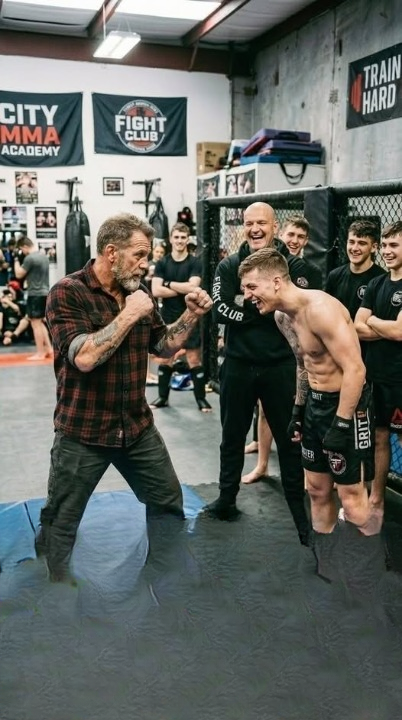
I never expected to test that rule in my personal life. I never expected to be standing in a dimly lit gym in the middle of the city, surrounded by young fighters who thought violence was a sport and fear was a joke. The smell of sweat and leather filled the air. Heavy bags swayed, and the sound of fists meeting pads reverberated like the distant echoes of a battlefield. And there he was—Dustin. My daughter’s tormentor. Her cage. He smirked like he owned the place, like he owned her, like he owned anyone who tried to get in his way.
I didn’t flinch. I didn’t raise my voice. I didn’t even tighten my fists. For a moment, I let him think he had the upper hand. His arrogance was a shield, one that made him underestimate the depth of what he was facing. I could have ended it in seconds. I could have shown him exactly why Marines are feared. I could have taught those young fighters a lesson in fear, right here, right now. But I didn’t.
Because strength without control is meaningless. Violence without purpose is just another mark of weakness. I had taught Marines to survive, to protect, to dominate—but I had also taught them to restrain themselves, to understand that the most powerful action is often the one you don’t take.
I spoke slowly, deliberately. I let my voice carry the weight of experience. “Dustin,” I said, “you’ve been walking around like this is a joke. Like you can threaten people, like you can hurt people without consequence. Let me be clear. Every move you’ve made, every choice, every threat—it stops here. And it stops on paper, not in your face.”
He laughed, the kind of laugh that comes from ignorance, from the illusion of control. He thought I was bluffing. But I wasn’t. I had spent years preparing Marines for life-and-death situations. I had walked into battles where hesitation could mean death. And I had learned something crucial: power is not just the ability to hit. Power is the ability to hold back. Power is using your knowledge to protect, not punish.
I could have broken him in front of his friends. One solid strike, one precise technique, and Dustin would have learned fear. He would have felt the full weight of what it means to cross someone trained to survive chaos. But that wouldn’t have solved anything. That would have been a performance. That would have been satisfying in the short term but hollow in the long term. The real battle wasn’t here, in the gym. The real battle was helping my daughter reclaim her safety, her voice, and her life.
I laid out the facts. Not threats, not bravado—facts. Every mark on her body was now evidence. Every text, every call, every manipulation was now documentation. The law, the system, the consequences—these were now my weapons. He could no longer act in the shadows. He was exposed. And I would make sure the exposure had teeth. The young fighters around him could see the shift in the room. They could sense it, even if they didn’t understand it. The air itself changed. Dustin’s smirk faltered. For the first time, he realized this wasn’t a man playing by the street rules. This was someone who had walked through real combat and understood the difference between a fight won with fists and a fight won with control.
I reminded him of that rule I lived by: Marines never lay a hand on a civilian. I didn’t need to explain the moral reasoning; the implication was enough. The law was the extension of that principle. Every assault, every act of violence against someone who didn’t choose the fight, would be met with a response greater than anything he could imagine. And I would ensure it was relentless. My daughter didn’t have to fight him alone. She had me, and I knew exactly how to wield power responsibly.
Dustin’s friends shifted uneasily. They were used to seeing strength expressed as domination, as physical aggression. They weren’t prepared for the quiet, calculated authority of someone who had survived war and chose to restrain himself. That is a different kind of power—one that doesn’t need to punch a hole in the wall to prove it exists. I didn’t shout. I didn’t threaten. I didn’t escalate. I laid out the cold, unshakable facts of accountability, and that was enough.
Walking away from that gym wasn’t weakness. Walking away was control. It was the ultimate demonstration of power: the ability to see the bigger picture, to protect rather than punish, to win without needing to destroy. I left Dustin with a clear understanding: the game had changed. He no longer had freedom to terrorize. The stakes were higher than he realized. The playground of fear he had built for himself was now a courtroom, a series of reports, a network of protective measures that he couldn’t simply punch his way out of.
Outside the gym, I found my daughter waiting. Her eyes were wide, cautious. She didn’t know what had just unfolded, but she knew it mattered. I held her close and explained what I had done—not the details, not the threats, but the principle. “You don’t have to fight him,” I told her. “You never should. You have me, and we’ll make sure you’re safe. That’s how you reclaim control over your life. Not by hurting anyone else, but by protecting yourself and demanding accountability.”
It wasn’t an instant fix. Trauma isn’t repaired with a single act of courage. But it was the beginning. Every report filed, every measure put in place, every boundary established was a step toward healing. My daughter began to see that she didn’t have to live in fear. She didn’t have to measure every action, every step, every word for the possibility of danger. She could start reclaiming her life—safely, deliberately, and without the need for violence to validate her power.
Fifteen years of teaching Marines had led to this moment. All the drills, all the combatives, all the late-night lectures about restraint—they culminated in the simple truth I had lived by: real strength is not in how you can dominate, but in how you choose to protect. The gym was a battlefield in miniature, and I walked through it without throwing a punch. And in doing so, I taught my daughter the most important lesson of all: strength without control is nothing, and love without boundaries is dangerous.
Dustin will remember that day, not for a strike he never received, but for the reality he couldn’t escape. My daughter will remember it, too—not for fear, but for the knowledge that she has the right to safety, the right to speak, and the right to reclaim her life. And I will carry forward the Marine rule, not just for my students, but for the daughter I fought to protect without ever laying a hand on the one who tried to harm her.
Because sometimes, the hardest fight is the one you don’t fight physically, and the strongest hand is the one that restrains.
Uncategorized