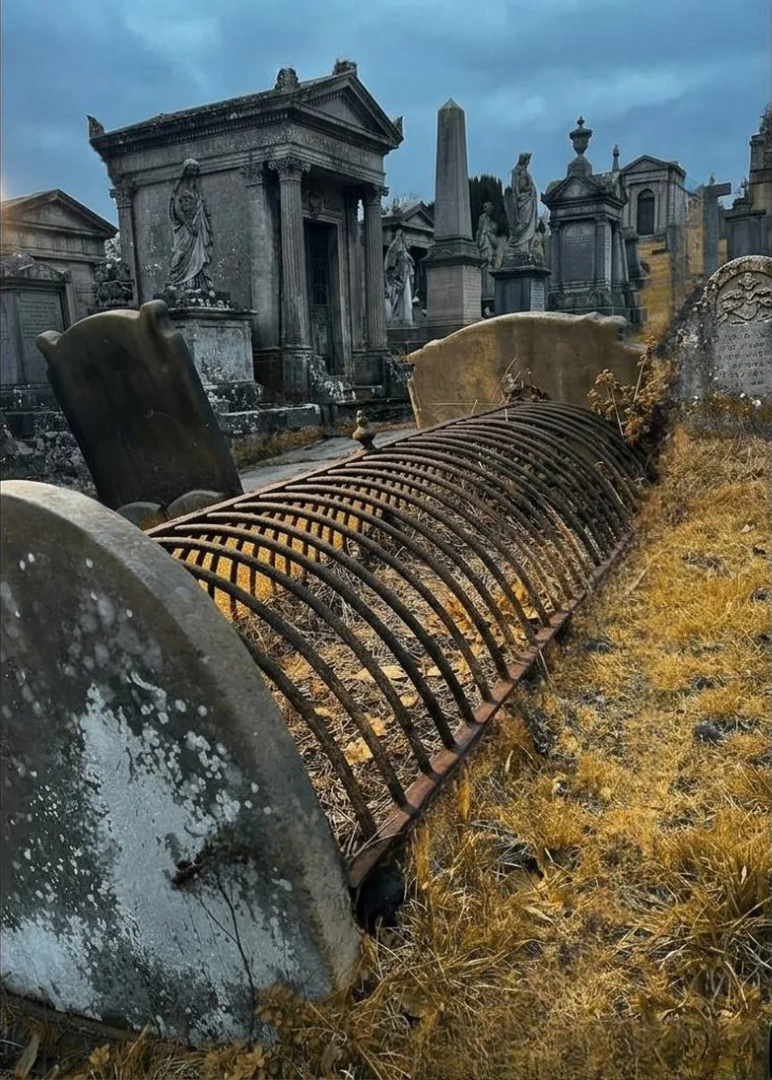
Walking through an old cemetery in parts of Europe, you might occasionally notice something unusual among the weathered headstones and moss-covered stone markers. Instead of only simple graves, some burial sites are enclosed in heavy iron frames—almost like cages resting over the ground. At first glance, they can look unsettling or even mysterious, as if they were meant to keep something in rather than protect something within.
But these structures, known as mortsafes, were never meant to be frightening. They were built for a very practical—and deeply human—reason.
Centuries ago, particularly during the 18th and 19th centuries, burial grounds were not always as peaceful as we imagine them today. While cemeteries were intended to be places of rest and remembrance, there was a troubling reality beneath the surface: grave robbing was a real and widespread concern in parts of Europe.
The reason behind it was not superstition or crime for its own sake, but demand—specifically from the growing field of medical science. As universities expanded their medical programs, there was an increasing need for human bodies to study anatomy. However, legal sources of cadavers were extremely limited at the time. This imbalance created an illegal trade in which recently buried bodies were sometimes stolen from graves and sold to medical schools.
For families who had just laid a loved one to rest, this possibility was deeply distressing. The idea that a grave might not guarantee peace after death created widespread fear and uncertainty in many communities.
In response, people began developing protective measures to safeguard burial sites. One of the most striking solutions was the mortsafe.
These were heavy iron structures placed directly over graves, designed to make it extremely difficult—often nearly impossible—for anyone to disturb the burial site. Constructed from thick iron bars and reinforced frames, mortsafes were not permanent fixtures in most cases. Instead, they were typically used during the early weeks after burial, when the risk of grave robbing was believed to be highest.
Families or local communities would sometimes rent these protective devices, installing them over fresh graves and leaving them in place until natural decomposition had progressed far enough that the body was no longer of interest for illegal removal. The presence of these iron covers acted as both a physical barrier and a psychological deterrent.
In some regions, protecting graves became a shared community effort. Neighbors took turns watching over cemeteries at night, and in certain towns, cemetery guards were even employed to patrol burial grounds. It was a time when fear and responsibility intertwined, shaping unusual but meaningful customs around death and burial.
Although mortsafe structures may appear harsh or unsettling through a modern lens, they reflect something deeply human: the desire to protect loved ones even after death. They were not symbols of cruelty, but of care—an attempt to preserve dignity in an era when legal systems had not yet caught up with scientific demand.
Eventually, this practice faded as society evolved. Governments introduced stricter laws regulating medical research and human dissection. One of the most important reforms was the establishment of legal donation systems for medical study, which reduced and eventually eliminated the need for grave robbing. As these changes took hold, the fear that once surrounded cemeteries gradually diminished.
With time, mortsafes became obsolete. Most were removed, repurposed, or left behind to rust quietly in old graveyards. Today, only a few remain, preserved as historical artifacts rather than functional objects.
Modern visitors who come across them often pause in curiosity, unsure of their purpose until they learn the story behind them. Once explained, however, these iron structures take on a very different meaning. They become reminders of a transitional period in history—when medicine was advancing rapidly, but ethical and legal frameworks were still catching up.
Standing before a mortsafe today invites reflection on how societies respond to uncertainty. It shows how communities, even in difficult times, created solutions to protect what they valued most. It also highlights how far medical ethics and laws have come in ensuring respect for the deceased while supporting scientific progress.
Ultimately, these iron covers are not just relics of fear—they are quiet witnesses to history. They tell a story of protection, change, and the long journey toward balancing knowledge with respect for human dignity.
Uncategorized