At first glance, it doesn’t look particularly impressive.
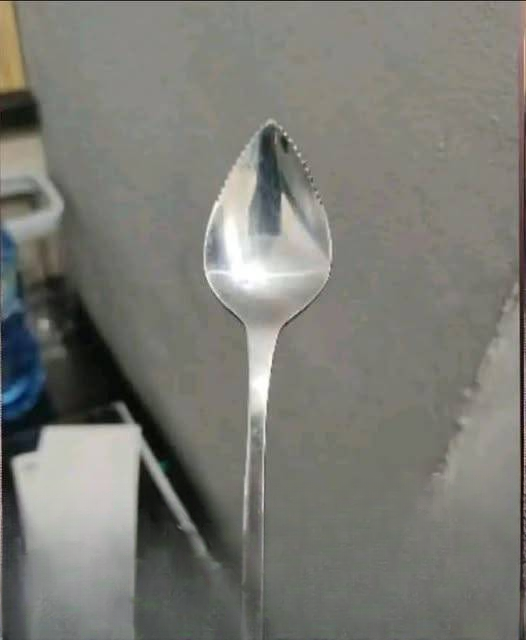
Most people notice it buried in a kitchen drawer and immediately wonder why it even exists. Its shape resembles an ordinary spoon, but the edges are lined with tiny serrations that make it appear oddly old-fashioned or unnecessarily complicated. Some assume it belongs to an outdated kitchen set. Others mistake it for a decorative utensil designed for special occasions nobody remembers anymore.
But this unusual little tool — known as a grapefruit spoon — is actually one of the smartest and most overlooked kitchen inventions ever created.
What makes it special is not complexity.
It is precision.
Unlike a standard spoon, a grapefruit spoon was specifically designed to solve a very frustrating problem: how to cleanly separate soft fruit from stubborn membranes, peels, and skins without turning the process into a messy struggle.
Anyone who has tried eating grapefruit with a regular spoon understands the issue immediately. The fruit’s juicy sections cling tightly to the surrounding membrane, forcing people to dig awkwardly, splash juice everywhere, or resort to using knives for delicate cutting work.
The grapefruit spoon quietly solves all of that.
Its tiny serrated edges glide between the fruit and membrane with surprisingly little effort. Instead of crushing or tearing the fruit apart, the spoon gently frees clean, neat sections in one smooth motion. Suddenly, eating grapefruit becomes less like kitchen labor and more like a simple, satisfying experience.
That small difference changes everything.
The brilliance of the design lies in how subtle it is. There are no moving parts, complicated gadgets, or unnecessary features. It simply combines the scooping shape of a spoon with delicate cutting edges that do exactly enough work to make difficult fruits easier to handle.
And once people use one properly, they often wonder how they ever managed without it.
But the grapefruit spoon’s usefulness extends far beyond grapefruit itself.
That is where the tool becomes unexpectedly versatile.
The same serrated edges that neatly separate citrus segments also work beautifully on many other soft fruits and foods that are usually slippery, delicate, or awkward to prepare. Kiwi, for example, becomes incredibly easy to scoop directly from the skin without wasting fruit. Passion fruit can be opened and eaten cleanly with almost no effort. Peaches and nectarines can be gently carved around the pit without damaging the soft flesh.
Even avocados benefit from the spoon’s clever design.
The edges trace smoothly along the inside of the peel, allowing the fruit to separate cleanly in perfect curved sections instead of collapsing into uneven chunks. Suddenly, preparing fruit feels more controlled, less messy, and strangely satisfying.
That quiet efficiency is what gives the grapefruit spoon its lasting appeal.
Many kitchen tools promise dramatic transformation but end up forgotten in drawers because they solve problems nobody actually has. The grapefruit spoon survives because it addresses a very real annoyance in an elegantly simple way.
It removes friction from small daily tasks.
And often, the best designs are the ones that quietly improve ordinary moments without demanding attention for themselves.
Part of the reason so many people overlook the grapefruit spoon is because its purpose is not immediately obvious. Unlike a whisk, a knife, or a peeler, the spoon exists in a strangely specific category that seems unnecessary until firsthand experience changes your perspective.
At first, people tend to laugh at it.
It looks overly specialized.
Almost excessive.
Why would anyone need a spoon with tiny teeth around the edge?
Then they try using it once.
And suddenly, something clicks.
The spoon slides effortlessly through grapefruit sections that previously required frustrating effort. It scoops kiwi cleanly from the skin in seconds. It handles soft fruit delicately without bruising or tearing it apart.
What once looked strange begins feeling oddly intuitive.
That transformation is part of the charm.
The grapefruit spoon belongs to a category of objects that reveal their value only through use. Reading about it does not fully explain the experience. Holding it in your hand while effortlessly separating fruit for the first time creates immediate understanding.
Afterward, many people stop viewing it as a novelty item entirely.
It simply becomes the “right” tool for certain jobs.
And once a person becomes accustomed to using the correct tool for a task, going back feels surprisingly inconvenient.
The spoon also reflects an era of kitchen design where utensils were often created with remarkable specificity. Before multipurpose gadgets dominated modern kitchens, many household tools were carefully designed around individual foods and preparation methods. While some of those inventions disappeared over time, others endured because they solved problems exceptionally well.
The grapefruit spoon survived because it works.
Its effectiveness also connects to something larger about human behavior and design psychology. People naturally appreciate tools that reduce frustration without adding complexity. The best inventions are often the simplest ones — objects that quietly make life smoother while requiring almost no learning curve.
The grapefruit spoon does exactly that.
There is also something nostalgic about it.
For many people, grapefruit spoons evoke memories of grandparents’ kitchens, family breakfasts, or carefully arranged silverware drawers from earlier decades. The utensil carries a subtle connection to slower routines and thoughtful dining habits that feel increasingly rare today.
That emotional familiarity gives the tool personality beyond mere function.
Even in modern kitchens filled with advanced gadgets and appliances, the grapefruit spoon still earns its place because its purpose remains timeless. Soft fruits continue being slippery. Citrus membranes remain stubborn. And people still appreciate easier, cleaner ways to prepare food.
Sometimes innovation does not require reinvention.
Sometimes it just requires one clever adjustment to something ordinary.
That is exactly what happened here.
By adding delicate serrated edges to a simple spoon, designers created a utensil capable of transforming small kitchen frustrations into smooth, controlled motions. The result feels surprisingly satisfying for something so simple.
Today, many people still discover grapefruit spoons accidentally — often inherited in old cutlery sets or found while sorting through kitchen drawers. At first, the utensil seems mysterious or oddly specific. But after using it once, most people immediately understand why it survived generation after generation.
It is not flashy.
It is not trendy.
It simply works extremely well.
And perhaps that is why the grapefruit spoon continues quietly earning loyalty from the people who give it a chance.
Because once you experience how effortlessly it handles grapefruit, kiwi, peaches, avocados, and other delicate fruits, it stops feeling like a “weird little spoon.”
Instead, it becomes one of those rare kitchen tools you instinctively reach for without even thinking about it.
A small invention.
A simple idea.
And a surprisingly satisfying reminder that good design often hides in the most ordinary objects.
Uncategorized