At first glance, this riddle seems absurdly simple. Most people read it and immediately feel confident they know the answer. But the clever wording tricks the human brain, causing hours of debate and confusion online. Some argue the store lost $200, others insist $170, and a few say $130. The source of the chaos? People often count the same $100 bill twice.
Here’s the scenario:
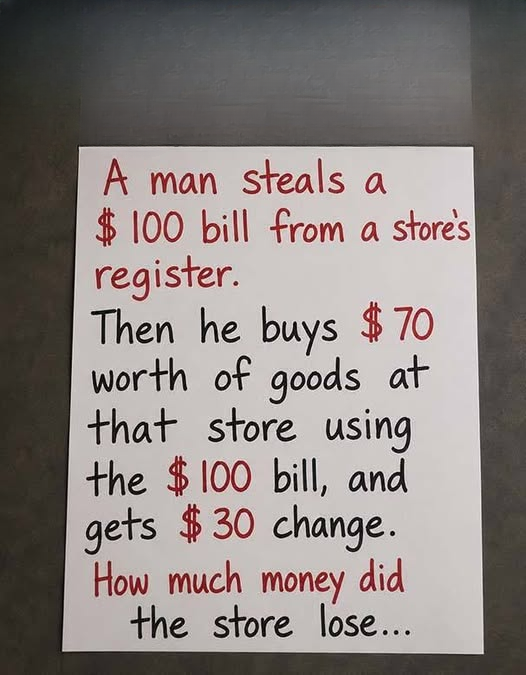
A man sneaks into a store and steals a $100 bill directly from the cash register. Later that same day, he returns as a customer, buys $70 worth of goods, and pays with the very $100 bill he stole. The cashier takes the bill, places it back in the register, and hands the man $30 in change.
At first, it seems confusing because money is moving multiple times, and we naturally want to “track” it in more than one way. But the key is to focus on what the store physically lost rather than trying to follow each piece of cash in isolation.
Let’s break it down carefully:
Step 1: The theft
The thief takes $100 from the register. At this moment, the store is down $100.
Step 2: The purchase
The thief buys $70 worth of merchandise using the stolen $100 bill. He hands the $100 back to the cashier. Physically, that same $100 bill is back in the register, so the cash balance itself is restored to the original state.
Step 3: Change given
The cashier gives the thief $30 in change. Now the store is missing $30 in cash, plus the $70 in goods that the thief took.
Step 4: Calculate the total loss
- Merchandise stolen: $70
- Change given: $30
$70 + $30 = $100 total loss
Notice that this calculation does not double-count the $100 bill that was stolen and then returned. Some people mistakenly add it again, thinking: “$100 stolen + $70 goods + $30 change = $200,” but that’s incorrect. The bill that was returned is no longer missing—it is back in the register.
Another way to visualize it is with a simpler analogy: Imagine the thief walks into the store and demands $70 worth of goods plus $30 cash, without ever giving a single dollar. The loss is obviously $100—the same as in our riddle. The difference is that the riddle’s trick makes our brains fixate on the movement of a single bill instead of the overall value lost.
The confusion often comes from mentally separating cash and goods, then adding the original $100 as if it were lost again. The trick is to always track what leaves the store permanently, not what moves temporarily.
Step 5: The final explanation
- Step 1: $100 is stolen (temporary loss)
- Step 2: $100 is returned to the register (loss canceled)
- Step 3: $70 in goods and $30 in cash leave permanently
Final loss = $70 + $30 = $100
No math tricks are required. You don’t need spreadsheets, algebra, or complex accounting. You just need to follow the physical outcome of what the store ends up missing at the end of the day.
Once people realize this, the riddle usually sparks one of two reactions: laughter at how simple it is, or frustration for having overcomplicated it. The puzzle is addictive because it challenges logic, not arithmetic. It forces you to separate mental assumptions from physical reality.
To summarize:
- The store temporarily loses a $100 bill, but it is returned.
- The thief takes $70 worth of goods and $30 cash as change.
- The total loss is therefore $100.
Everything else—debates about $130, $170, or $200—comes from counting the returned bill twice or trying to “track” the cash instead of the permanent loss.
This riddle reminds us that even a simple, everyday scenario can feel confusing if our brains impose unnecessary layers of complexity. By focusing on what is actually missing at the end, the solution becomes crystal clear:
The store lost exactly $100.
Uncategorized