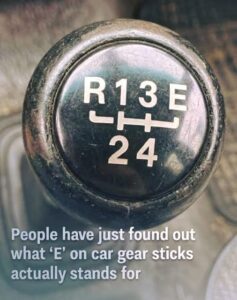
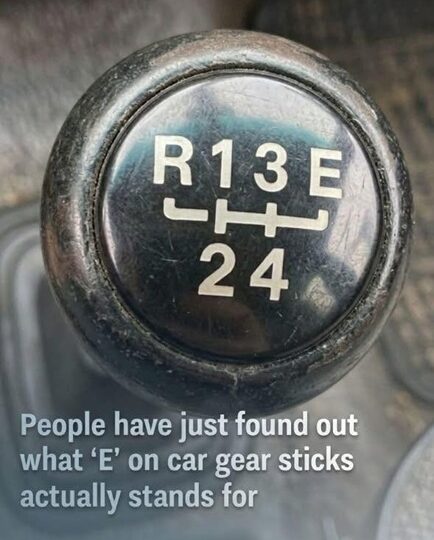
For many drivers today, automatic gear selectors are simple and intuitive, typically marked with letters such as P (Park), R (Reverse), N (Neutral), and D (Drive). These markings have become standard across modern vehicles and require little explanation for everyday use. However, in older automatic transmissions, some drivers may notice an additional marking—“E”—which often leads to confusion. Unlike the more familiar gear positions, the “E” was not part of the basic driving controls.
Instead, it represented a special driving mode found in certain older automatic vehicles. Its purpose was practical rather than decorative, designed specifically to influence how the vehicle behaved under certain driving conditions. In most cases, the “E” stood for “Economy.” This mode was engineered to improve fuel efficiency by adjusting the vehicle’s engine and transmission behavior. When engaged, the car would prioritize lower engine revolutions, smoother gear shifts, and reduced acceleration response.
The overall goal was to minimize fuel consumption during everyday driving. At a time when fuel efficiency was becoming increasingly important, especially during periods of rising fuel costs, this feature provided drivers with a simple way to manage consumption. Instead of requiring advanced driving techniques, the “E” mode allowed the vehicle to automatically adjust itself for more efficient performance.
Economy mode was especially useful during highway driving or long-distance travel. In such conditions, maintaining a steady speed is more important than rapid acceleration. By keeping engine output lower and reducing unnecessary gear changes, the vehicle could operate more efficiently over extended periods.
Fuel Efficiency∝Distance TraveledFuel Consumed\text{Fuel Efficiency} \propto \frac{\text{Distance Traveled}}{\text{Fuel Consumed}}
This simple principle explains why “E” mode was valued in older vehicles. By reducing fuel consumption per distance traveled, drivers could achieve better mileage without changing their driving habits significantly.
However, as automotive technology evolved, the need for a dedicated economy gear mode gradually decreased. Modern automatic transmissions became more advanced, incorporating electronic control systems that continuously monitor driving conditions in real time. These systems automatically adjust shifting patterns, engine output, and fuel injection without requiring manual selection from the driver.
With the introduction of computer-controlled engine management systems, vehicles gained the ability to optimize performance dynamically. Whether driving in city traffic, on highways, or uphill terrain, the car could adapt instantly to conditions. As a result, manual economy modes like “E” became less necessary and eventually disappeared from most modern gear selectors.
In many newer vehicles, especially those produced in the last two decades, the traditional “E” mode has been replaced by selectable driving modes such as Eco, Comfort, Sport, or Individual settings. These modes provide more refined control over performance and efficiency while relying on integrated electronic systems rather than mechanical adjustments.
Today, the concept behind the “E” has not disappeared entirely—it has simply evolved. In electric vehicles, for example, efficiency remains a central focus, but it is managed through software and battery optimization systems rather than a physical gear setting. Some electric and hybrid vehicles still use an “Eco” mode, which serves a similar purpose to the original “E” function.
Eco modes in modern vehicles typically adjust throttle response, climate control usage, and energy distribution to extend driving range. In electric vehicles, this can directly influence how far a car can travel on a single charge, making efficiency a critical part of vehicle performance.
Driving Range=Battery CapacityEnergy Consumption per km\text{Driving Range} = \frac{\text{Battery Capacity}}{\text{Energy Consumption per km}}
This evolution shows how automotive engineering has shifted from mechanical solutions to digital intelligence. What was once controlled by a simple gear selector is now managed by complex onboard computers that continuously optimize efficiency.
Despite these advancements, older vehicles with “E” mode remain an interesting reminder of how driving technology has changed over time. They reflect an era when drivers had more direct control over mechanical systems and when efficiency features were introduced in a more manual and visible way.
For automotive enthusiasts and historians, the “E” marking represents a transitional stage in vehicle development. It bridges the gap between purely mechanical transmissions and today’s intelligent driving systems, highlighting how innovation has steadily improved fuel efficiency and performance over decades.
Ultimately, whether labeled as “Economy” in older cars or “Eco” in modern vehicles, the purpose remains consistent: to make driving more efficient, reduce fuel or energy consumption, and improve overall sustainability. What has changed is not the goal, but the technology used to achieve it.