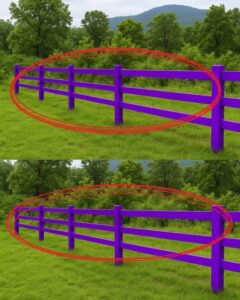
Exploring the outdoors often leads to unexpected and memorable discoveries. Whether it’s a hidden trail, an unfamiliar landscape, or an unusual landmark, these moments can spark curiosity and a desire to learn more. One such sight that frequently captures attention—especially in rural areas across the United States—is a fence, tree, or post marked with bright purple paint.
At first glance, many people assume this is simply a decorative choice. It may appear that a landowner selected a bold color to make their property stand out or to add a personal touch. However, the truth behind this distinctive marking is far more significant. A purple fence is not about aesthetics—it carries a clear and important message rooted in law and property rights.
Understanding the Meaning of Purple Paint
In many parts of the United States, purple paint serves as a legal indicator of private property. This practice is commonly referred to as the “Purple Paint Law.” Where it is recognized, it provides landowners with a simple yet effective way to communicate that entry onto their land is not permitted without permission.
Rather than relying solely on traditional “No Trespassing” signs, which can be damaged or removed, property owners use purple paint as a durable and highly visible alternative. When applied correctly, this marking holds the same legal weight as a posted sign in states where the law is in effect.
The message is straightforward: the marked area is private, and crossing into it without authorization may result in legal consequences.
Why Purple Was Chosen
The choice of purple as the designated color was not arbitrary. Lawmakers selected it for several practical reasons. First, purple stands out clearly against natural backgrounds such as trees, grass, and soil. Unlike green or brown, which can blend into the environment, purple is highly visible even from a distance.
Second, it is not commonly used for other warnings or markings. Colors like red, yellow, and orange are frequently associated with construction zones, hazards, or general caution. By selecting a less commonly used color, authorities ensured that purple would carry a distinct and recognizable meaning specific to property boundaries.
Over time, this color has become widely associated with private property restrictions in regions where the law applies.
The Origins and Purpose of the Law
The development of the Purple Paint Law was driven by practicality and efficiency. Traditional signage, while effective, comes with several challenges. Signs can fade over time, be knocked down by weather conditions, or even be intentionally removed. Replacing them repeatedly can be costly and time-consuming for landowners.
Paint, on the other hand, offers a more permanent solution. Once applied, it can remain visible for years with minimal maintenance. It is also more difficult to tamper with or remove, making it a reliable method of marking boundaries.
This approach benefits both landowners and the public. Property owners gain a low-maintenance way to protect their land, while visitors receive a clear and consistent visual signal indicating where access is restricted.
Legal Implications of Ignoring Purple Markings
In states where the Purple Paint Law is recognized, ignoring these markings can have serious consequences. Entering marked property without permission may be considered trespassing, which can lead to fines or other legal actions.
The exact penalties vary depending on local laws, but the principle remains the same: the paint serves as a legally valid warning. This is particularly important for individuals who spend time outdoors, such as hikers, hunters, and campers.
Recognizing and respecting these markings is essential for avoiding unintentional violations. A quick observation of a fence post or tree marked in purple can provide valuable information about property boundaries.
Variations Across States
It is important to note that the Purple Paint Law is not universal across the entire United States. Some states have fully adopted it, while others do not recognize it at all. In regions where it is enforced, there are often specific guidelines regarding how the paint must be applied.
These rules may include:
- The height at which the paint must be placed on a tree or post
- The size and shape of the markings
- The spacing between each marked point
These standards are designed to ensure that the markings are visible and consistent, reducing the likelihood of confusion. Because regulations can vary, individuals who frequently travel or explore different regions should familiarize themselves with local laws.
Benefits for Landowners
For property owners, the use of purple paint offers several advantages. It provides a clear, cost-effective method of marking boundaries without the need for frequent maintenance. This is especially valuable for individuals who own large areas of land, where installing and maintaining signs can be impractical.
Additionally, the visibility of the markings can help deter unauthorized entry. By clearly communicating property limits, landowners can reduce the risk of accidental trespassing and protect their property, livestock, and personal safety.
The system also supports legal clarity. In the event of a dispute, clearly marked boundaries can serve as evidence that proper notice was given.
A Social Signal of Respect and Boundaries
Beyond its legal significance, a purple fence or marking also carries a social message. It reflects a landowner’s expectation of privacy and their desire to maintain control over their property.
For those encountering these markings, the appropriate response is simple: respect the boundary. While curiosity may encourage exploration, honoring property lines is an important aspect of responsible outdoor behavior.
This mutual respect helps maintain positive relationships between landowners and the public, ensuring that outdoor spaces can be enjoyed safely and responsibly.
Practical Tips for Outdoor Enthusiasts
If you spend time hiking, camping, or exploring rural areas, it is helpful to be aware of visual cues that indicate property boundaries. Purple paint is one such cue that should never be ignored.
Here are a few practical tips:
- Stay observant of your surroundings, especially when entering wooded or unfamiliar areas
- Look for markings on trees, posts, or fences
- When in doubt, avoid crossing into areas that appear marked
- Seek permission if access is necessary
By following these guidelines, you can reduce the risk of unintentionally entering private property.
A Simple Color with a Powerful Message
What may appear to be a simple design choice is, in reality, a clear and legally supported form of communication. The use of purple paint transforms an ordinary fence or tree into a boundary marker with real significance.
Its effectiveness lies in its simplicity. Without the need for words or complex signage, it delivers a message that is easy to understand: this area is private.
Conclusion: Respecting Boundaries in the Outdoors
The next time you encounter a purple-painted fence, tree, or post, take a moment to recognize its meaning. That vibrant color is more than just a visual detail—it represents a boundary established by law and reinforced by social responsibility.
Understanding and respecting these markings is essential for maintaining safe and respectful interactions in shared outdoor environments. While exploration is an important part of experiencing nature, it should always be balanced with awareness and consideration for others.
In the end, the message behind the purple paint is both simple and important: respect property, follow the rules, and enjoy the outdoors responsibly. By doing so, you help ensure that natural spaces remain accessible, safe, and enjoyable for everyone.