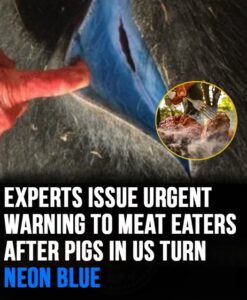
A trapper in California discovered several wild pigs were “neon blue” — a shocking find that has triggered an urgent warning for meat eaters.
Warning: graphic images included below.
Dan Burton has handled hundreds of wild pigs through his work in Salinas, California, but one recent find stopped him in his tracks when he cut into an animal and discovered something completely unexpected – bright blue meat.
“I’m not talking about a little blue,” Burton, owner of Urban Trapping Wildlife Control, told the LA Times. “I’m talking about neon blue, blueberry blue.”
The color was impossible to ignore, showing up vividly in both muscle and fat, and raising questions about whether the meat was safe for consumption – meat that is often donated to low-income families.
After Burton made “multiple observations” of the unusual coloring in the pigs his company had trapped, it triggered concern and a call to local and state officials.
Those early reports quickly led to a wider investigation involving the California Department of Fish and Wildlife (CDFW).
Poison behind the shocking color
As investigators looked deeper, the explanation became clearer – and more troubling.
According to the CDFW, the pigs had been exposed to diphacinone, an anticoagulant rodenticide widely used to control pests such as rats, mice, and squirrels.
“The blue tissue can be a sign of rodenticide bait ingestion,” CDFW said in a statement, adding that “one of the wild pigs that was recovered with blue tissues” was found to have “the anticoagulant rodenticide diphacinone in the stomach and liver contents.”
Blue used to identify poison
The poison is commonly used in agricultural settings, and while it is designed to target small animals, it does not stay contained.
“Wildlife can be inadvertently exposed to rodenticides either by eating rodenticide bait or by eating other animals that have ingested rodenticides,” CDFW explained.
“Rodenticide baits often contain dye to identify them as a poison. Blue-colored muscle or fat may be a sign that game meat has been contaminated by rodenticides, although this blue discoloration may not always be present.
“CDFW urges hunters to always use caution when harvesting game animals and be aware of potential risks.”
Serious risk for meat eaters
The concern does not stop with the pigs themselves. Experts warn that the toxin can remain in the animal’s body, creating a risk for anyone who consumes the meat.
“Hunters should be aware that the meat of game animals, such as wild pig, deer, bear and geese, might be contaminated if that game animal has been exposed to rodenticides,” Ryan Bourbor, pesticide investigations coordinator with the state agency, said in the statement.
“Rodenticide exposure can be a concern for non-target wildlife in areas where applications occur in close proximity to wildlife habitat,” he continued.
This type of contamination can lead to what officials describe as “secondary exposure,” meaning predators – and humans – may ingest the poison by eating affected animals.
‘It’s just wild’
Burton’s experience offers a closer look at how the exposure likely happened.
He had been hired by an agricultural firm to trap some wild pigs who were destroying crops. The creatures are euthanized in line with state regulations and their meat is typically then donated, he said.
This time, however, everything changed when the pigs were cut open and revealed bright blue muscle and fat.
“I thought, OK, that’s weird,” Burton said after seeing the blue meat. “It’s just wild.”
As he looked into it further, he noticed a pattern in the pigs’ behavior. The animals seemed drawn to bait stations used to manage squirrel populations.
“These pigs were seeking [the bait traps] out,” Burton told the LA Times. “I saw them trying to flip it over, breaking them, trying to get access to the poison.”
Slow death
Despite consuming the toxic bait, the pigs did not show immediate signs of illness. Weighing between 100 and 200 pounds, they continued to act normally, even as the poison affected their bodies internally.
The bait is meant for much smaller animals, so it didn’t kill the pigs immediately. Instead, the poison built up in their bodies over time, quietly taking hold beneath the surface. Burton said the toxin works slowly, meaning even small animals can remain alive for days before the effects fully set in, dragging the process out into a prolonged and painful decline.
Testing later confirmed that the pigs had been exposed to the poison over an extended period.
What do you think about this shocking discovery? Let us know in the comments, and share this story so others are aware of the risks of consuming blue meat.