The process of clearing out the home of a deceased family friend is one of the most emotionally complex experiences a person can go through. It is not simply a matter of organizing belongings or deciding what to keep and discard. It is, instead, a quiet confrontation with memory itself. Every object carries weight beyond its physical form, representing moments, habits, and fragments of a life that once moved through those same rooms. The silence of such a space often feels heavier than words, as if the house itself is aware of the absence left behind.
We were working slowly through the attic of our late family friend’s home, a space filled with dust, fading light, and decades of accumulated history. Boxes were stacked unevenly, some sealed and others half-opened, revealing layers of forgotten life. Old photographs, handwritten notes, and worn household items created a strange sense of suspended time. It felt less like cleaning and more like stepping through a personal archive that had been untouched for years, each item waiting to be seen again.
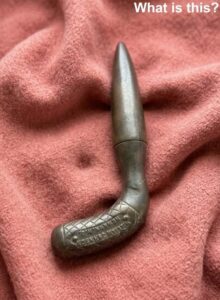
As we moved deeper into the attic, carefully lifting and sorting through objects, something unusual caught our attention. Beneath a pile of aged fabrics and wooden frames, partially hidden from view, was a dense and oddly shaped object. It was immediately clear that it did not belong to the ordinary clutter of household belongings. Its weight was unexpected, its surface unusually smooth, and its form too intentional to be random. It felt like something that had a specific purpose, even if that purpose was no longer immediately recognizable.
When we first lifted it into the light, the room seemed to shift into silence. Everyone paused, instinctively drawn to the object as if it demanded attention. It was not visually dramatic, but it carried a presence that made it difficult to ignore. The surface showed signs of long-term use, softened by time and handling. It had clearly been held repeatedly over many years, shaped not by decoration, but by function. That alone made it feel significant, even before anyone understood what it was.
We passed the object carefully between us, each person trying to interpret its form. Its shape suggested purpose, but not familiarity. It was neither clearly decorative nor immediately identifiable as modern equipment. Some suggested it might be an antique household tool, perhaps something used in workshops or kitchens long ago. Others thought it could be part of mechanical equipment or even a specialized instrument from a trade none of us were familiar with. The uncertainty only deepened the curiosity surrounding it.
What made the object even more compelling was the feeling that it belonged to a very specific world. It did not feel mass-produced in a modern sense, but rather crafted for a particular skill or environment. There was a sense of history embedded in it, as if it had traveled through time carrying stories that were never documented. In that attic, surrounded by silence and dust, it became more than just an object—it became a question waiting to be answered.
The search for its meaning became a small but meaningful focus of the day. Between sorting boxes and folding old clothing, our attention kept returning to the mysterious item. It disrupted the emotional heaviness of the task, replacing it temporarily with curiosity. In moments like these, grief and discovery often intertwine, creating space for reflection that feels both grounding and unsettling at the same time.
It was only after further research, and later consultation with someone knowledgeable in historical maritime tools, that the object was finally identified. It was a fid, a traditional tool used in rope work, particularly in maritime settings. This small but essential instrument was historically used by sailors and riggers to separate strands of thick rope during the process of splicing or repair. Though simple in appearance, it played a crucial role in maintaining the strength and functionality of ship rigging.
Understanding its purpose changed everything about how we viewed it. Suddenly, the object was no longer just an unidentified relic from an attic. It became a link to a very specific and demanding way of life—one shaped by the sea, by physical labor, and by reliance on skill and precision. The fid represented a world where tools were extensions of human effort, designed for survival and functionality rather than convenience or appearance.
Holding it again after understanding its meaning gave it a completely different presence. It was easy to imagine it being used aboard a wooden vessel, surrounded by ropes, sails, and the constant movement of the ocean. The idea that this object had once been part of something so vast and unpredictable added emotional depth to its discovery. It was no longer just a tool—it was a connection to human experience across time and environment.
This realization also changed how we thought about the man who had owned it. Until that moment, we had known him mostly through everyday interactions and local memories. But this object suggested another dimension of his life, one that was not immediately visible. It hinted at interests, experiences, or histories that were never openly discussed, reminding us that people often carry entire worlds within them that others may never fully see.
As the attic cleaning continued, the fid remained in our thoughts. It became a symbol of how easily meaning can be hidden within ordinary surroundings. Objects that appear forgotten or insignificant may actually hold deep connections to history, identity, and personal narrative. In this case, a single tool transformed the atmosphere of the entire day, shifting it from simple sorting into reflection and discovery.
Eventually, the decision was made to preserve the object rather than discard it. After being carefully cleaned, it was placed in a visible spot within the home as a quiet tribute. It no longer sat as an unknown piece of clutter, but as a reminder of the layered lives people live and the quiet histories they leave behind. It stood as a symbol of memory, craftsmanship, and the unseen depth of ordinary existence.
In the end, the experience of discovering the fid became more than just an unusual moment during an estate clean-out. It became a reminder that every person’s life contains hidden chapters, and every object has the potential to carry meaning far beyond its appearance. Even in silence and loss, there are traces of story waiting to be uncovered, if only we take the time to look closely enough.