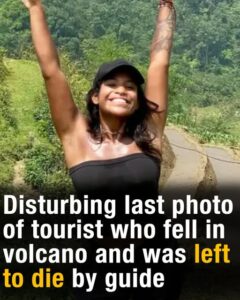
Juliana Marins was a woman defined by her insatiable hunger for the world, a twenty-six-year-old soul who carried the light of discovery in every photograph she sent home to her parents. But on the treacherous, volcanic slopes of Mount Rinjani, that light was abruptly extinguished by a single, harrowing misstep. As she plummeted into the unforgiving darkness of a remote ravine, the silence that followed was not just an absence of sound, but a deafening, terrifying void that would…
…soon consume the hope of everyone who loved her. The tragedy was not merely the fall itself, but the agonizing sequence of events that unfolded in the aftermath. Reports suggest that as Juliana lay broken in the shadows of the mountain, a catastrophic failure of communication—or worse, a chilling indifference—took hold. While her family waited thousands of miles away, clinging to the messages of a daughter who was supposed to be living her dream, the guide tasked with her safety was allegedly moving forward, leaving her to face the cold, thin air of the crater alone.
A Search Against Time
The hours that followed the accident stretched into an eternity. As the realization of her disappearance set in, the search efforts were met with the brutal reality of the Indonesian terrain. Mount Rinjani is a place of sublime beauty, but it is also a place that does not forgive mistakes. The rugged, volcanic landscape, characterized by steep drops and unstable scree, turned the rescue operation into a desperate race against the elements. Every minute that ticked by without a sign of life was a hammer blow to her family’s resolve.
For those watching from afar, the distance was a torture of its own. They were forced to process their grief through the lens of uncertainty, waiting for news that felt perpetually delayed by the harsh geography of the mountain. When the truth finally emerged, it brought with it a wave of indignation that rippled far beyond her immediate circle.
The Weight of Responsibility
In the wake of the tragedy, Juliana’s father became the voice of a grieving family, speaking not just of his daughter’s courage and the vibrant, full life she had packed into her twenty-six years, but of the systemic failures that allowed such a nightmare to occur. The questions he raised remain haunting: How could a guide, entrusted with the life of a tourist, fail to notice that his charge was missing? Was it a breakdown in protocol, a language barrier, or a callous decision to prioritize the schedule over the safety of a human life?
This incident has ignited a necessary, if painful, conversation about the ethics of the adventure tourism industry. It serves as a stark reminder that when we venture into the wild, we are often placing our lives in the hands of others who may not share our understanding of duty. Juliana’s story is a testament to the fragility of human existence, but it is also a call for accountability. As her family continues to navigate the hollow space she left behind, their struggle for answers serves as a beacon, demanding that no other traveler should ever be left to face the silence of the mountain alone.