The Routine of Ordinary Mornings
Every morning, before sunrise had fully colored the sky, I opened the little café on the corner of Elm Street. I turned on the lights, set out clean cups, wiped down the wooden tables, and waited for the familiar rhythm of the day to begin—the soft hum of the coffee machine, the first hiss of steam, the gentle chime of the doorbell.
It was a quiet job, steady and predictable, and I liked it that way. People came and went with sleepy smiles, the same faces greeting the same smells of roasted beans and sugar. But one morning, as I refilled the napkin holders, I noticed someone new—a boy.
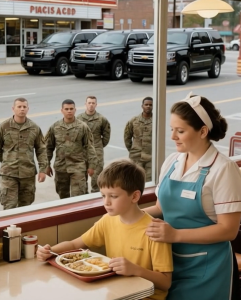
He looked about ten years old, small for his age, with dark hair that fell unevenly across his forehead and a backpack that seemed to weigh as much as he did. He came in right at 7:15, every single day, like clockwork. He always sat in the same corner booth, the one near the window, and ordered only a glass of water.
For the first few days, I thought little of it. Maybe he was waiting for someone, maybe he liked the quiet before school. But by the tenth day, I realized there was something different about him. He sat too still, spoke too softly, and his eyes—those deep, searching eyes—carried a tiredness far beyond his years.
The First Pancakes
On the fifteenth morning, something inside me shifted. I couldn’t bear to watch him sit there, hungry and pretending not to be. So I brought over a plate of pancakes, warm and golden, with a touch of syrup.
“We accidentally made extra,” I said lightly, pretending it was a harmless mistake.
He looked up, surprised. Then his face softened into a shy smile. “Thank you,” he whispered.
From that morning on, I began leaving a plate for him every day—sometimes pancakes, sometimes eggs and toast, sometimes just a muffin and a glass of milk. I didn’t ask questions, and he didn’t offer answers. We simply shared quiet mornings, a secret kindness tucked between two ordinary lives.
I learned to expect the sound of his small sneakers tapping the floor, the soft scrape of his chair. He never lingered long, always leaving with a polite nod and a soft “See you tomorrow.”
And for reasons I can’t explain, those words—so small and simple—became something I looked forward to more than anything else.
The Morning He Didn’t Come
Then, one cold morning, the chair in the corner stayed empty. The clock hit 7:15, then 7:30. The bell above the door stayed silent. I told myself he might just be late. But as the minutes passed, a strange heaviness settled in my chest.
By nine o’clock, the café had filled with the usual morning crowd. I poured coffee, smiled, took orders—but inside, I was waiting. Watching the door.
At 9:17, the waiting ended.
Four black SUVs pulled up outside the café. The engines hummed low, steady, and out stepped a group of men in uniform. The chatter inside the café faded into silence. One of the men—tall, square-shouldered—removed his cap and asked quietly, “Is the woman who fed the boy here?”
My throat closed. “I’m… I’m her,” I managed to say.
He handed me a folded letter. “His name was Adam,” he said gently. “His father was a soldier. He was killed in the line of duty.”
I opened the letter with shaking hands. Inside were a few simple lines, written in a careful, uneven hand:
“Thank the woman from the café who fed my son. She gave him what the world had taken away—the feeling that he was still remembered.”
The words blurred as tears filled my eyes. The plate I had been holding slipped from my hands and shattered on the floor. No one moved. The soldiers stood in silent respect. I couldn’t speak; I could barely breathe.
The Letter That Stayed
After they left, I sat at the counter for a long time, the letter trembling in my hands. The café’s noises came back slowly—the hiss of the coffee machine, the clinking of spoons—but nothing sounded the same.
For days afterward, I found myself glancing toward the corner booth, half expecting to see him there again. I kept making his breakfast, unable to stop the habit. Every morning, the pancakes cooled on the plate before I finally put them away.
Weeks passed. The world, as it always does, moved on. But I couldn’t forget that boy. The kindness between us had been quiet, but it had meant everything—to him, to me, to a man who would never come home.
The Second Letter
Then, one afternoon, another letter arrived. This one was from the same officer who had handed me the first. Inside was a photograph and a short note.
The photo showed Adam sitting on the grass beside a man in uniform—smiling, the same shy, gentle smile I remembered.
The note read:
“Adam was adopted by his father’s best friend, a soldier whose life his father once saved. He has a home now. And he often thinks of the woman who fed him in the mornings.”
I pressed the photo to my heart. Relief, sorrow, and gratitude mingled together until I couldn’t tell them apart. I had thought I’d lost him forever, but here he was—alive, safe, loved.
The Memory That Stays
Even now, years later, I keep that photograph framed behind the counter. Customers sometimes ask who the boy is, and I tell them, “He’s a reminder.”
A reminder that small acts—an extra plate, a few kind words, a moment of care—can reach further than we ever imagine.
Adam taught me that compassion doesn’t need grand gestures. It just needs quiet consistency. Sometimes the simplest kindness can become the anchor that keeps a heart from drifting too far.
And though I never saw him again, every morning when I pour the first cup of coffee and set out the plates, I still whisper, “Good morning, Adam.”
Because love, once given freely, never truly disappears—it just finds a new home.