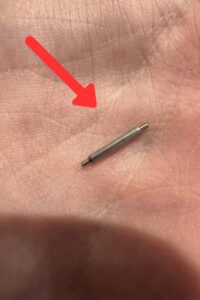
Every so often, you stumble upon a tiny metal object that instantly sparks curiosity. It might be lying on a workbench, tucked into the corner of a drawer, or even resting quietly on the floor where it somehow appeared without explanation.
At first glance, it doesn’t seem like much.
Perhaps it’s shiny and reflective, catching light like a miniature mirror. Or maybe it’s dull and matte, marked with faint scratches that hint at a long journey through machinery, tools, or daily use. Sometimes these objects feel surprisingly heavy for their size, while others seem almost weightless when you pick them up.
Despite their simple appearance, these little fragments often carry a sense of mystery.
You rotate the object slowly between your fingers. You tilt it toward the light. You examine the edges, the curves, the tiny details that might reveal something about its purpose. You may even test its flexibility or see whether it fits somewhere nearby.
Yet even after careful inspection, the answer remains elusive.
There’s no label. No brand. No obvious function.
Just a tiny piece of metal—quietly challenging your curiosity.
And that’s where the intrigue begins.
Where did it come from?
What was it designed to do?
Why is it shaped exactly the way it is?
At first, these questions might seem small. But they awaken a deeper sense of wonder that many people rarely experience in a world where answers are usually just seconds away.
In an age of instant searches, automated information, and digital convenience, encountering something that cannot be immediately explained can feel surprisingly refreshing.
It slows us down.
It invites us to observe more carefully.
And most importantly, it reminds us that even the smallest objects can hold fascinating stories.
The Hidden Importance of Small Things
Throughout history, human innovation has relied not only on massive machines and grand inventions but also on countless tiny components working quietly behind the scenes.
The Industrial Revolution, for example, transformed entire societies with steam engines, factories, and large-scale manufacturing. Yet none of those breakthroughs would have been possible without the small parts that held everything together.
Bolts.
Rivets.
Springs.
Pins.
Clips.
Washers.
Gears.
Each of these pieces played a crucial role in keeping machinery running smoothly. Remove just one small component from a complex system, and the entire machine could stop functioning.
This principle remains just as true today.
Modern technology relies on miniature precision parts more than ever before. The devices we use daily—from smartphones and laptops to cameras and household appliances—are filled with tiny metal elements designed to perform very specific tasks.
A small, unidentified metal object you discover could belong to any number of systems.
It might be:
-
A retaining clip from an electronic device
-
A structural tab from a laptop hinge
-
A connector bracket from a circuit board
-
A mechanical pin from a bicycle or power tool
-
A calibration element from a medical instrument
-
A spring housing from a mechanical watch
-
A grounding contact from electrical equipment
To someone unfamiliar with engineering or mechanical design, these objects may appear nearly identical.
But to a trained technician or engineer, even the smallest detail reveals clues about its purpose.
The curvature of a bend.
The placement of a hole.
The thickness of the metal.
Even the type of alloy used.
Each characteristic serves a function within a larger system.
Engineering Hidden in Plain Sight
One of the most fascinating aspects of small metal components is the amount of planning and expertise required to design them.
Even the simplest-looking part may have been carefully engineered through multiple stages of development.
Engineers must consider a wide range of factors before finalizing a design.
These include:
-
Mechanical stress and pressure
-
Temperature changes
-
Exposure to moisture or corrosion
-
Long-term wear and fatigue
-
Vibrations during operation
-
Ease of installation and replacement
Different materials are chosen depending on the job the part must perform.
Stainless steel is often used for corrosion resistance.
Aluminum offers lightweight strength.
Brass provides excellent electrical conductivity.
Titanium delivers exceptional durability while remaining relatively light.
Once a design is finalized, the manufacturing process begins.
This process can involve several stages.
First, engineers create detailed digital models using computer-aided design (CAD) software.
Next, prototypes may be produced to test the part’s performance.
After testing, the component moves into full production, which may include:
-
Precision stamping or machining
-
Heat treatment to strengthen the metal
-
Surface finishing or polishing
-
Protective coatings to prevent rust
-
Quality inspections to ensure accuracy
Although the finished object may look simple, it often represents hours—or even months—of careful engineering and testing.
When Tiny Parts Carry Big Responsibilities
In certain industries, the reliability of tiny metal components is absolutely critical.
Consider the aerospace field.
Aircraft engines and flight systems contain thousands of small precision parts that must function flawlessly under extreme conditions. These components endure intense heat, vibration, and pressure while maintaining exact alignment.
A single faulty fastener or connector could potentially compromise safety.
Similarly, the medical field relies on extremely precise mechanical components.
Surgical tools, diagnostic equipment, and implantable devices often contain miniature metal elements that must operate with micrometer-level accuracy.
A tiny metal tab inside a surgical instrument might secure a component responsible for delicate medical procedures.
Automotive engineering provides another example.
Cars contain hundreds of small clips, brackets, and fasteners that keep systems securely connected—even while the vehicle travels at high speeds or across rough terrain.
These small parts help secure:
-
Brake lines
-
Fuel systems
-
Electrical wiring
-
Engine components
-
Interior panels
Without them, modern vehicles simply wouldn’t function safely.
Why the Brain Loves a Mystery
When we encounter an unknown object, our brains naturally begin trying to categorize it.
Humans are wired to recognize patterns and assign meaning to unfamiliar shapes.
So when you hold a mysterious metal piece in your hand, your mind starts exploring possibilities.
Could it belong to a lock?
Maybe it’s part of a computer?
Or perhaps it came from a kitchen appliance?
This process activates problem-solving regions in the brain.
Psychologists often describe curiosity as a powerful driver of learning. When we encounter something puzzling, we become more attentive and engaged.
We examine details more carefully.
We ask questions.
We form hypotheses.
In other words, our brains turn the situation into a puzzle.
And humans love puzzles.
In a world where so much information is instantly accessible, encountering a genuine mystery can feel surprisingly exciting.
It reminds us that exploration and discovery are still possible—even in everyday moments.
The Rise of Online Mystery Solvers
In recent years, curiosity about unidentified objects has found a new home online.
Many internet communities are dedicated to helping people identify strange or mysterious items.
Members share photographs of unfamiliar objects—often small metal pieces—and ask others for help determining their purpose.
What follows is often a fascinating collaborative investigation.
Participants bring different kinds of expertise:
-
Engineers analyze the shape and structure
-
Mechanics compare the object with machine components
-
Hobbyists recall similar parts from personal projects
-
Historians recognize vintage manufacturing techniques
Sometimes the answer appears quickly.
Other times, the discussion evolves into an extended exploration involving diagrams, product manuals, and historical references.
Even when the mystery takes time to solve, the process itself becomes enjoyable.
It’s a reminder that curiosity is something people love to share.
Craftsmanship Behind the Scenes
Behind every small metal component lies a long tradition of craftsmanship.
Centuries ago, blacksmiths shaped metal tools and parts by hand using hammers, anvils, and fire.
Each piece required skill, patience, and experience.
Today, modern manufacturing techniques have dramatically increased precision.
Advanced machines such as CNC mills, laser cutters, and robotic stamping presses can produce metal parts with astonishing accuracy.
Some components are stamped from large sheets of metal at incredible speeds. Others are carefully machined from solid blocks to achieve extremely precise tolerances.
Heat treatments strengthen metals.
Protective coatings prevent corrosion.
Micro-polishing ensures smooth movement in mechanical assemblies.
Despite all this sophisticated work, the final product may appear almost ordinary.
That contrast between hidden complexity and outward simplicity is part of what makes these objects so intriguing.
Small Components in Everyday Life
Tiny metal parts are everywhere.
We encounter them daily, often without realizing it.
Consider just a few examples:
The hinges on eyeglasses rely on tiny screws to fold smoothly.
The zipper on a jacket uses metal guides to align the teeth.
A car’s seatbelt latch contains spring-loaded metal components designed for safety.
Remote controls include small conductive tabs that connect the batteries to the circuit.
Mechanical watches contain dozens of microscopic gears and springs.
Each part is small.
But each one plays a vital role.
The same principle applies on a much larger scale.
Bridges rely on thousands of engineered fasteners.
Wind turbines use specialized brackets and connectors.
Power plants depend on precision components to regulate energy production.
In many ways, modern civilization runs on small parts.
The Beauty of Not Knowing
Perhaps the most delightful aspect of discovering a mysterious metal object is the simple joy of uncertainty.
In a culture focused on instant answers, not knowing something can feel unusual.
Yet uncertainty also creates space for imagination.
When you hold an unidentified object, your mind begins creating possibilities.
Maybe it traveled across the country inside a shipment.
Maybe it fell from a device during a repair.
Maybe it belongs to something unexpectedly ordinary—or something highly specialized.
That sense of wonder connects us with an older tradition of exploration.
Before digital databases existed, people learned by observing objects closely and experimenting with them.
They studied materials.
They tested mechanisms.
They learned through patience and curiosity.
A tiny mystery object quietly invites us to do the same.
Learning to Look Closely
Small puzzles like these teach an important skill: attention to detail.
When examining a metal object carefully, we begin noticing characteristics we might normally overlook.
We might ask questions like:
Is the metal magnetic?
Are there signs of heat exposure?
Does the object snap into place or rotate freely?
Are there wear marks indicating friction?
These observations strengthen analytical thinking.
Even if we never identify the object with complete certainty, the process of investigation itself is valuable.
It sharpens our awareness.
And it encourages us to appreciate the subtle complexity of the world around us.
Why Tiny Parts Matter So Much
It is easy to focus on large, visible innovations—skyscrapers, spacecraft, high-speed trains.
But behind every major achievement lies a network of smaller components working together.
A spacecraft launch may depend on thousands of precisely engineered fasteners.
A life-saving medical device may rely on a tiny bracket maintaining perfect alignment.
A laptop’s durability may depend on a metal hinge reinforcement hidden beneath the casing.
Small does not mean unimportant.
In fact, the most critical parts are often those we never notice—until something stops working.
A Reminder of Curiosity and Discovery
Ultimately, the magic of a mysterious metal object lies not in its size but in the perspective it offers.
It reminds us that the world is filled with hidden complexity.
It encourages us to slow down and observe.
It invites us to ask questions instead of rushing past them.
These little fragments of metal represent engineering, craftsmanship, and creativity condensed into tiny forms.
They show how much thought can be hidden within something that appears simple.
And perhaps most importantly, they remind us that curiosity still matters.
The joy of discovery does not always require a distant journey or a groundbreaking invention.
Sometimes it begins with something no larger than a fingertip.
A silent puzzle.
A tiny piece of metal.
A reminder that even the smallest objects can hold extraordinary stories waiting to be uncovered.