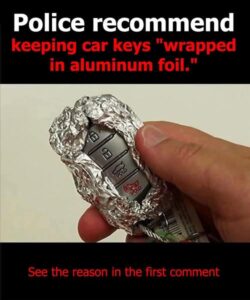
It sounds like something your great-grandmother might have suggested, something old-fashioned or even superstitious: Wrap your car key in aluminum foil. But beginning today, cybersecurity experts say this isn’t just a quirky hack — it’s one of the simplest, cheapest, and most effective ways to protect your modern vehicle from being stolen without the thief ever touching your keys.
And yes — criminals really can steal your car without the key ever leaving your pocket.
As cars have become smarter, thieves have too. The key fob in your purse or hanging by your front door sends out a constant radio signal. Your car listens for that signal 24/7. When the “song” matches — the car opens.
That convenience is also the vulnerability.
Welcome to the world of signal-relay car theft, a growing crime worldwide. And the solution, surprisingly, begins with a roll of aluminum foil sitting in your kitchen drawer.
Let’s break down why this matters, how the theft works, and how such a simple, low-tech fix can block a very modern criminal attack.
The Surprising Problem Hiding Inside Your Car Key
Today’s vehicles rely heavily on radio-frequency identification (RFID), allowing doors to unlock when you approach, push-button start, remote access features, and even smartphone integration. The idea is seamless convenience.
But here’s the catch:
Your key fob is always sending out a small, low-power signal — even when you’re asleep or at work or sitting at home watching television.
Think of it as a tiny radio station broadcasting the same tune repeatedly. The car hears it. The car recognizes it. The car trusts it.
Criminals, however, have found a way to copy it.
They don’t need to steal the key.
They don’t need to break into your home.
They don’t even need to touch your car.
They only need the signal.
How Thieves Steal a Car Without Your Key — The Relay Attack
The attack is shockingly simple.
Two thieves work together:
1. The first thief stands near your home
Even from outside your front door or garage, they use a small electronic device to “scan” or “listen” for your key’s signal. These devices are cheap and easily purchased online.
Your key fob, sitting on a hook or in your jacket pocket, is still transmitting its unique code.
The device captures it instantly.
2. The second thief stands by your car
The captured signal is relayed wirelessly — in real time — to another device near the vehicle. The car receives the code and thinks you’re standing right next to it.
Door unlocks.
Engine starts.
Thieves drive away.
All without breaking a window.
All without ever touching the real key.
The whole crime can take under 30 seconds.
And it’s happening everywhere.
Why This Attack Is Growing Fast
Just a decade ago, you needed technical knowledge to pull this off. Today? The tools are:
available online
inexpensive
small enough to pocket
simple enough to use with no training
Cybersecurity experts — including Moshe Shlisel, former Israeli Air Force engineer and CEO of GuardKnox Cyber Technologies — warn that these attacks are increasing every year.
Shlisel explains it simply:
“Think of a song that’s constantly used between a radio and a lock that opens when it plays that song. If I know the song, I can open your lock.”
In other words: steal the signal, steal the car.
The automotive industry is working on solutions, but criminals adapt faster than manufacturers can innovate. Until better technology becomes standard, drivers must protect themselves.
And that’s where aluminum foil comes in.
Why Aluminum Foil Works So Well
It’s almost embarrassing how simple the solution is:
Wrap your key in a piece of aluminum foil.
That’s it.
It sounds too basic — maybe even primitive — but it works because aluminum foil acts as a Faraday shield, blocking electromagnetic waves.
When you wrap your key, you’re creating a tiny cage around it. That cage traps the radio signal inside. The “song” the car needs can’t escape. A thief’s device can’t hear it.
Foil:
blocks the signal
prevents duplication
stops relay attacks
protects your vehicle
It’s cheap.
It’s fast.
It’s effective.
And you already have it in your kitchen.
Is Aluminum Foil Really Enough? Experts Say Yes
Cybersecurity professionals have tested foil against scanning devices, and time after time, it performs surprisingly well. It’s not a perfect long-term solution — eventually foil tears or wears down — but as an immediate, inexpensive safety measure, it works.
It’s so effective that many police departments, auto security agencies, and insurance companies recommend it.
It creates a literal wall between your car and the criminals trying to “listen” to your key.
Better Than Foil? Yes — But Foil Is Still an Excellent Start
If you want an upgrade, there’s a cheap modern alternative:
A Faraday bag.
They cost just a few dollars and are made from multiple layers of metallic fabric that block signal transmission even more reliably than foil. They’re designed to hold:
keys
phones
credit cards
passports
RFID devices
A Faraday pouch lasts longer and works even if you toss it in your purse or glove compartment.
But if you don’t have one?
Foil works right now, today, within seconds.
Why You Should Take This Seriously — Even If Your Area Seems “Safe”
When people hear about relay attacks, many shrug and assume it won’t happen to them.
But thieves target:
quiet suburbs
apartment buildings
rural homes
shopping centers
workplace parking lots
Anywhere the car sits unattended.
Why?
Because relay theft leaves no broken glass, no alarm, and no evidence. Cars vanish without a trace. Insurance companies often label these cases as “mysterious disappearance,” which can complicate claims.
And because criminals only need a small scanning device, they don’t need to risk breaking in or making noise. They can walk by your window, stroll past your driveway, or wander through a parking garage while appearing completely normal.
Once they capture your key’s signal, your car is gone — quietly and quickly.
The Automotive Industry Is Trying to Catch Up
Car manufacturers know the problem is serious. Engineers are experimenting with:
rolling codes
motion-activated key fobs
keyless entry locks
encrypted signals
biometric access
proximity-limited transmissions
But mass adoption of new technology takes years.
Right now? The vulnerability already exists. And criminals are using it daily.
That’s why cybersecurity experts continue repeating the same message:
Protect your key. Don’t leave its signal exposed.
Common Signs Your Key Could Be Vulnerable
If your car offers any of the following features, your key fob constantly transmits signals:
keyless entry
passive unlock “walk up and open”
push-button start
proximity sensors
remote start
smart trunk opening
smartphone integration
In other words: almost every modern car from the last 10–12 years.
You don’t need luxury vehicles or specialized systems. Even basic models are vulnerable. Thieves target the simplest cars first because they’re easiest to steal.
Why Thieves Prefer This Method Over Traditional Theft
Relay attacks offer huge advantages to criminals:
No noise
No glass breaking, no alarms, no smashed doors.
No time wasted
It takes seconds to capture the signal and drive off.
No suspicion
Thieves look like ordinary pedestrians.
No tools required
Just small scanners… often smaller than a smartphone.
Built-in trust
Once the car recognizes the stolen signal, it behaves exactly as if the real owner is present.
Quick resale
Stolen cars are often shipped abroad in less than 24 hours.
It’s modern theft for the modern world — and it’s all invisible.
So What Should You Do Starting Today?
Here’s a simple plan recommended by cybersecurity experts, police departments, and auto theft investigators:
1. Wrap your key in aluminum foil
You can wrap it completely or place it inside a small foil pouch.
This blocks all outgoing signals.
2. Keep your keys away from doors and windows
Most relay thefts happen when keys are stored near:
entrances
garage doors
hallways
front tables
upstairs windows near the driveway
Distance matters. A thief only needs to capture the signal once.
3. Consider buying a Faraday pouch
For long-term use, a Faraday bag is more durable than foil.
Use it daily. It’s simple. It’s cheap. It works.
4. Turn off your key fob’s signal (if possible)
Some newer models have a tiny power button or a sleep mode.
Check your manual — many drivers don’t even know this feature exists.
5. Use a steering wheel lock
Even with the signal, thieves don’t want extra obstacles.
This old-fashioned tool remains one of the most effective deterrents.
6. Update your car’s software
Some manufacturers release anti-relay updates.
Dealerships often install them for free.
7. Let your insurance provider know you’re protecting your key
It may lower your premium or strengthen your theft coverage.
A Real-World Example: How One Driver Lost His Car in Seconds
Not long ago, a driver in the UK shared his story with the BBC.
He had parked his new SUV in the driveway, hung his key on a hook beside the front door, and went inside. Less than 60 seconds later, thieves with a relay device captured the key signal from outside the door.
A second thief stood beside the car.
Unlock.
Start.
Drive.
The entire theft was caught on home security footage — and still, the driver couldn’t believe it.
He’d done everything “right.”
His key never left the house.
He’d locked the car.
He had a modern security system.
But he hadn’t protected the signal.
He later told reporters:
“I didn’t even know my key could be read through the wall. They didn’t break anything. They just took it.”
It’s a reminder that the future of car theft doesn’t involve crowbars or shattered windows. It involves wireless signals. Invisible weakness. Quiet crimes.
And your best defense may start with aluminum foil.
Why This Advice Sounds Strange — but Works
We live in a world overflowing with advanced technology. The idea that aluminum foil — a material used to wrap sandwiches — could shield your expensive modern vehicle seems almost ridiculous.
But technology isn’t just about complexity.
It’s about physics.
It’s about signals.
It’s about electromagnetic waves.
Foil interrupts those waves.
It blocks them.
It silences the invisible “song” your key constantly sings.
That’s why engineers agree:
It works.
It’s cheap.
It’s effective.
And you should start today.
Final Thought: Protecting Yourself Is Easier Than You Think
Car theft is becoming smarter, quieter, and more technologically advanced. But protection doesn’t have to be complicated. You don’t need expensive gadgets or complicated systems.
You need awareness.
And sometimes, a simple hack.
Wrapping your key in aluminum foil isn’t a superstition or a myth. It’s a low-tech solution to a high-tech problem — one that security experts recommend because it blocks the very method thieves use to steal modern cars.
So starting today, take a small step that could save you thousands of dollars and weeks of stress.
Open your kitchen drawer.
Pull out a square of foil.
Wrap your key.
Sleep easier.
In a world where cars can be stolen without breaking a lock or touching a key, this tiny precaution might be the smartest move you make all year.