Nearly five decades after his passing, Elvis Presley’s life still feels unfinished, filled with untold stories and unrealized potential. A new Netflix documentary, Return of the King: The Fall & Rise of Elvis Presley, pulls back the curtain on one of the most pivotal moments of his career: the 1968 Comeback Special. At the time, Elvis was deeply dissatisfied, trapped in a cycle of formulaic Hollywood musicals that left him feeling humiliated and creatively suffocated. Behind the scenes, fear and frustration dominated his world. He hadn’t performed live in seven years, and the image Hollywood had built for him felt like a cage he couldn’t escape. Yet it was precisely at this low point that Elvis began plotting his return—not just to the stage, but to himself.
The documentary reveals how terrified Elvis truly was before stepping back in front of a live audience. Director Jason Hehir describes a man nearly paralyzed by stage fright, someone who almost didn’t leave his dressing room that night. Elvis later admitted he felt obligated to roles and projects he didn’t believe in, painfully aware that his dignity as an artist had been eroded. Priscilla Presley, watching footage of him forced to sing children’s songs in late-career films, calls it “a crime,” noting how much he knew he had become a laughingstock. Elvis had once dreamed of being taken seriously as an actor, inspired by figures like James Dean and Marlon Brando—but by the late 1960s, that dream felt shattered.
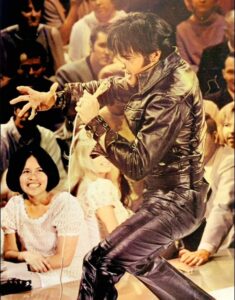
It was Marlon Brando, however, who unexpectedly helped Elvis reclaim his edge. Producer Steve Binder stumbled upon a photo of Elvis sitting on a motorcycle in a leather outfit reminiscent of Brando in The Wild One. That image sparked the idea for the now-legendary black leather look. Costume designer Bill Belew reimagined it into something distinctly Elvis—bold, defiant, and powerful. The high-collared leather jacket, paired with soft silk and a scarf, framed Elvis not as a faded movie star, but as a dangerous, magnetic performer. Under the scorching studio lights, the outfit was physically uncomfortable, but symbolically it was perfect. It announced that Elvis was no longer playing a role written by Hollywood—he was writing his own.
When Elvis finally stepped onto that stage, the transformation was undeniable. The leather-clad performance wasn’t just a fashion statement; it was a declaration of identity. Viewers saw the artist Elvis had always been—raw, vulnerable, and electrifying. The special was a massive success, reigniting his career and leading to a return to live performances that would define his final years. While Hollywood had damaged his confidence as an actor beyond repair, the comeback helped him rediscover what truly mattered: music, performance, and connection. Channeling Brando wasn’t about imitation—it was about rebellion, authenticity, and reclaiming dignity. In that leather suit, Elvis didn’t just come back. He reminded the world who the King really was.