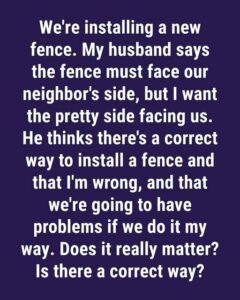
When planning a new backyard fence, many homeowners hear the same piece of advice over and over: “Make sure the finished side faces your neighbor.” It’s often presented as an unquestionable rule—something so widely accepted that few people stop to ask why.
But is this actually required? Or is it simply a long-standing custom that has been repeated so often it feels like law?
If you’re preparing to install a fence, understanding the difference between legal requirements and neighborhood etiquette can save you time, money, and potential tension. In this comprehensive guide, we’ll break down what the “finished side” really means, where the rule came from, whether it’s legally required, and what you should consider before building.
By the end, you’ll have a clear picture of your options—and how to make the best decision for your property.
What Does “Finished Side” of a Fence Mean?
Before discussing rules or customs, it’s important to understand the terminology.
When people refer to the “finished side” of a fence, they usually mean the side that looks smooth, clean, and visually appealing. On many traditional wood privacy fences, this is the side where you see only the vertical boards (often called pickets), without visible support rails or posts.
The “unfinished” side is typically the structural side. This is where you can see:
-
Horizontal rails
-
Vertical support posts
-
Fasteners or framing components
In a standard wooden privacy fence, one side presents a flat, polished look, while the other reveals the structural framework holding everything together.
This difference is where disputes or confusion can arise between neighbors.
Why Does Fence Orientation Matter?
At first glance, fence direction may seem like a minor detail. After all, it’s just wood panels and posts—right?
Not exactly.
A fence can affect:
-
Property appearance
-
Neighborhood harmony
-
Home value
-
Perceived fairness
-
Long-term maintenance responsibilities
If one neighbor ends up looking at the less attractive structural side of a fence every day, it can create frustration—especially if no discussion took place beforehand.
That’s why the topic generates so much debate.
Where Did the “Finished Side Faces the Neighbor” Rule Come From?
Interestingly, the idea that the finished side must face outward is largely rooted in social etiquette rather than law.
Historically, when one homeowner paid for and installed a fence, they would place the more polished side facing outward toward their neighbor or the street. This was considered a gesture of goodwill and respect.
It signaled:
-
Fairness
-
Courtesy
-
Consideration
-
Neighborly cooperation
Even though the person installing the fence covered the cost, they didn’t want to leave their neighbor staring at the structural framework.
In close suburban neighborhoods where homes sit near shared property lines, this practice became common. Over time, it evolved into what many people now believe is a hard-and-fast rule.
But traditions are not always laws.
Is It Actually a Legal Requirement?
Here’s the key question most homeowners want answered:
Does the law require the finished side of a fence to face your neighbor?
In most places, the answer is no.
There is no universal law across the country mandating fence orientation. In many cities and counties, building codes regulate fence height, materials, and setbacks—but not which side must face outward.
That said, there are exceptions.
Some municipalities and homeowner associations (HOAs) include specific fence orientation requirements in their guidelines. These rules are more common when:
-
The fence borders a public street
-
The fence faces a sidewalk
-
The property is part of a planned community
-
Uniform neighborhood aesthetics are required
Because regulations vary widely by location, it’s essential to check locally before assuming anything.
Who Should You Contact Before Building?
Before installing a fence, consider confirming details with:
-
Your local building or zoning department
-
Your city or county code enforcement office
-
Your homeowners association (if applicable)
-
A licensed land surveyor (to confirm property boundaries)
Fence disputes often stem from unclear property lines or misunderstandings about shared responsibility. A little research upfront can prevent major problems later.
Property Ownership and Fence Placement
Fence orientation decisions often depend on ownership and placement.
1. Fence Fully Inside Your Property Line
If you build the fence entirely inside your property boundary—typically a few inches from the line—you generally have full control over:
-
Fence type
-
Material
-
Height (within code limits)
-
Orientation
In this situation, you are usually not required to consult your neighbor about which side faces outward (unless local rules say otherwise).
2. Fence Directly on the Property Line
When a fence sits exactly on the boundary line between two properties, it is often considered a shared or “boundary” fence.
This changes things.
Shared fences may involve:
-
Shared maintenance responsibilities
-
Shared cost agreements
-
Mutual decision-making
In some areas, local laws address boundary fences specifically, outlining how costs and responsibilities are divided.
If the fence is shared, it’s wise to:
-
Discuss plans openly with your neighbor
-
Agree on materials and style
-
Put cost-sharing agreements in writing
Clear communication can prevent misunderstandings.
Situations Where the Finished Side Doesn’t Face the Neighbor
Despite the common advice, there are many legitimate reasons why a homeowner may choose a different orientation.
Double-Sided “Good Neighbor” Fences
Some fences are designed to look identical on both sides. These are often called “good neighbor” fences.
They alternate pickets on each side or use panels that appear finished from both directions. In these cases, orientation becomes irrelevant—both homeowners enjoy the same view.
Structural or Security Considerations
Sometimes fence rails are placed on the inside for security reasons. When rails face inward, it can be harder for someone to climb the fence from outside.
In other cases, structural support requires posts to be positioned in a specific way, particularly for taller or wind-resistant fences.
Sloped Terrain
If the yard slopes significantly, fence orientation may depend on how panels are stepped or angled to follow the land.
Topography can influence installation more than etiquette.
Cost Constraints
Budget can also affect design. Some fencing materials are more affordable but may not have a visually polished side.
Homeowners working within a tight budget may prioritize functionality over symmetry.
Obstacles and Landscaping
Trees, sheds, retaining walls, and other landscape features may limit fence placement and orientation.
Sometimes practicality outweighs tradition.
How HOAs Can Change the Rules
If you live in a neighborhood governed by a homeowners association, the HOA’s guidelines may override general customs.
HOAs often regulate:
-
Fence height
-
Approved materials
-
Color
-
Orientation
-
Placement
Failure to follow HOA rules can result in fines or required modifications. Always review community guidelines before starting construction.
Common Fence Types and How Orientation Works
Different fence materials impact how noticeable orientation differences are.
Wood Privacy Fences
Traditional wood privacy fences often have a clear finished and unfinished side.
Vinyl Fences
Many vinyl panels are manufactured to appear identical on both sides, eliminating the issue entirely.
Aluminum or Wrought Iron
Metal fences typically look the same from either direction, though decorative elements may face one way.
Chain Link
Chain link fences generally do not have a distinct finished side, though posts and tension wires may be more visible from one direction.
Material choice can make fence direction either significant—or irrelevant.
Best Practices Before Installing a Fence
If you’re planning to build a fence, here are smart steps to take:
1. Verify Property Lines
Never rely solely on old markers or assumptions. A professional survey can confirm boundaries accurately.
2. Check Local Regulations
Review city and county requirements for:
-
Height restrictions
-
Setback distances
-
Permit requirements
-
Orientation rules
3. Review HOA Guidelines
If applicable, confirm design and placement requirements before purchasing materials.
4. Talk to Your Neighbor
Even if not legally required, a brief conversation can:
-
Prevent misunderstandings
-
Clarify shared expectations
-
Foster goodwill
A friendly discussion often goes a long way.
5. Get Agreements in Writing
If sharing costs or responsibilities, document everything clearly.
The Role of Courtesy in Fence Decisions
While laws vary, courtesy is consistent everywhere.
Even when not legally required, many homeowners choose to place the finished side outward because it:
-
Promotes goodwill
-
Reduces potential conflict
-
Enhances neighborhood appearance
-
Demonstrates respect
That said, courtesy should be balanced with practical needs.
If structural or security reasons justify a different orientation, clear communication can ease concerns.
Does Fence Orientation Affect Property Value?
In most cases, fence orientation alone does not significantly impact property value.
However, factors that can influence value include:
-
Overall fence condition
-
Material quality
-
Visual appeal
-
Compliance with local codes
-
Harmony with neighborhood design
A well-maintained fence—regardless of orientation—is typically more important than which side faces outward.
What Happens If a Dispute Arises?
Fence disputes sometimes escalate when:
-
Property lines are unclear
-
No discussion occurred beforehand
-
Shared cost expectations differ
If disagreement occurs:
-
Review local laws and HOA guidelines.
-
Revisit any written agreements.
-
Attempt calm communication.
-
Consider mediation if necessary.
Legal action is usually a last resort.
Most conflicts can be resolved through conversation.
Should You Always Face the Finished Side Toward Your Neighbor?
After examining laws, customs, and practical considerations, the answer becomes clearer:
There is no universal requirement.
In many cases, placing the finished side toward your neighbor is considered polite and neighborly—but it is not automatically mandatory.
Your final decision should consider:
-
Local building codes
-
HOA requirements
-
Property ownership
-
Shared agreements
-
Structural needs
-
Security preferences
-
Aesthetic goals
And perhaps most importantly—communication.
The Bigger Picture: Fences and Relationships
The phrase “good fences make good neighbors” is often quoted, but it’s only partly true.
A well-placed fence can provide:
-
Privacy
-
Security
-
Clear boundaries
But respectful communication builds stronger relationships than any physical barrier.
If you’re uncertain, leaning toward courtesy while staying informed about your legal rights is usually the safest approach.
Final Thoughts
Choosing which side of your fence faces your neighbor isn’t just a construction detail—it’s a decision that blends practicality, local regulations, and social consideration.
In most areas, there is no strict legal requirement dictating orientation. However, local rules, HOA guidelines, and shared property lines can influence what’s allowed.
If you’re planning a fence installation:
-
Research local codes
-
Confirm your property boundaries
-
Speak with your neighbor
-
Document agreements
-
Balance courtesy with practicality
A fence may define a boundary, but thoughtful planning and communication define good neighbors.
When in doubt, aim for clarity, fairness, and respect. Those principles will serve you far longer than the boards and posts themselves.