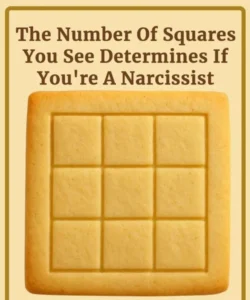
A simple grid image has been making its way around social media recently. At first glance, it looks almost like a neatly scored cookie. But it’s the caption above it that grabs attention: “The number of squares you see determines if you’re a narcissist.” The statement is meant to be humorous, yet it certainly makes people pause and wonder.
This puzzle has sparked lively conversation, not because it’s scientific, but because it plays with the idea that the way we notice patterns might reveal something about how our minds work. For many older adults who enjoy visual brain teasers, this little square grid has become a surprisingly thoughtful exercise.
Let’s take a closer look at what the puzzle actually measures—and what it doesn’t.
First Step: How Many Squares Do You See?
When you first see the grid, you’ll probably spot the nine small squares right away. But if you take a slower, more deliberate look, you start noticing additional layers:
• Four medium squares created by grouping smaller ones
• One large square forming the outline of the entire grid
All together, there are 14 squares hidden within the image. Spotting them all requires a calm eye for structure and the ability to view the picture both up close and as a whole.
Online, people have turned the puzzle into a playful personality game. While these categories are not based on real psychology, they’re lighthearted ways to think about how your brain approaches patterns:
6–8 squares:
You tend to look at what’s most obvious and move forward without overthinking. You’re relaxed, practical, and not easily rattled by small details.
9–11 squares:
You enjoy solving problems and have a steady, analytical mind. You balance big-picture thinking with a knack for noticing patterns.
12–14 squares:
You see layers and connections that many people miss. You have a sharp eye for detail and strong pattern recognition. The online joke labels this group as “a bit self-focused,” but this is simply playful teasing—not a reflection of personality.
Why This Puzzle Feels Strangely Accurate
This image isn’t a diagnostic tool, nor is it connected to personality disorders or mental health assessments. Instead, it simply shows how differently people process visual information.
Some individuals naturally scan for the overall shape before looking at finer points. Others immediately zoom in on the small details and build outward. Neither approach is right or wrong—they’re just different ways of organizing information.
The teasing mention of “narcissism” in the viral caption speaks to something more lighthearted: how much time someone might spend analyzing a simple challenge or how seriously they take small differences. It’s all meant as gentle humor.
In reality, your attitude toward the puzzle says far more than the number you counted. Were you proud of finding them all? Did you laugh when you realized you missed a few? Did you scroll on without thinking twice? Each response reflects your natural temperament—curious, relaxed, thoughtful, or simply amused.
The Quiet Lesson Behind the “Square Cookie Test”
One reason this visual puzzle resonates with so many people is that it reflects the way we break down the world. Think of the squares as pieces of life: responsibilities, relationships, hobbies, challenges, hopes. Some people focus on individual pieces. Others instinctively see how the parts connect to form a bigger picture. Both approaches are equally valuable.
This little grid reminds us that awareness comes in many forms. Noticing patterns, seeing connections, or simply enjoying a moment of curiosity are all signs of a healthy, active mind. Engaging in light brain teasers like this can be a refreshing way to stay mentally flexible at any age.
So… What Does Your Answer Mean?
It doesn’t label you.
It doesn’t define your personality.
And it certainly doesn’t say anything about deeper traits.
What it does show is that you were interested enough to pause, look closer, and explore how your mind works. That willingness to stay curious is one of the strongest signs of lifelong learning and emotional vitality.
The next time a puzzle like this pops up on your screen, enjoy it for what it is: a moment of mental playfulness, a spark of curiosity, and a chance to appreciate the way your mind finds order in simple shapes.
So, now that you’ve taken a good look—how many squares did you find?